
Now Reading: CH3OH and HCN in Interstellar Comet 3I/ATLAS Mapped with the ALMA Atacama Compact Array: Distinct Outgassing Behaviors and a Remarkably High CH3OH/HCN Production Rate Ratio
-
01
CH3OH and HCN in Interstellar Comet 3I/ATLAS Mapped with the ALMA Atacama Compact Array: Distinct Outgassing Behaviors and a Remarkably High CH3OH/HCN Production Rate Ratio

CH3OH and HCN in Interstellar Comet 3I/ATLAS Mapped with the ALMA Atacama Compact Array: Distinct Outgassing Behaviors and a Remarkably High CH3OH/HCN Production Rate Ratio

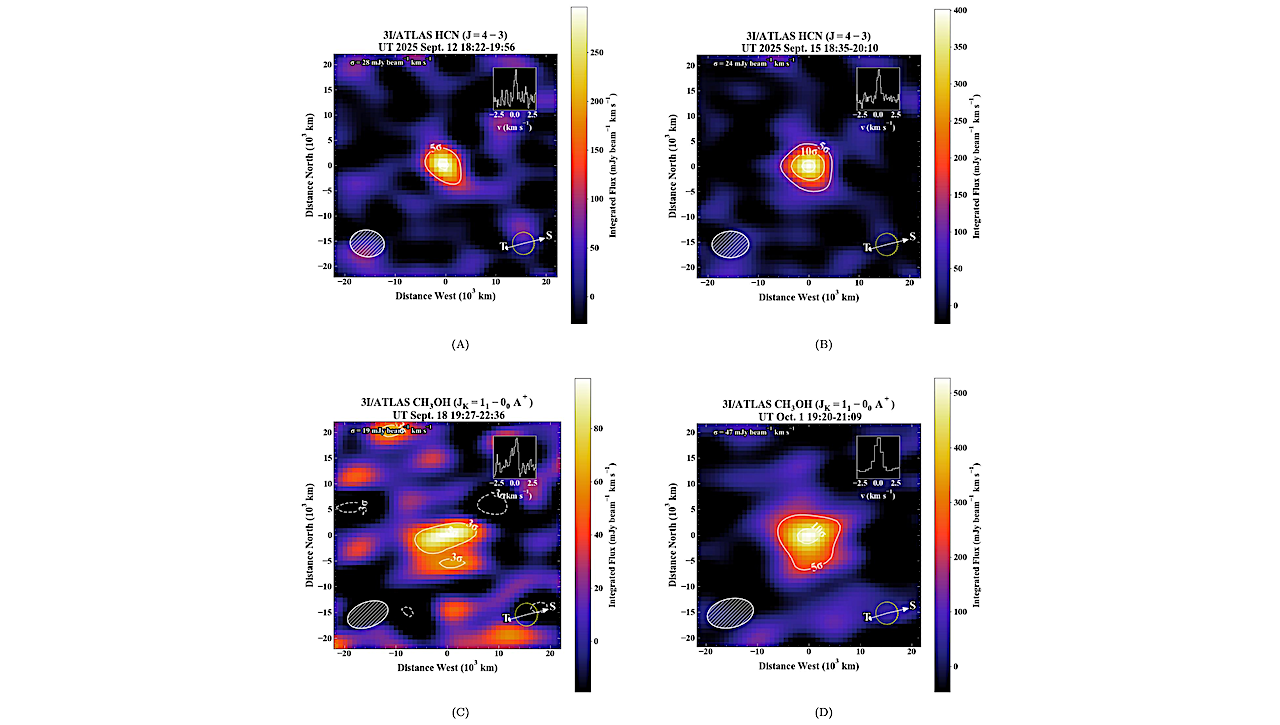
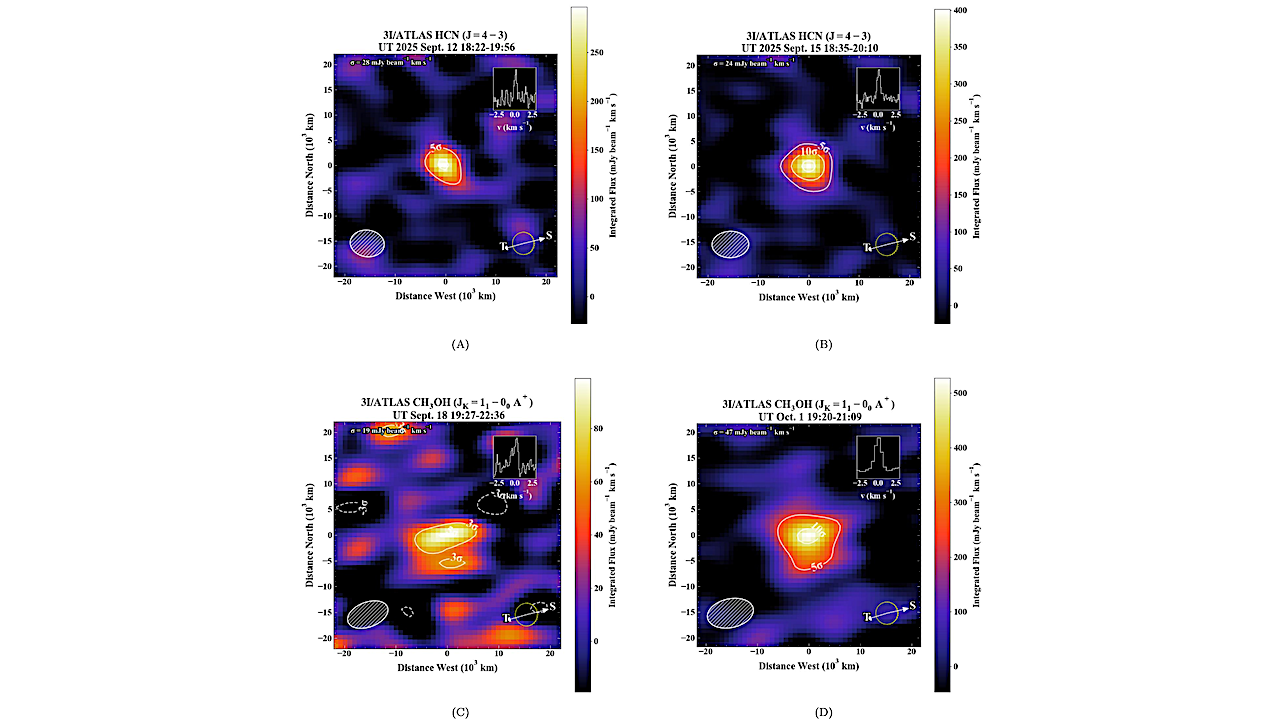
(A)–(D). Spectrally integrated flux maps for HCN on September 12 and 15 and for CH3 on September 18 and October 1. Contour intervals in each map are given in multiples of the rms noise. The rms noise (σ, mJy beam−1 km s−1 ) is indicated in the upper left corner of each panel. Contours are 5σ and 10σ for HCN and for CH3OH on October 1, and 3σ and 5σ for CH3OH on September 18. Sizes and orientations of the synthesized beam (Table A1) are indicated in the lower left corner of each panel. The comet’s observer-centered illumination (ϕSTO ∼ 20◦ ), as well as the direction of the Sun and dust trail, are indicated in the lower right. A spectrum of the HCN (J = 4 − 3) transition from a 10′′ diameter aperture centered on the peak emission is shown in the upper right. The CH3OH map on September 18 shows the same extract for the high resolution spectrum of the JK = 11 − 00A+ transition near 350 GHz, whereas the October 1 map shows this transition at low spectral resolution on October 1. — astro-ph.EP
We report the detection of methanol (CH3OH) toward interstellar comet 3I/ATLAS using the Atacama Compact Array of the Atacama Large Millimeter/Submillimeter Array (ALMA) on UT 2025 August 28, September 18 and 22, and October 1, and of hydrogen cyanide (HCN) on September 12 and 15.
These observations spanned pre-perihelion heliocentric distances (rH) of 2.6 — 1.7 au. The molecules showed outgassing patterns distinct from one another, with HCN production being depleted in the sunward hemisphere of the coma, whereas CH3OH was enhanced in that direction.
Statistical analysis of molecular scale lengths in 3I/ATLAS indicated that CH3OH included production from coma sources at Lp>258 km at 99% confidence, although low signal-to-noise on long baselines prevented definitively ruling out CH3OH as purely a parent species.
In contrast, HCN production was indistinguishable from direct nucleus sublimation. The CH3OH production rate increased sharply from August through October, including an uptick near the inner edge of the H2O sublimation zone at rH = 2 au.
Compared to comets measured to date at radio wavelengths, the derived CH3OH/HCN ratios in 3I/ATLAS of 124+30−34 and 79+11−14 on September 12 and 15, respectively, are among the most enriched values measured in any comet, surpassed only by anomalous solar system comet C/2016 R2 (PanSTARRS).
Nathan X. Roth, Martin A. Cordiner, Dominique Bockelée-Morvan, Nicolas Biver, Jacques Crovisier, Stefanie N. Milam, Emmanuel Lellouch, Pablo Santos-Sanz, Dariusz C. Lis, Chunhua Qi, K. D. Foster, Jérémie Boissier, Kenji Furuya, Raphael Moreno, Steven B. Charnley, Anthony J. Remijan, Yi-Jehng Kuan, Lillian X. Hart
Subjects: Earth and Planetary Astrophysics (astro-ph.EP); Astrophysics of Galaxies (astro-ph.GA)
Cite as: arXiv:2511.20845 [astro-ph.EP] (or arXiv:2511.20845v1 [astro-ph.EP] for this version)
https://doi.org/10.48550/arXiv.2511.20845
Focus to learn more
Submission history
From: Nathan Roth
[v1] Tue, 25 Nov 2025 20:48:30 UTC (3,283 KB)
https://arxiv.org/abs/2511.20845
Astrobiology, Astrochemistry,










Related Posts

Stay Informed With the Latest & Most Important News


Advertisement
-
 01Two Black Holes Observed Circling Each Other for the First Time
 -
 02From Polymerization-Enabled Folding and Assembly to Chemical Evolution: Key Processes for Emergence of Functional Polymers in the Origin of Life
 -
 03Astronomy 101: From the Sun and Moon to Wormholes and Warp Drive, Key Theories, Discoveries, and Facts about the Universe (The Adams 101 Series)
 -
 04True Anomaly hires former York Space executive as chief operating officer
 -
 05Φsat-2 begins science phase for AI Earth images
 -
 06Hurricane forecasters are losing 3 key satellites ahead of peak storm season − a meteorologist explains why it matters
 -
 07Binary star systems are complex astronomical objects − a new AI approach could pin down their properties quickly