
Now Reading: Chemical Imaging With A Spaceflight LDMS Instrument For Planetary Exploration
-
01
Chemical Imaging With A Spaceflight LDMS Instrument For Planetary Exploration



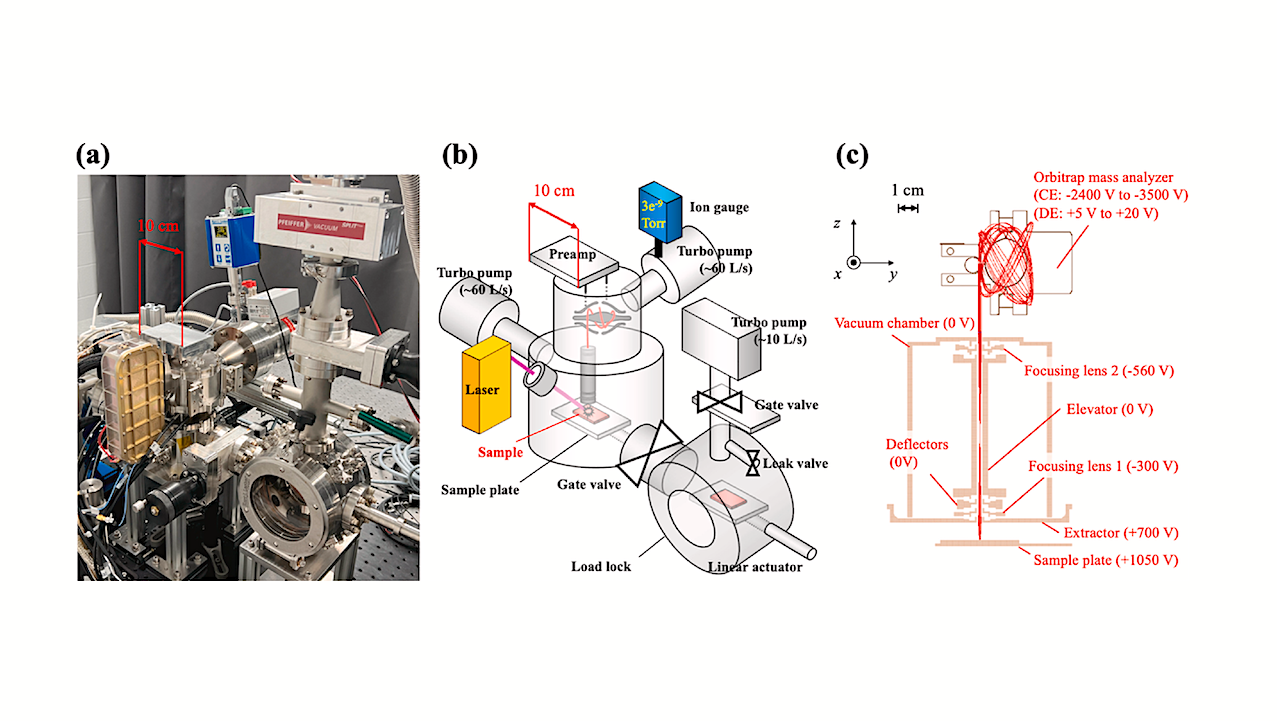
(a) CORALS engineering test unit. (b) Schematic diagram of Fig. 1a illustrating key subsystems and components. (c) Ion optics simulation using SIMION® 8.1, showing a cut plane of the instrument. The brown structures show the geometry of electrodes, and red lines show ion trajectories generated within a 110-μm diameter circle centered on the optical axis. — International Journal of Mass Spectrometry
One of the analytical advantages of Laser desorption/ablation mass spectrometry (LDMS) is its potential for spatially-resolved composition analysis of solid samples, supporting 2D chemical mapping and/or 3D depth profiling as ions are generated within a focused laser beam footprint.
In this study, we present the imaging capabilities of a spaceflight LDMS instrument named CORALS (Characterization of Ocean Residues and Life Signatures), centered around an Orbitrap™ mass analyzer ruggedized for planetary missions. Four types of samples with distinct morphologies and compositions were characterized, specifically high-purity metal foils, organic fingerprint impressions, Widmanstätten patterns in the Gibeon iron meteorite, and multiple mixtures of gypsum and hematite with different volumetric proportions.
We show that the CORALS instrument supports a wide field-of-view (FOV: ∼1.4 × 1.7 mm2) with fine spatial resolution (∼100 μm), along with the demonstrations to analyze organic patterns at the 100-μm spatial scale and to perform semi-quantitative analysis to distinguish two different phases. These capabilities will enable elemental, molecular, and isotopic analysis of morphologies and textures in planetary samples ranging from sub-mm to mm scales (e.g., biochemical structures such as stromatolite layers, mineralogical diversity of rocks and soils, and co-located organics and host minerals).
This study confirms that CORALS is a high-value instrument that complements previous spaceflight chemical imaging instruments (e.g., SHERLOC on NASA’s perseverance rover), providing critical context for detailed in-situ analysis of potential biosignatures.
Astrobiology,











Related Posts
Stay Informed With the Latest & Most Important News
Previous Post
Next Post
Advertisement
-
 01Two Black Holes Observed Circling Each Other for the First Time
 -
 02From Polymerization-Enabled Folding and Assembly to Chemical Evolution: Key Processes for Emergence of Functional Polymers in the Origin of Life
 -
 03Astronomy 101: From the Sun and Moon to Wormholes and Warp Drive, Key Theories, Discoveries, and Facts about the Universe (The Adams 101 Series)
 -
 04True Anomaly hires former York Space executive as chief operating officer
 -
 05Φsat-2 begins science phase for AI Earth images
 -
 06Hurricane forecasters are losing 3 key satellites ahead of peak storm season − a meteorologist explains why it matters
 -
 07Binary star systems are complex astronomical objects − a new AI approach could pin down their properties quickly