
Now Reading: China ends month-long launch hiatus with separate Guowang and Shiyan-30 satellite missions
-
01
China ends month-long launch hiatus with separate Guowang and Shiyan-30 satellite missions

China ends month-long launch hiatus with separate Guowang and Shiyan-30 satellite missions

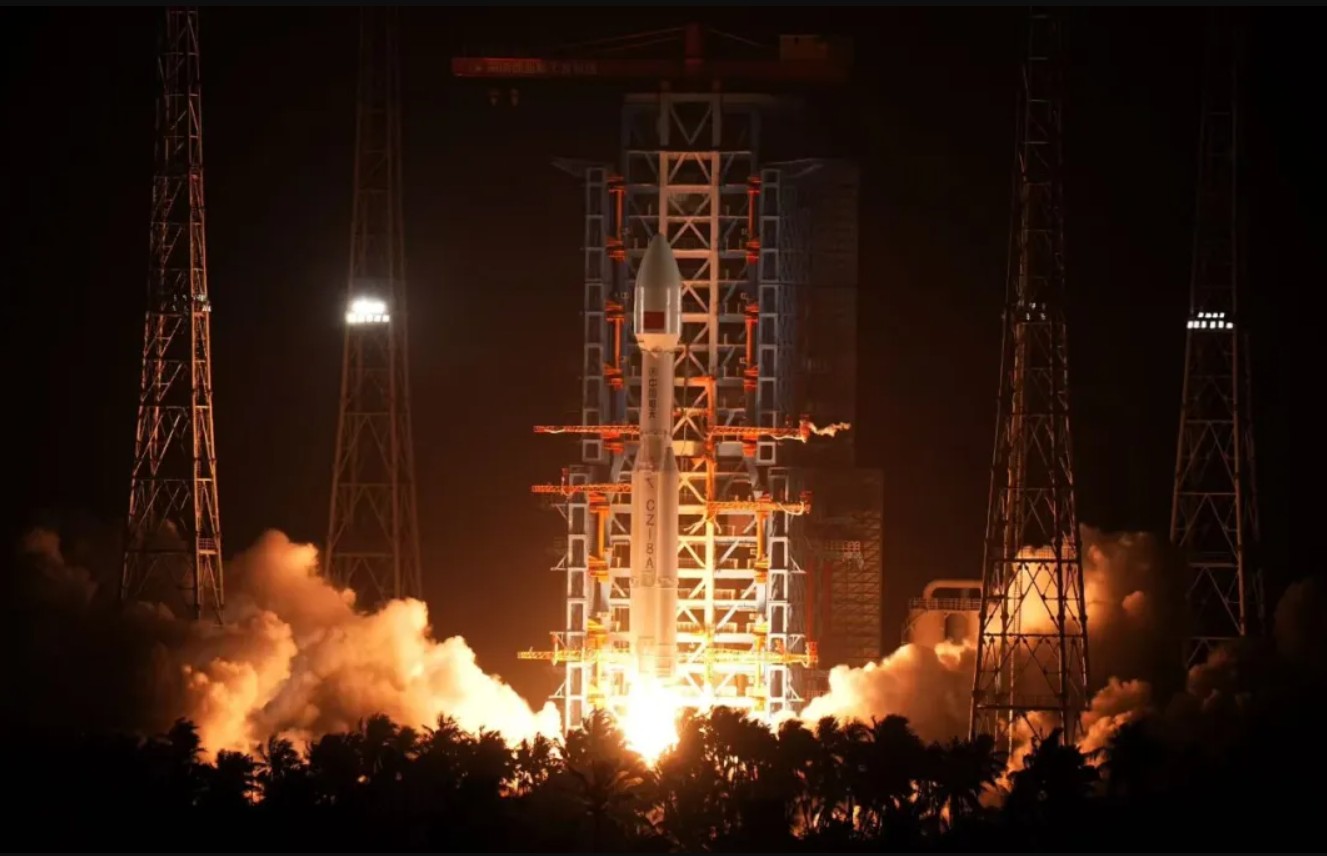

HELSINKI — China resumed orbital launch activity Thursday with a pair of missions lifting off from Hainan and Xichang spaceports, launching satellite internet and technology test satellites.
The country had not conducted a launch since Feb. 12, when a Jielong-3 solid rocket sea launch carried the PRSC-EO2 remote sensing satellite and other passengers to orbit, ahead of a break for the Chinese New Year holiday. China’s annual political sessions in Beijing and a failure of a Long March 3B launch in January may also have contributed to the extended pause in launch activity.
The resumption came on Thursday, with a Long March 8A lifting off from Hainan commercial launch center at 2:48 p.m. Eastern, March 12 (1948 UTC). The China Aerospace Science and Technology Corporation (CASC) announced launch success around two hours after liftoff, officially revealing the mission to be carrying the 20th group of satellites for the national Guowang low Earth orbit satellite internet megaconstellation.
Orbital data for the launch had not been published at time of reporting. Long March 8A launches typically carry nine Guowang satellites, while airspace closure notices indicate that this batch would join others in around 1,100-kilometer-altitude low Earth orbits inclined by 50 degrees.
The satellites were manufactured by the Innovation Academy for Microsatellites of the Chinese Academy of Sciences (IAMCAS). Paperwork filed with the ITU shows Guowang is intended to be a 13,000-satellite constellation. There are now around 163 operational Guowang satellites in orbit, while the near-term target for Guowang is to have 400 satellites in orbit by 2027.
Guowang is part of China’s response to Starlink and other proliferated low Earth orbit constellations. The country has moved to greatly increase its launch capabilities, including reusable launch vehicles. A new Five-Year Plan also highlighted the advancement of satellite internet and reusable launch as priorities.
Shiyan-30 (03, 04)
Hours later, a second launch saw a classified technology demonstration mission liftoff from southwest China. A Long March 2D rocket lifted off at 5:33 p.m. Eastern (2233 UTC) from Xichang Satellite Launch Center.
CASC declared the launch a success, revealing the payloads to be the Shiyan-30 (03 and 04) satellites.
The Shiyan-30 (03 and 04) satellites are described as “primarily used for testing and verifying Earth observation technologies.” The spacecraft may be launched in pairs in order to allow interferometry tests. Combining data from the pair could enable more precise elevation measurements or improved optical or radar resolution. The pair may also be testing inter-satellite links, autonomous navigation and formation flying, and other applications.
The mission follows the first Shiyan-30 pair, launched in September 2025, which entered roughly circular 590-kilometer-altitude orbits inclined by 35 degrees.
Shiyan missions are typically opaque, but outside analysts believe Shiyan satellites are used to trial new systems such as sensors, communications subsystems and environmental instruments, forming part of China’s efforts to validate new space technologies in orbit.
Satellites in the series appear to have been used for a range of purposes, including technology demonstrations, space environment monitoring, electronic intelligence, remote sensing, space situational awareness and space operations such as rendezvous and proximity maneuvers (RPO). Many Shiyan satellites operate in low Earth or near-polar orbits, though a number have headed to geosynchronous orbits, including the possible inspector satellites Shiyan-12 (01) and (02). Shiyan-10 satellites, meanwhile, entered Molniya orbits.
The launches were China’s 11th and 12th orbital launch attempts of 2026, of which two have been failures. The country is likely aiming to surpass the 100 launch mark in a single year for the first time in 2026, having recorded a national record 92 orbital launch attempts in 2025.










Related Posts

Stay Informed With the Latest & Most Important News
Previous Post
Next Post




Advertisement
-
 01Two Black Holes Observed Circling Each Other for the First Time
 -
 02From Polymerization-Enabled Folding and Assembly to Chemical Evolution: Key Processes for Emergence of Functional Polymers in the Origin of Life
 -
 03Astronomy 101: From the Sun and Moon to Wormholes and Warp Drive, Key Theories, Discoveries, and Facts about the Universe (The Adams 101 Series)
 -
 04True Anomaly hires former York Space executive as chief operating officer
 -
 05Φsat-2 begins science phase for AI Earth images
 -
 06Hurricane forecasters are losing 3 key satellites ahead of peak storm season − a meteorologist explains why it matters
 -
 07Binary star systems are complex astronomical objects − a new AI approach could pin down their properties quickly