
Now Reading: China hearing focuses on U.S. policy shortfalls
-
01
China hearing focuses on U.S. policy shortfalls


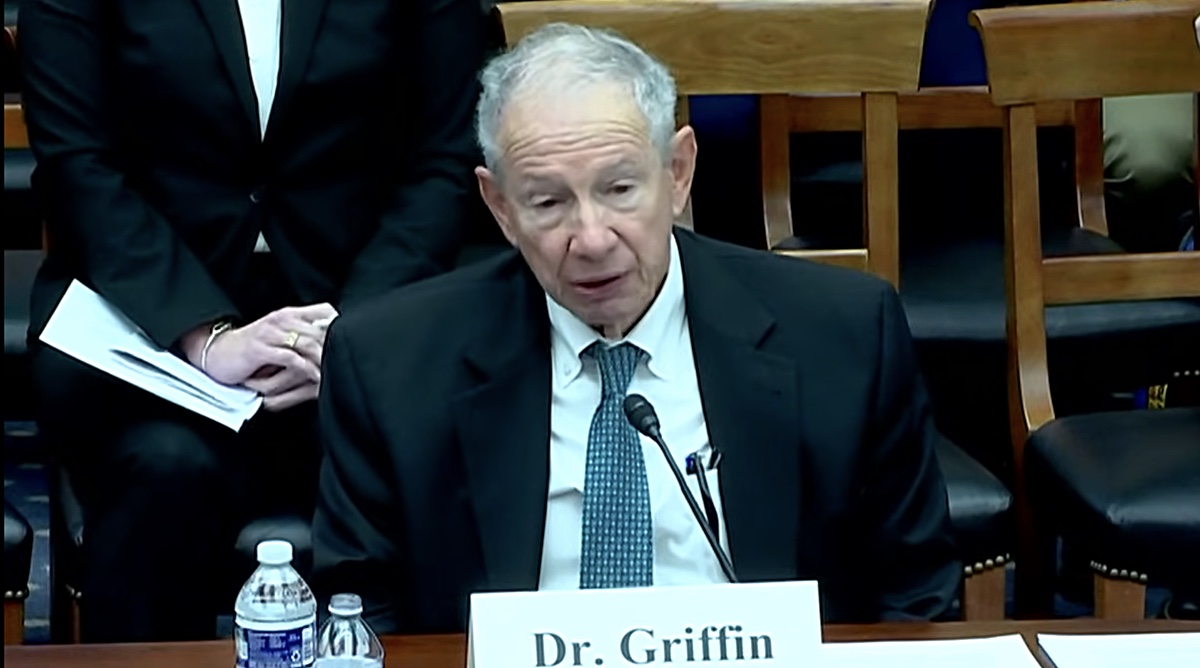

WASHINGTON — A House hearing on the rise of China’s space program turned into a broader critique of U.S. space policy, including NASA’s current approach to returning astronauts to the moon.
The Dec. 4 hearing by the House Science Committee’s space subcommittee was billed as an examination of China’s growing space capabilities and the emerging race with the United States to land the next crew on the lunar surface. Lawmakers framed that competition as part of a wider geopolitical struggle in space.
“The question we should be asking as we explore beyond the planet is, will humanity carry forward the American values of economic and political freedom, or those of the Chinese Communist Party?” said Rep. Mike Haridopolos, R-Fla., chairman of the subcommittee, in his opening remarks.
“I will not stand for handing the keys to lunar exploration or space leadership to China,” added Rep. Valerie Foushee, D-N.C., the subcommittee’s ranking member. “This is a pivotal moment.”
She and other Democrats used the hearing to criticize actions by the Trump administration, including layoffs and proposed budget cuts at NASA, which they argued weakened U.S. competitiveness with China.
Foushee cited “gutting” of the federal science and engineering workforce and “significantly underinvesting in research and development” as key concerns. “Is this a winning strategy?”
China represents “a real threat to the United States’ long history as the undisputed global leader in space,” said Rep. Zoe Lofgren, D-Calif., ranking member of the full committee. “It’s also critical that we redouble our commitment to supporting and stewarding a strong, robust space program.”
She contrasted China’s steady progress with budget cuts and ongoing work to close facilities at NASA’s Goddard Space Flight Center. “I simply do not understand how anyone reconciles rhetoric about competing with China while pulling the rug out from under our own research enterprise,” she said.
Those upheavals directly affected one of the hearing’s witnesses. Patrick Besha, founder of Global Space Group, testified about China’s space capabilities, noting he joined NASA nearly 20 years ago as a specialist on China. Asked by Foushee why he was no longer at the agency, he said he had been part of NASA’s Office of Technology, Policy and Strategy, which was shut down in March. “Myself and about a dozen colleagues were RIF’ed,” he said, using the acronym for “reduction in force.”
“That’s beyond puzzling and, I would say, incredibly alarming,” Foushee replied.
Artemis doubts
While some members focused on recent turmoil at NASA, another witness sharply criticized the agency’s long-term approach to its Artemis lunar exploration campaign.
“The problem facing us is not China’s rise. We cannot control what China is doing,” said Mike Griffin, a former NASA administrator. “We can control only what we are doing. Of those efforts, I am forced to say that mediocrity would be an improvement.”
He argued that NASA’s current architecture, which relies on SpaceX’s Starship for the Artemis 3 landing, is not feasible, citing the potentially large number of Starship refueling flights required in low Earth orbit. “The Artemis 3 mission and those beyond should be canceled, and we should start again,” he said.
Griffin’s criticism is not new. In January, testifying before the same subcommittee, he called the current approach “excessively complex” and “highly unlikely to be completed in a timely manner.”
He referenced that earlier testimony and said opposition to NASA’s architecture is growing, pointing to Senate testimony in September by former NASA Administrator Jim Bridenstine and more recent assessments by the Aerospace Safety Advisory Panel that Artemis 3 could face years of delays.
Other witnesses did not directly address the Artemis 3 architecture but did not challenge the likelihood that China is on track to land its first astronauts on the moon by 2030. Asked if NASA could return humans to the lunar surface before China, responses ranged from “maybe” by Besha and “worried” by Clayton Swope of the Center for Strategic and International Studies to “very pessimistic” by Dean Cheng of the Potomac Institute and “no possible way” by Griffin.
Witnesses contrasted that uncertainty with China’s steady progress. “One of the ironies here is that the very authoritarianism that is a hallmark of the Chinese system does grant certain benefits,” Cheng said, such as long-term program stability. “That is an enormous benefit.”
“Sticking to a plan is important when the plan makes sense. China is sticking to a plan that makes sense,” Griffin said. “We have stuck to a plan that does not make sense.”










Related Posts

Stay Informed With the Latest & Most Important News






Advertisement
-
 01Two Black Holes Observed Circling Each Other for the First Time
 -
 02From Polymerization-Enabled Folding and Assembly to Chemical Evolution: Key Processes for Emergence of Functional Polymers in the Origin of Life
 -
 03Astronomy 101: From the Sun and Moon to Wormholes and Warp Drive, Key Theories, Discoveries, and Facts about the Universe (The Adams 101 Series)
 -
 04True Anomaly hires former York Space executive as chief operating officer
 -
 05Φsat-2 begins science phase for AI Earth images
 -
 06Hurricane forecasters are losing 3 key satellites ahead of peak storm season − a meteorologist explains why it matters
 -
 07Binary star systems are complex astronomical objects − a new AI approach could pin down their properties quickly