
Now Reading: China launches AlSat-3A for Algeria, Ceres-1 sea launch adds to Tianqi constellation
-
01
China launches AlSat-3A for Algeria, Ceres-1 sea launch adds to Tianqi constellation

China launches AlSat-3A for Algeria, Ceres-1 sea launch adds to Tianqi constellation

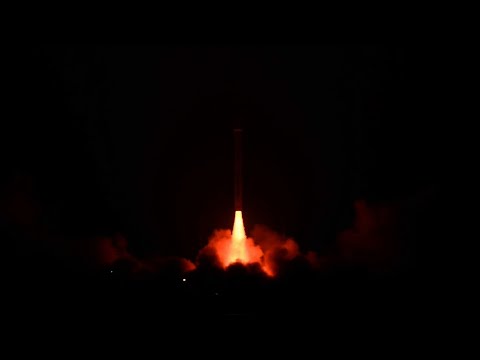
HELSINKI — China conducted its third and fourth launches of 2026 with Long March 2C and Ceres-1 rockets lifting off from Jiuquan and a sea platform respectively.
A Long March 2C rocket lifted off at 11:01 p.m. Eastern, Jan. 14 (0401 UTC, Jan. 15) from Jiuquan Satellite Launch Center in northwest China. Insulation tiles were shed from the launch vehicle as it ascended into the sky above the desert spaceport.
The state-owned China Aerospace Science and Technology Corporation (CASC) announced launch success, revealing the payload to be the Algerian Remote Sensing Satellite-3A, also known as AlSat-3A.
Few details of the satellite were released, with Algerian press reports stating the satellite would provide very high resolution capabilities dedicated to observation and strengthen capabilities in geospatial intelligence.
The China Great Wall Industry Corporation (CGWIC), a CASC subsidiary, signed a contract with the Algerian Space Agency (ASAL) in July 2023 for on-orbit delivery of two optical remote sensing satellites.
The China Academy of Launch Vehicle Technology (CALT) provided the launcher while the China Academy of Space Technology (CAST) developed the satellite. China previously worked with Algeria on Alcomsat-1.
AlSat-3A was later cataloged in a 489 by 627-kilometer-altitude, 97-degree inclination orbit by U.S. Space Force.
Nighttime sea launch
The AlSat-3A mission was followed hours later by a nighttime sea launch for the Ceres-1, a solid rocket developed by commercial launch firm Galactic Energy.
The Ceres-1S Y7 lifted off at 3:10 p.m. Eastern (2010 UTC) Jan. 15 from the converted sea platform Defu 15001 off the coast of Shandong province. Galactic Energy announced a successful launch, with four satellites for the Tianqi constellation (numbers 37-40) successfully inserted into 850-km, 45-degree inclination orbits. Tianqi is one of China’s more mature Internet-of-things constellations and is operated by commercial startup Guodian Gaoke.
The mission marks a return-to-flight for the light-lift Ceres-1 following a launch failure in November 2025 stemming from an anomaly affecting the fourth stage.
Upcoming launches, 2026 plans
The launches were China’s third and fourth orbital launch attempts of 2026, following a Long March 6A sending Yaogan-50 (01) into an unusual, highly retrograde orbit and a Long March 8A sending an 18th batch of Guowang satellites into orbit.
Chinese activity is set to continue with three launches in the coming days. A Long March 3B rocket, typically used for launches to geosynchronous transfer orbit, is set to launch from Xichang, southwest China, around midday Eastern later on Jan. 16.
Galactic Energy, which raised $336 million in September, is expected to attempt the debut launch of its larger Ceres-2 solid rocket (1,600 kg to 500-km LEO) as soon as late Jan. 16 Eastern (early Jan. 17 UTC) from Jiuquan’s Dongfeng commercial test zone. A Long March 12 launch is expected from the coastal Hainan commercial spaceport early Jan. 19.
China launched 92 times overall in 2025, with the country expected to clear 100 launches for the first time this year. Major missions will include a first flight of the Long March 10A and the Mengzhou crew spacecraft, Shenzhou-23 and 24—with the latter potentially carrying an international astronaut to the Tiangong space station for the first time—and the Chang’e-7 robotic lander to the lunar south pole.











Related Posts

Stay Informed With the Latest & Most Important News
Previous Post
Next Post





Advertisement
-
 01Two Black Holes Observed Circling Each Other for the First Time
 -
 02From Polymerization-Enabled Folding and Assembly to Chemical Evolution: Key Processes for Emergence of Functional Polymers in the Origin of Life
 -
 03Astronomy 101: From the Sun and Moon to Wormholes and Warp Drive, Key Theories, Discoveries, and Facts about the Universe (The Adams 101 Series)
 -
 04True Anomaly hires former York Space executive as chief operating officer
 -
 05Φsat-2 begins science phase for AI Earth images
 -
 06Hurricane forecasters are losing 3 key satellites ahead of peak storm season − a meteorologist explains why it matters
 -
 07Binary star systems are complex astronomical objects − a new AI approach could pin down their properties quickly