
Now Reading: China launches experimental cargo spacecraft, opaque tech demo mission and remote sensing satellite
-
01
China launches experimental cargo spacecraft, opaque tech demo mission and remote sensing satellite

China launches experimental cargo spacecraft, opaque tech demo mission and remote sensing satellite

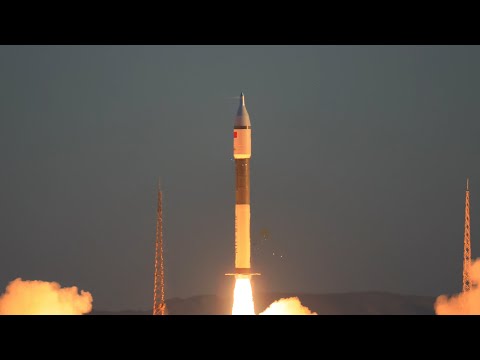
HELSINKI — China conducted a pair of launches in recent days, sending an experimental commercial cargo spacecraft into orbit, followed by a remote sensing satellite.
A Kuaizhou-11 solid rocket lifted off at 8:08 p.m. Eastern, Dec. 12 (0108 UTC, Dec. 13) from the Jiuquan Satellite Launch Center in the Gobi Desert, quickly accelerating into a clear blue sky above the spaceport.
Aboard were the DEAR-5 spacecraft for commercial firm AZSpace and the Xiwang-5 (Phase II) satellite from the state-owned China Academy of Space Technology (CAST).
DEAR-5 is based on the B300-L small cargo spacecraft with a payload capacity of up to 300 kilograms and a volume of 1.8 cubic meters. It carries 34 experimental payloads from research institutes, universities, and enterprises, according to AZSpace, with the experiments set to continue for one year.
The company, in a post-launch statement, claims the mission paves the way for broader space science research, space technology verification and application development, and cargo transportation. A day later, AZSpace published an update stating all tests were proceeding smoothly, showing an image from the exterior of the spacecraft.
AZSpace was founded in 2019 and ultimately aims to conduct crewed orbital spaceflight, targeting tests in 2027 or 2028.
DEAR-1 launched in December 2023 aboard an iSpace Hyperbola-1 solid propellant rocket, while the DEAR-3 microgravity research platform was lost on the failed Kinetica-1 rocket launch in December 2024.
Little is known about Xiwang-5 (Phase II), which appears unrelated to the Xiwang-1 amateur radio and educational microsatellite launched in December 2009. The new satellite appears to be a technology demo mission, with CAST stating that it is technically challenging and has numerous large system interfaces, while revealing little about the spacecraft and its objectives.
Both spacecraft from the launch were catalogued orbiting at 504 by 525 kilometers with an inclination of 41 degrees.
It is only the third launch of the Kuaizhou-11, which can carry up to 1,500 kilograms into low Earth orbit. The first launch, in 2020, ended in failure, while the second successfully launched the Xingyun Jiaotong VDES satellite in December 2022.
The rocket is operated by Expace, a spinoff from the giant state-owned missile and defense contractor China Aerospace Science and Industry Corporation (CASIC). It regularly launches the smaller Kuaizhou-1A solid rocket, which most recently launched Dec. 5.
Ziyuan-3 (04) launch
The next launch out of China followed late Monday. A Long March 4B lifted off at 10:17 p.m. Eastern, Dec. 15 (0317 UTC, Dec. 16) from Taiyuan Satellite Launch Center, with thermal insulation falling from the fairing as the rocket ascended. The launch successfully sent the Ziyuan-3 (04) remote sensing satellite into orbit, the state-owned China Aerospace Science and Technology Corporation (CASC) confirmed.
The satellite was developed by CAST and is part of a long-standing national civil space infrastructure program. It carries a stereo mapping camera, a multispectral camera and a laser altimeter. CASC, of which CAST is a major subsidiary, says Ziyuan-3 (04) will provide high-precision data products for key natural resource operations such as geographic information resource construction, natural resource surveys and monitoring, land spatial planning and land use control, and natural resource supervision and enforcement.
The launches were China’s 85th and 86th orbital launch attempts of 2025, with that number containing two failures of commercially developed rockets.
China’s launch record
While China has already far surpassed its previous national record of 68 launches in a calendar year, further activity is expected. The debut flight of the reusable Long March 12A was expected late Dec. 16 Eastern, but airspace closure notices for the launch have been rescinded, with no indication of a possible new launch date. The commercial Ceres-2 solid rocket from Galactic Energy could also fly for the first time before the end of the year.
The next orbital launch out of China appears to be a Long March 5 rocket scheduled to launch from Wenchang Spaceport on Hainan island no earlier than Dec. 20. The payload for the mission is currently unknown to the outside. Long March 8 series (Wenchang) and Long March 3B (Xichang) rocket launches are also scheduled for late December.











Related Posts


Stay Informed With the Latest & Most Important News
Previous Post
Next Post




Advertisement
-
 01Two Black Holes Observed Circling Each Other for the First Time
 -
 02From Polymerization-Enabled Folding and Assembly to Chemical Evolution: Key Processes for Emergence of Functional Polymers in the Origin of Life
 -
 03Astronomy 101: From the Sun and Moon to Wormholes and Warp Drive, Key Theories, Discoveries, and Facts about the Universe (The Adams 101 Series)
 -
 04True Anomaly hires former York Space executive as chief operating officer
 -
 05Φsat-2 begins science phase for AI Earth images
 -
 06Hurricane forecasters are losing 3 key satellites ahead of peak storm season − a meteorologist explains why it matters
 -
 07Binary star systems are complex astronomical objects − a new AI approach could pin down their properties quickly