
Now Reading: China launches new Guowang satellites, Long March 12A launch and landing attempt date set
-
01
China launches new Guowang satellites, Long March 12A launch and landing attempt date set

China launches new Guowang satellites, Long March 12A launch and landing attempt date set

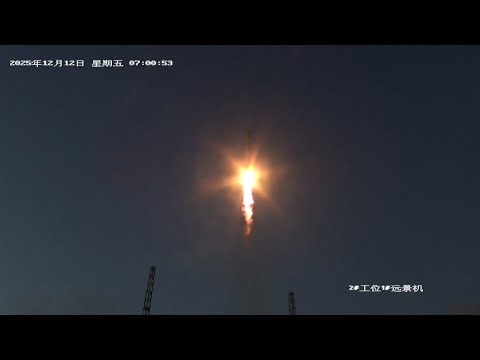
HELSINKI — China launched new Guowang satellite internet payloads Dec. 11 as preparations advanced for a Long March 12A orbital launch and first stage landing attempt.
The fourth Long March 12 lifted off at 6:00 p.m. Eastern (2300 UTC) Dec. 11 from the coastal Hainan commercial space launch center, with the rocket rising into the sky just before local sunrise (Dec. 12). The China Aerospace Science and Technology Corporation (CASC) announced launch success more than three hours after liftoff, confirming the payloads to be for the Guowang satellite internet megaconstellation.
Airspace closure notices indicate the satellites—the 16th group launched for Guowang—would head into 50 degree inclination orbits. Though not stated by CASC, nine satellites are expected to have been aboard the launch, following the profiles of two earlier Long March 12 launches carrying Guowang satellites. The 62-meter-long kerosene-liquid oxygen Long March 12 can carry a payload of 12,000 kilograms to low Earth orbit (LEO), and 6,000 kg to sun-synchronous orbit (SSO).
China plans for the national Guowang project, led by the state-owned China SatNet, to consist of nearly 13,000 low Earth orbit satellites. It is part of China’s response to Starlink, both commercially and strategically. The near-term target for Guowang is to have 400 satellites in orbit by 2027. So far, the groups have been launched into orbits of around 1,100 kilometers in altitude, with inclinations either 86.5 degrees or 50 degrees.
The launch comes just days after the 15th group of Guowang satellites reached orbit. There are now 127 satellites in orbit for the Guowang project proper, along with further experimental and test satellites.
Little is known about the Guowang satellites. Manufacturers include CASC’s China Academy of Spaceflight Technology (CAST), the Innovation Academy for Microsatellites Chinese Academy of Sciences (IAMCAS), and commercial satellite manufacturer GalaxySpace. Estimates of their size and mass, based on the numbers of satellites and rocket payload capacities, as well as the opacity of the project, may indicate the spacecraft may have functions and purposes beyond those of civilian satellite internet connectivity.
The launch was China’s 84th of a record-breaking year for the country. 15 dedicated launches for Guowang have taken place this year, accounting for a significant portion in the growth of China’s launch cadence. Long March models 5B, 6A, 8A and 12 have been used to launch the satellites, though the project appears to be open to commercial launch partners in the future.
Long March 12A launch set for Dec. 16 Eastern
China’s second orbital launch and landing attempt appears set to follow two weeks after the first attempt, which saw the debut flight of the commercial Zhuque-3 rocket reach orbit but the first stage combust during the final stages of descent and crash close to the landing pad.
The Long March 12A, developed by CASC’s Shanghai Academy of Spaceflight Technology (SAST) is set to launch from the Jiuquan spaceport’s Dongfeng Commercial Space Innovation Test Zone during a launch window of between 8:54 p.m. and 11:14 p.m. Eastern, Dec. 16 (0154-0414 UTC, Dec. 17), according to airspace closure notices. The flight path passes over a dedicated landing pad for the Long March 12A located 250 km downrange in Minqin county, Gansu province.
While the Long March 12A shares a 3.8-meter-diameter with the standard Long March 12, it is powered by methane-liquid oxygen engines, with engines for test articles provided by commercial engine maker Jiuzhou Yunjian. SAST performed a high altitude launch and splashdown test in January without providing comment on the outcome. Launch infrastructure for the 12A was recently completed at Jiuquan.
CASC has also been experimenting with grid fins on rockets such as the expendable Long March 2C as far back as 2019 as part of broader experiments related to recovery and reusability.
China’s pursuit of reusable rocketry spans both the state-owned and commercial space sectors. Attaining this capability will help further boost the country’s launch cadence, with great demands for launch coming from Guowang and the Shanghai-backed Thousand Sails (Qianfan) megaconstellation.











Related Posts

Stay Informed With the Latest & Most Important News
Previous Post
Next Post


Advertisement
-
 01Two Black Holes Observed Circling Each Other for the First Time
 -
 02From Polymerization-Enabled Folding and Assembly to Chemical Evolution: Key Processes for Emergence of Functional Polymers in the Origin of Life
 -
 03Astronomy 101: From the Sun and Moon to Wormholes and Warp Drive, Key Theories, Discoveries, and Facts about the Universe (The Adams 101 Series)
 -
 04True Anomaly hires former York Space executive as chief operating officer
 -
 05Φsat-2 begins science phase for AI Earth images
 -
 06Hurricane forecasters are losing 3 key satellites ahead of peak storm season − a meteorologist explains why it matters
 -
 07Binary star systems are complex astronomical objects − a new AI approach could pin down their properties quickly