
Now Reading: China launches new TJS satellite, commercial Kinetica-1 lofts 9 spacecraft
-
01
China launches new TJS satellite, commercial Kinetica-1 lofts 9 spacecraft


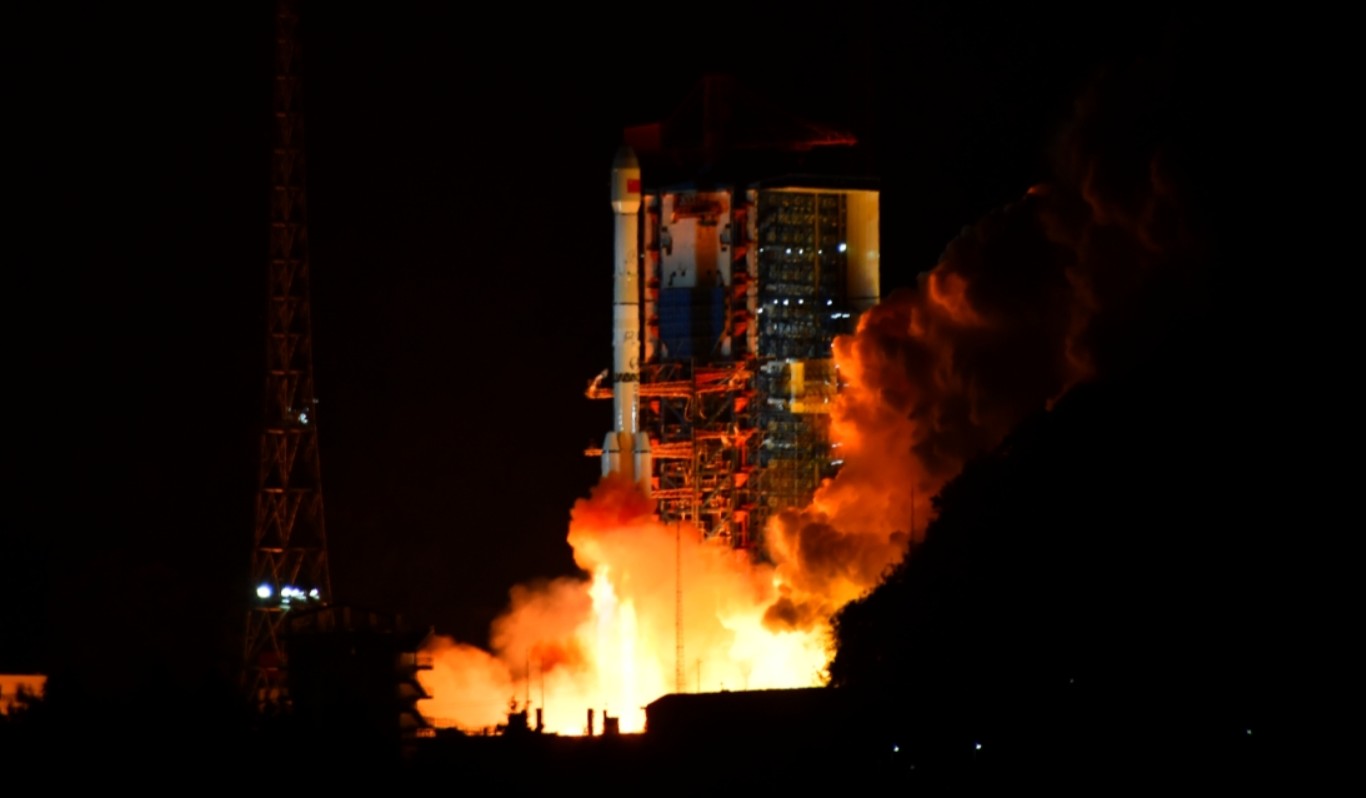

HELSINKI — China continued a surge in launch activity with a pair of missions Tuesday, adding to an opaque satellite series and launching new remote sensing satellites.
The first launch saw a hypergolic Long March 3B rocket lift off at 10:08 a.m. Eastern (1508 UTC) Dec. 9 from Xichang Satellite Launch Center in southwest China. The China Aerospace Science and Technology Corporation (CASC) announced a successful launch, revealing the payload to be the communications technology test satellite 22 (TJS-22), part of an opaque series of mostly geosynchronous satellites.
The satellite is primarily used for satellite communication, broadcasting, data transmission, and related technology testing and verification, according to CASC. No images or further information was provided, as is typical for the TJS series. A mission patch from the satellite maker, CASC’s Shanghai Academy of Spaceflight Technology (SAST), depicts Sun Wukong, the Monkey King.
TJS satellites mainly operate in geostationary orbit (GEO). The series is seen by Western analysts as potentially carrying out classified missions including signals intelligence, missile early warning and satellite inspection activities to support the People’s Liberation Army (PLA).
TJS-13 and TJS-21—the latter launched last month—entered highly-elliptical, Molniya-like orbits, along with experimental satellites Shiyan-10 (01 and 02), providing long periods of visibility over the northern hemisphere. Infrared payloads would provide missile early warning capabilities. TJS-3, launched in 2018, later appeared to release a subsatellite.
The launch marked the third launch of a Long March rocket within a 24-hour period, following on from the launch of Yaogan-47 via Long March 4B late Dec. 8 Eastern. The Long March 3B remains a workhorse for GEO launches, despite the development of the kerosene-liquid oxygen Long March 7A, which launches from Wenchang, some 8 degrees of latitude closer to the equator.
Kinetica-1 launches 11 satellites
Next up, a Kinetica-1 solid rocket lifted off at 11:03 p.m. Eastern, Dec. 9 (0403 UTC, Dec. 10) from the Jiuquan Satellite Launch Center in the Gobi Desert. Aboard were nine payloads, including three involving international partners, namely the United Arab Emirates, Egypt and Nepal.
The satellites aboard the flight, codenamed “Create the Future,” were the Jinlin-1 Gaofen 07B01, 07C01 and 07D01 remote sensing satellites for Changguang Satellite Technology, another CAS spinoff, with a spatial resolution better than 0.5 meters, Satellite 813 (UAE), Dongpo-15, Yixing-2 09, Yixian-A, the SPNEX science satellite (Egypt) and the Slipper2Sat educational satellite for Nepal.
Satellite 813, for observing soil and climate, was developed by the Innovation Academy for Microsatellites under CAS. Jilin-1 Jixing 07D01 was described as being able to monitor the structural conditions of power grid components, such as transmission lines and pylons, by Chinese media.
CAS Space is a commercial spinoff from the Chinese Academy of Sciences (CAS). The company has attracted payloads involving a number of international partners. Earlier this year it launched a pair of femtosatellites for a Mexican company, among other payloads, in August, and the hyperspectral Pakistan remote sensing satellite (PRSS-2-HS1) in October. It also launched a pair of VLEO Chutian satellites in November for Chinese space and defense giant CASIC.
The company is also preparing for a first suborbital test flight of the Lihong-1 rocket which is being developed for suborbital tourism, and the debut of its Kinetica-2 kerosene-liquid oxygen rocket. Both launches could come before the end of the year.
Tuesday’s launches were China’s 82nd and 83rd of 2025, following four launches in the preceding days. Launch attempts in the near future include a Long March 12 set to fly from Wenchang late Dec. 11, and a potential flight out of Taiyuan two days later. Further potential flights within the next week could include debut launches for the reusable Long March 12A and the Ceres-2 solid rocket from commercial outfit Galactic Energy.










Related Posts
Stay Informed With the Latest & Most Important News
Previous Post
Next Post


Advertisement
-
 01Two Black Holes Observed Circling Each Other for the First Time
 -
 02From Polymerization-Enabled Folding and Assembly to Chemical Evolution: Key Processes for Emergence of Functional Polymers in the Origin of Life
 -
 03Astronomy 101: From the Sun and Moon to Wormholes and Warp Drive, Key Theories, Discoveries, and Facts about the Universe (The Adams 101 Series)
 -
 04True Anomaly hires former York Space executive as chief operating officer
 -
 05Φsat-2 begins science phase for AI Earth images
 -
 06Hurricane forecasters are losing 3 key satellites ahead of peak storm season − a meteorologist explains why it matters
 -
 07Binary star systems are complex astronomical objects − a new AI approach could pin down their properties quickly