
Now Reading: China set for in-flight abort test of Mengzhou crew spacecraft
-
01
China set for in-flight abort test of Mengzhou crew spacecraft


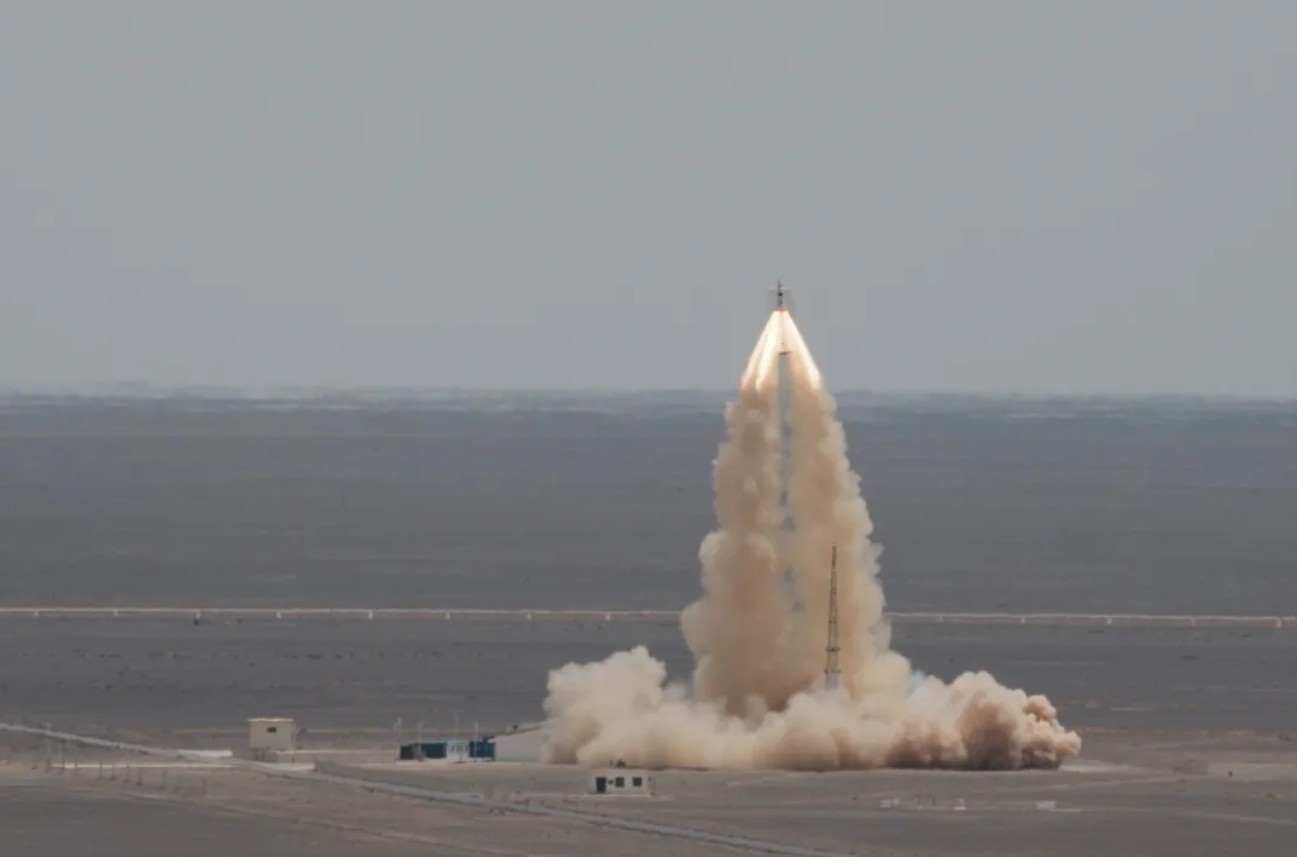

HELSINKI — China appears set for an in-flight abort test of its new-generation Mengzhou spacecraft next week in a key step for the country’s human spaceflight plans.
Images shared on Chinese social media show a first stage of a Long March 10A rocket at a new launch pad at Wenchang Satellite Launch Center. Airspace closure notices indicate a launch window of between 9:51 p.m. Eastern Feb. 10 and 1:50 a.m. Feb. 11 (0251-0650 UTC Feb. 11).
The demonstration will be a crucial step in China’s plans to attempt to land astronauts on the moon by 2030.The abort is expected near maximum dynamic pressure, when aerodynamic forces on the vehicle peak during ascent. Demonstrating that the launch escape system can rapidly pull the Mengzhou crew capsule away from a failing rocket under such conditions is a key requirement for human-rating the spacecraft for future low Earth orbit and lunar missions.. NASA’s Orion spacecraft went through an in-flight abort test in 2019.
A successful test would pave the way for a potential first full mission of Mengzhou and the Long March 10A rocket to low Earth orbit and even a visit to the Tiangong space station later this year.
China performed a pad abort test for Mengzhou at Jiuquan spaceport in June 2025, seeing the launch escape system carry the return capsule rapidly away from the ground before deploying parachutes.
Further images shared on social media show a recovery vessel designed to implement a wire catch recovery system. The vessel could be used for either a recovery attempt or simulated recovery and splashdown test of the Long March 10A first stage. The images of the test stage show both grid fins and recovery hooks at the top of the stage.
The China Aerospace Science and Technology Corporation (CASC) will be conducting the in-flight test for the China Manned Space Engineering Office (CMSEO), but neither entity has publicly commented on the upcoming event.
Mengzhou is designed to be partially reusable and replace the Soyuz-derived Shenzhou for low Earth orbit (LEO) and allowing missions beyond LEO, such as to the moon. Mengzhou features a service module and a crew module and can carry six or seven astronauts to LEO, while a heavier variant can carry three astronauts to the moon to dock with a lunar lander stack. The three-module Shenzhou can carry three astronauts and is limited to LEO.
China launched a prototype, boilerplate version of what is now named Mengzhou in 2020 on the first flight of the Long March 5B rocket. The spacecraft was sent to an apogee of around 8,000 kilometers before testing a high velocity reentry.
The Long March 10A is a single-stick variant for LEO, whereas the full Long March 10 will be a tri-core rocket. Separate launches of the Long March 10 will send a Mengzhou and lunar lander stack into translunar injection where the spacecraft will dock ahead of a lunar landing attempt. China conducted a landing and liftoff test of the Lanyue lunar lander in August 2025.










Related Posts
Stay Informed With the Latest & Most Important News
Previous Post
Next Post



Advertisement
-
 01Two Black Holes Observed Circling Each Other for the First Time
 -
 02From Polymerization-Enabled Folding and Assembly to Chemical Evolution: Key Processes for Emergence of Functional Polymers in the Origin of Life
 -
 03Astronomy 101: From the Sun and Moon to Wormholes and Warp Drive, Key Theories, Discoveries, and Facts about the Universe (The Adams 101 Series)
 -
 04True Anomaly hires former York Space executive as chief operating officer
 -
 05Φsat-2 begins science phase for AI Earth images
 -
 06Hurricane forecasters are losing 3 key satellites ahead of peak storm season − a meteorologist explains why it matters
 -
 07Binary star systems are complex astronomical objects − a new AI approach could pin down their properties quickly