
Now Reading: China’s astronauts complete cave training amid preparations for moon missions
-
01
China’s astronauts complete cave training amid preparations for moon missions


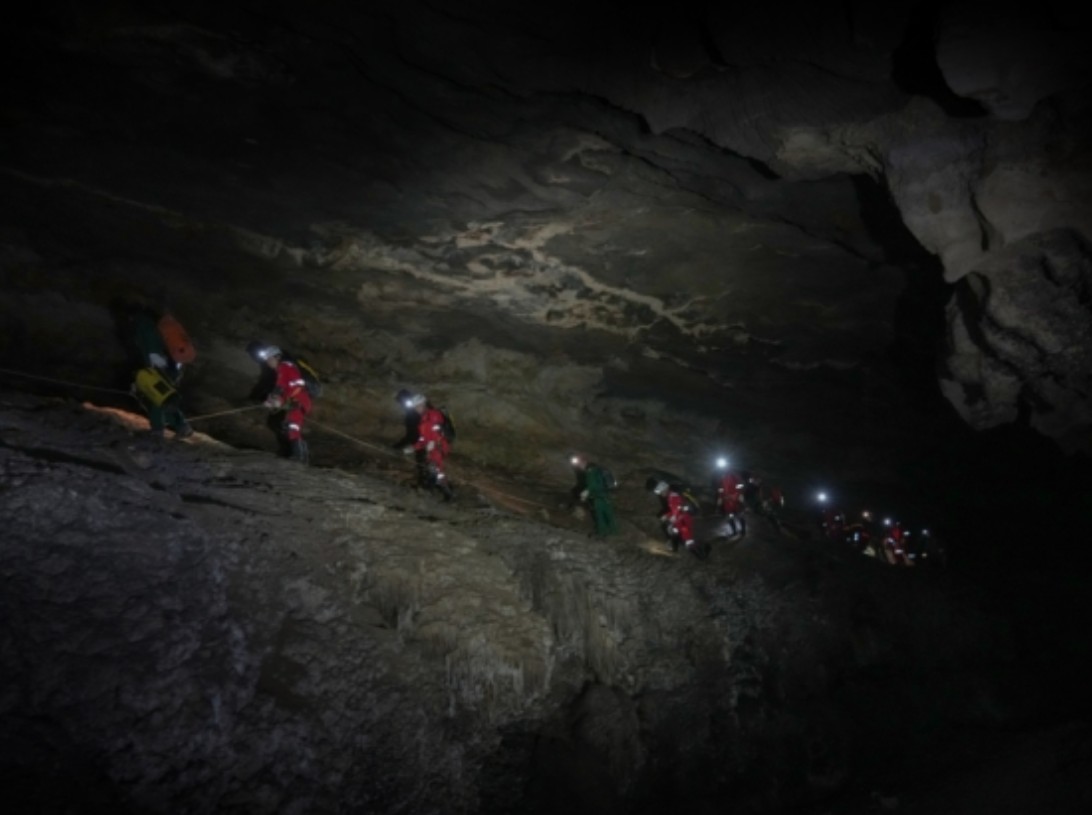

HELSINKI — China’s astronaut corps has completed a near month-long underground cave training, conducted in part to prepare for future crewed lunar landing missions.
A team of 28 astronauts participated in the training program which was held in a mountainous area of Chongqing municipality in the country’s southwest. The astronauts were divided into four groups, with each taking turns spending sessions of six days and five nights in cold, humid underground conditions.
The intensive training was designed to align closely to real mission requirements and expand China’s astronaut training system, while testing astronauts’ abilities to cope with extreme environments.
Training topics included environmental monitoring, cave mapping, simulated space–ground communications, and team psychological and behavioural training, while scientific research projects focused on areas such as human–extreme environment interactions. Instructors also introduced unexpected simulated medical evacuations to test teams’ emergency response and collaborative problem-solving capabilities.
“The data will provide crucial support for establishing psychological support systems for astronauts undertaking long-duration space station missions and crewed lunar landing missions in the future,” Jiang Yuan, an instructor from the China Astronaut Research and Training Center, told China Central Television (CCTV).
The program was organized by the China Astronaut Research and Training Center and was the first time China had conducted training similar to the European Space Agency’s Cooperative Adventure for Valuing and Exercising human behavior and performance Skills (CAVES) program. This training program also included two days of jungle training for each session. The completion of the training was announced Jan. 5, on the 28th anniversary of the establishment of the Chinese Astronaut Corps in 1998.
One of the training program directors was Ye Guangfu, a veteran of the Shenzhou-13 and Shenzhou-18 missions to the Tiangong space station and a participant in a 2016 ESA CAVES training which also involved NASA astronauts.
“Compared with the cave training in Europe, our support team inside the cave intervened as little as possible,” Ye said, according to a Xinhua report. “This approach pushed astronauts to rely on their own judgment, unlocking both individual initiative and their full problem-solving potential.”
“The cave was sealed, in complex terrain, dark and wet,” he said. “It re-created the solitude and unknowns of deep space exploration, challenging our physical and mental limits,” added Zhu Yangzhu, China’s first spaceflight engineer who flew on the Shenzhou-16 mission.
The training can be seen as one aspect of China’s planning to conduct crewed operations on the moon, with the country’s first crewed lunar mission planned for before 2030.
In 2025 the country conducted a series of tests for its crewed lunar ambitions, including a static fire for the Long March 10 rocket, a pad abort test for the Mengzhou crew spacecraft, and a takeoff and landing test for the Lanyue crew lander. A full first flight of the Long March 10A, possibly integrated with the Mengzhou spacecraft, is scheduled for some time in 2026, following an in-flight escape test at maximum dynamic pressure for Mengzhou.
China aims to put a pair of astronauts on the lunar surface before the end of the decade in what will be a short duration mission. The mission will involve two separate launches of the tri-core Long March 10, carrying the separate crew spacecraft and lunar landing stack. These will then dock in lunar orbit before a descent to the moon’s surface. The country also plans to construct the International Lunar Research Station (ILRS) in the 2030s.
NASA is set to return astronauts to the vicinity of the moon for the first time in more than 50 years this year, with its Artemis 2 mission set to launch no earlier than February. The Artemis 3 crewed landing mission is planned for no earlier than 2027, though a 2028 date appears to be accepted as the year in which there will be a human return to the lunar surface.










Related Posts

Stay Informed With the Latest & Most Important News
Previous Post
Next Post

Advertisement
-
 01Two Black Holes Observed Circling Each Other for the First Time
 -
 02From Polymerization-Enabled Folding and Assembly to Chemical Evolution: Key Processes for Emergence of Functional Polymers in the Origin of Life
 -
 03Astronomy 101: From the Sun and Moon to Wormholes and Warp Drive, Key Theories, Discoveries, and Facts about the Universe (The Adams 101 Series)
 -
 04True Anomaly hires former York Space executive as chief operating officer
 -
 05Φsat-2 begins science phase for AI Earth images
 -
 06Hurricane forecasters are losing 3 key satellites ahead of peak storm season − a meteorologist explains why it matters
 -
 07Binary star systems are complex astronomical objects − a new AI approach could pin down their properties quickly