
Now Reading: China’s Chang’e-7 arrives at spaceport for lunar south pole exploration mission
-
01
China’s Chang’e-7 arrives at spaceport for lunar south pole exploration mission


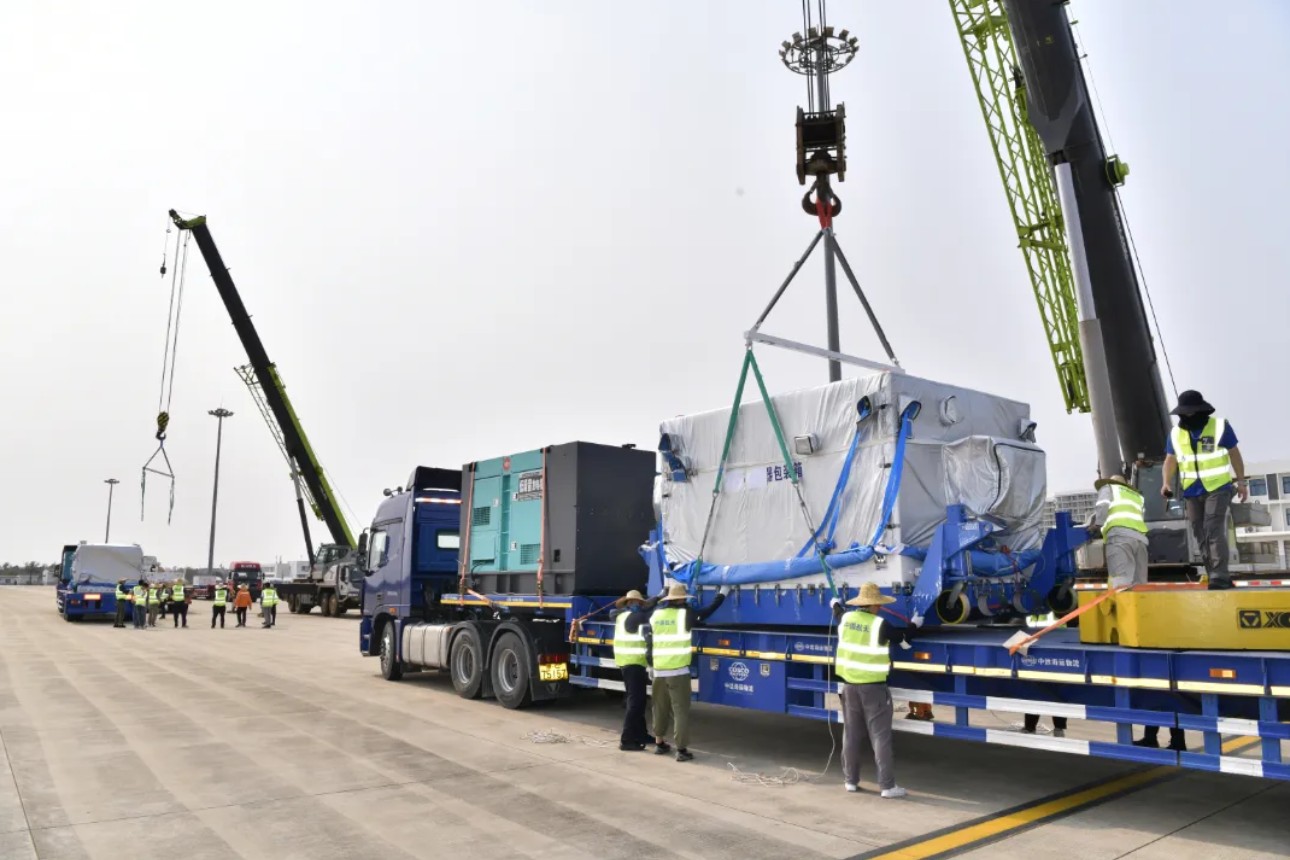

HELSINKI — China’s multi-element Chang’e-7 lunar spacecraft has arrived at Wenchang spaceport for launch preparations ahead of a planned liftoff in the second half of 2026.
Chang’e-7 will be prepared for launch on a Long March 5 rocket from Wenchang, with earlier reports suggesting launch in August. The mission consists of an orbiter, lander, rover and a unique hopping probe to seek out evidence of water-ice in permanently shadowed craters at the lunar south pole. It is also a key step in China’s roadmap toward a sustained robotic and eventual crewed presence on the moon.
The Chang’e-7 spacecraft was flown from Beijing to Haikou, Hainan island, via an Antonov An-124 aircraft April 9. China’s human spaceflight agency, CMSEO, which is working to integrate China’s crewed and robotic lunar programs, confirmed the spacecraft’s arrival at Wenchang Satellite Launch Center.
The mission preparation is taking place amid growing global lunar exploration activity, with the spacecraft’s arrival at Wenchang taking place a day ahead of the scheduled return to Earth of NASA’s Artemis 2 crew, April 10, marking the first crewed circumlunar mission in more than half a century. China is also working towards its own lunar crewed capabilities and conducted an in-flight abort test of its new Mengzhou crew spacecraft in February. A full orbital flight using the new Long March 10A rocket could take place later this year.
Chang’e-7 is expected to target a landing in the vicinity of the lunar south pole, with sites around Shackleton crater earlier identified as leading candidate sites. The site selection process involves identifying areas offering favorable illumination while also being close to permanently shadowed regions which could host volatiles such as water-ice.
The hopping spacecraft, also described as a mini-flying probe, carries the Lunar soil Water Molecule Analyzer (LUWA) payload. The spacecraft, designed to work in darkness and intense cold, will drill for samples, which will be sealed, heated, and then analyzed using a mass spectrometer.
The detection of water-ice could have big implications for lunar exploration, with the resource potentially providing drinking water and oxygen production for astronauts, or being split into hydrogen and oxygen to be used as rocket propellant.
The mission carries 18 science payloads in total, including three aboard the supporting Queqiao-2 communications relay satellite. The orbiter carries optical and radar imagers and other payloads for assessing mineral presence and characterizing the space environment, while the lander carries landing and topography cameras, a seismograph and a laser corner reflector from Italy. The rover features a panoramic camera, ground-penetrating radar and Raman spectrometer among its science instruments.
The Chang’e-7 mission, together with Chang’e-8, scheduled for around 2029, will form a basic outline of the China-led International Lunar Research Base (ILRS). Chang’e-8 will involve in-situ resource utilization tests, such as the use of lunar regolith to make bricks. Both missions will be supported by Queqiao-2, which is already operating in an elliptical lunar orbit, and supported China’s Chang’e-6 lunar far side sample return mission in 2024.
China is launching Chang’e-7 ahead of NASA’s own mission to seek out volatiles on the moon. The agency last year revived the Volatiles Investigating Polar Exploration Rover, or VIPER, mission, selecting Blue Origin and its Blue Moon Mark 1 lander to deliver the rover to the moon’s south pole no earlier than 2027.










Related Posts

Stay Informed With the Latest & Most Important News
Previous Post
Next Post



Advertisement
-
 01Two Black Holes Observed Circling Each Other for the First Time
 -
 02From Polymerization-Enabled Folding and Assembly to Chemical Evolution: Key Processes for Emergence of Functional Polymers in the Origin of Life
 -
 03Astronomy 101: From the Sun and Moon to Wormholes and Warp Drive, Key Theories, Discoveries, and Facts about the Universe (The Adams 101 Series)
 -
 04True Anomaly hires former York Space executive as chief operating officer
 -
 05Φsat-2 begins science phase for AI Earth images
 -
 06Hurricane forecasters are losing 3 key satellites ahead of peak storm season − a meteorologist explains why it matters
 -
 07Binary star systems are complex astronomical objects − a new AI approach could pin down their properties quickly