
Now Reading: China’s commercial space sector accelerates with new rocket launches and ambitious exploration plans
-
01
China’s commercial space sector accelerates with new rocket launches and ambitious exploration plans

China’s commercial space sector accelerates with new rocket launches and ambitious exploration plans

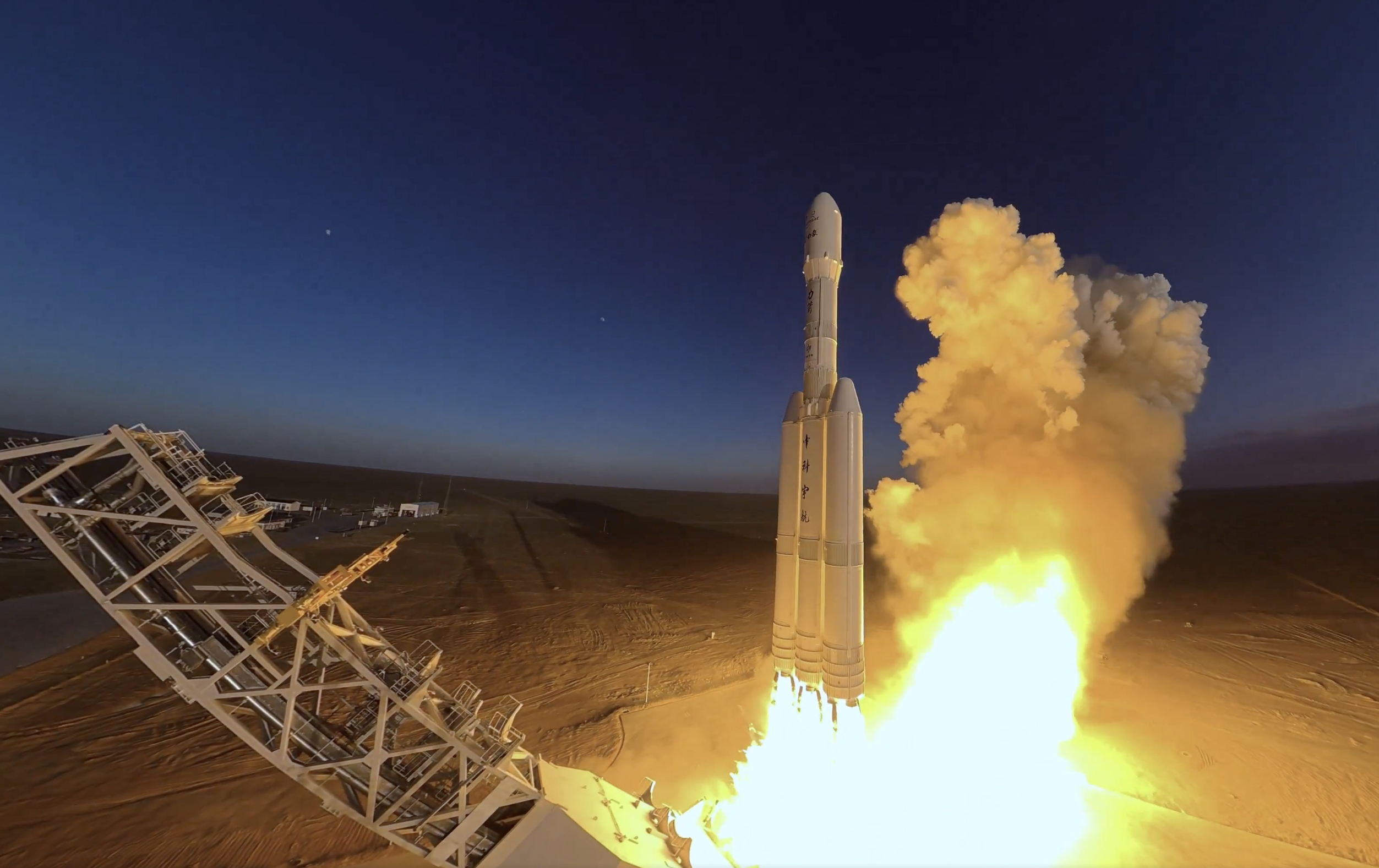

China’s burgeoning commercial space sector is witnessing a surge of activity, with recent announcements from two key players in the field. CAS Space and Space Pioneer have each launched new rocket systems shortly after one another, while also unveiling plans for innovative technologies and future deep-space missions.
In March, China marked an impressive eight successful launches, culminating in the debut of CAS Space’s Lijian-2 rocket on March 30. This medium-lift vehicle, part of a broader effort to enhance commercial space capabilities, carried a prototype of the Qingzhou cargo spacecraft. Designed to support supply missions to the Tiangong space station, Qingzhou aims to provide a lightweight alternative to the larger Tianzhou craft. The first operational model of Qingzhou is projected to launch in late 2026, with the potential to transport up to two tons of cargo on each flight. The Lijian-2 launch not only validated its design but also delivered two additional satellites into polar orbit.
CAS Space is set to scale up its production capabilities with the establishment of a superfactory in Zhejiang Province, which will enable the production of up to 12 Lijian-2 rockets annually. The new Liqing-2 engine, which utilizes a reusable design and is expected to replace older engine models, is currently undergoing tests. Plans to achieve full reusability for the Lijian-2 by 2028 will include propulsive landings for all three booster cores.
On April 3, Space Pioneer launched its Tianlong-3 rocket, which unfortunately encountered a failure during ascent, preventing it from reaching orbit. This launch had been highly anticipated, having been delayed multiple times. With a height of approximately 71 meters, the Tianlong-3 is designed to compete directly with established vehicles in the commercial sector, with a payload capacity aimed at reducing costs through reusability.
Meanwhile, China continues to push forward with its ambitions in deep-space exploration. During the recent Two Sessions meetings held in Beijing, authorities laid out plans for several upcoming missions, including an asteroid redirection test targeted for late 2027. This mission will focus on altering the orbit of the near-Earth asteroid 2016 WP8 through a kinetic impact, a technique previously demonstrated by NASA.
China’s lunar ambitions are also ramping up, as new details about the future crewed Lanyue lander emerged recently. Aiming for lunar missions by the decade’s end, the Lanyue lander design incorporates lessons learned from previous lunar missions and is expected to prioritize astronaut safety during critical landing phases. The two-module system will facilitate both lunar descent and ascent, optimizing performance and fuel efficiency.
In addition to these projects, a demonstration of an innovative robotic arm for in-space refueling has been successfully completed by the commercial firm Sustain Space. The flexible arm was tested in orbit and is part of a larger initiative aimed at prolonging the operational life of satellites.
As these developments unfold, it is clear that China’s commercial space industry is rapidly evolving, positioning itself as a formidable player in both satellite launches and broader space exploration endeavors. With multiple missions planned in the coming years, the country is gearing up to enhance its capabilities and presence in the final frontier.










Related Posts
Stay Informed With the Latest & Most Important News
Previous Post
Next Post

Advertisement
-
 01Two Black Holes Observed Circling Each Other for the First Time
 -
 02From Polymerization-Enabled Folding and Assembly to Chemical Evolution: Key Processes for Emergence of Functional Polymers in the Origin of Life
 -
 03Astronomy 101: From the Sun and Moon to Wormholes and Warp Drive, Key Theories, Discoveries, and Facts about the Universe (The Adams 101 Series)
 -
 04True Anomaly hires former York Space executive as chief operating officer
 -
 05Φsat-2 begins science phase for AI Earth images
 -
 06Hurricane forecasters are losing 3 key satellites ahead of peak storm season − a meteorologist explains why it matters
 -
 07Binary star systems are complex astronomical objects − a new AI approach could pin down their properties quickly