
Now Reading: China’s commercial Tianlong-3 rocket fails on debut launch
-
01
China’s commercial Tianlong-3 rocket fails on debut launch


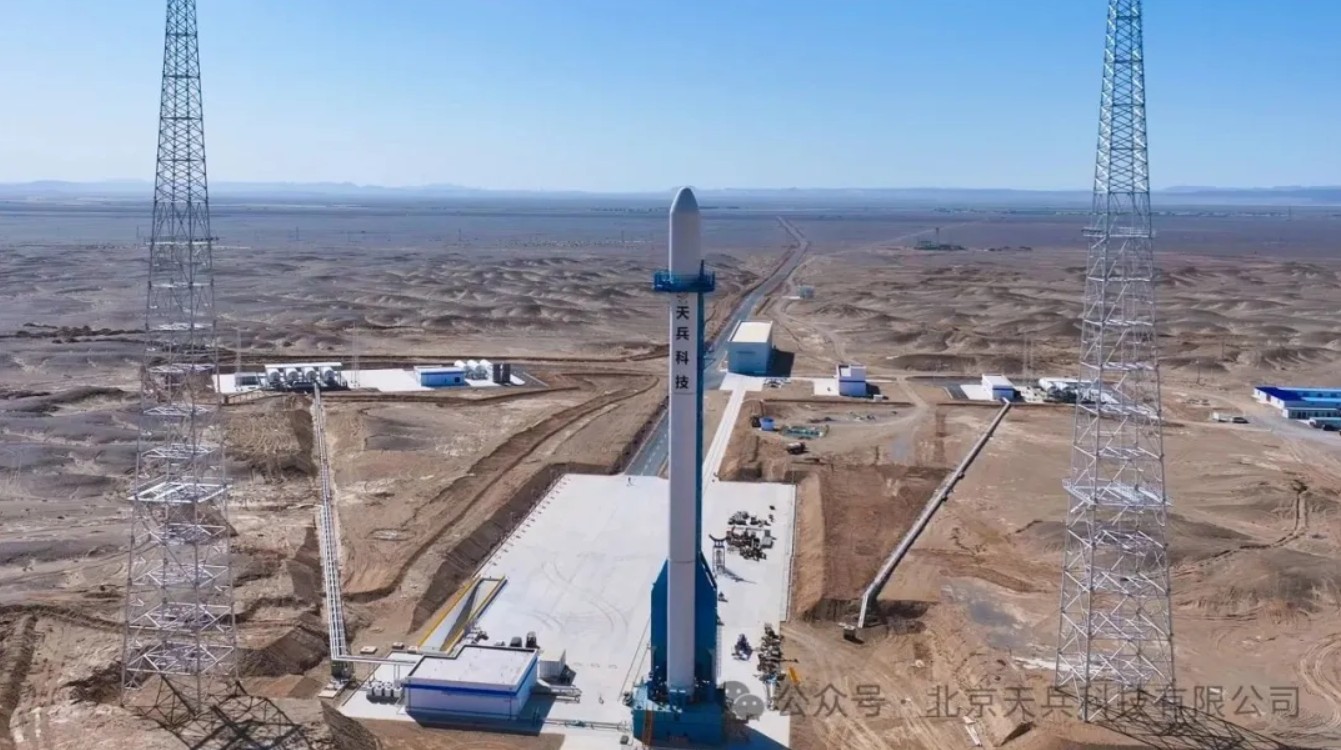

HELSINKI — The first launch of the Tianlong-3 rocket from Chinese commercial firm Space Pioneer failed Friday after suffering an anomaly in its ascent phase.
The Tianlong-3 lifted off at 12:17 a.m. Eastern (0417 UTC) April 3 from the Dongfeng Commercial Aerospace Innovation Test Zone at the Jiuquan Satellite Launch Center. Amateur footage shared on Chinese social media captured the event, showing apparent issues during the ascent.
State media Xinhua confirmed the failure with a short text report a few hours after liftoff. The specific cause is under further analysis and investigation, the report stated.
A later statement from Space Pioneer included an apology to its partners and all sectors of society who care about the development of commercial spaceflight. The company stated it would work to ensure the complete success of subsequent launch missions. The company did not disclose whether any payloads were lost.
Tianlong-3 is a 72-meter-long, 3.8-meter-diameter, two-stage launch vehicle using a kerosene-liquid oxygen propellant mix. Designed for partial reusability, it is intended to be comparable to SpaceX’s Falcon 9. It is capable of carrying 17-22,000 kilograms to low Earth orbit, or 10-17,000 kg to a 500-kilometer sun-synchronous orbit. The first stage is powered by nine Tianhuo-12 variable thrust engines.
Saturday’s failure follows nearly two years after a near-disastrous event in June 2024, when a static fire test of the Tianlong-3 first stage saw the stage unintentionally lift off after escaping its clamps, flying a short distance before crashing into a nearby hillside and exploding. The incident prompted a review of regulations for the commercial launch sector and forced a redesign of the first stage and a significant delay for the Tianlong-3.
In July 2025, Space Pioneer completed the launch pad for Tianlong-3 at Dongfeng Commercial Aerospace Innovation Test Zone and completed a successful static fire of the redesigned first stage. It was among a number of new, potentially recoverable rockets developed by commercial and state entities then preparing for debut flights, including the Zhuque-3 and Long March 12A, both of which successfully reached orbit but failed with first stage recovery attempts in December.
Space Pioneer announced funding rounds totalling around $350 million in October 2025 to support the Tianlong-3 and next-generation launch vehicle and engine development. The company also developed the Tianlong-2 kerosene-liquid oxygen rocket which reached orbit on its solitary flight in April 2023.
The launch was China’s 19th orbital launch attempt of 2026, and the third failure. It follows the successful debut flight of CAS Space’s Kinetica-2 kerolox rocket March 30 carrying a prototype cargo spacecraft. The two previous failures occurred in mid-January, with the loss of the first Ceres-2 solid rocket, while a Long March 3B rocket suffered a third stage anomaly.
China is targeting around 140 launches in 2026, according to a commercial space executive. Notable activities will include numerous constellation launches, tests related to China’s crewed lunar program, human spaceflight missions to Tiangong space station, and the Chang’e-7 lunar landing mission.










Related Posts
Stay Informed With the Latest & Most Important News




Advertisement
-
 01Two Black Holes Observed Circling Each Other for the First Time
 -
 02From Polymerization-Enabled Folding and Assembly to Chemical Evolution: Key Processes for Emergence of Functional Polymers in the Origin of Life
 -
 03Astronomy 101: From the Sun and Moon to Wormholes and Warp Drive, Key Theories, Discoveries, and Facts about the Universe (The Adams 101 Series)
 -
 04True Anomaly hires former York Space executive as chief operating officer
 -
 05Φsat-2 begins science phase for AI Earth images
 -
 06Hurricane forecasters are losing 3 key satellites ahead of peak storm season − a meteorologist explains why it matters
 -
 07Binary star systems are complex astronomical objects − a new AI approach could pin down their properties quickly