
Now Reading: China’s Kinetica-2 rocket debuts successfully, sending prototype cargo spacecraft to orbit
-
01
China’s Kinetica-2 rocket debuts successfully, sending prototype cargo spacecraft to orbit

China’s Kinetica-2 rocket debuts successfully, sending prototype cargo spacecraft to orbit

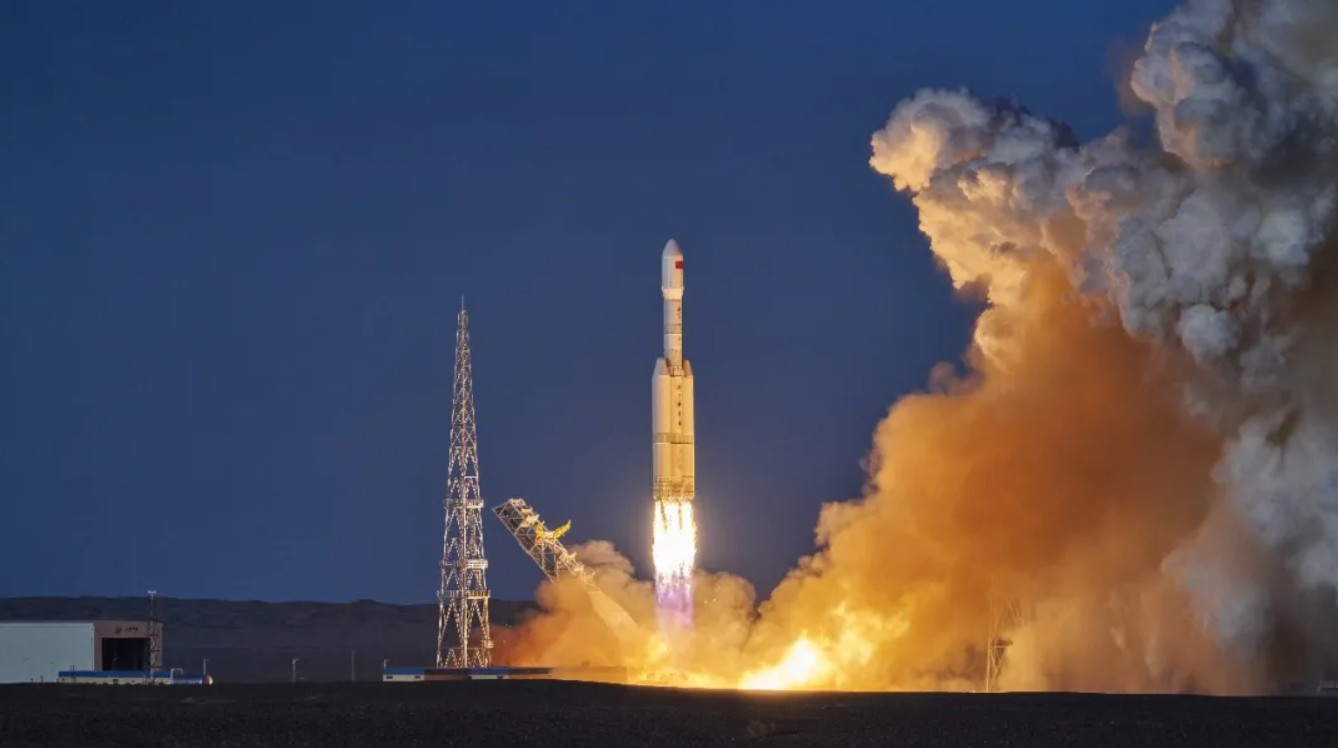

HELSINKI — Chinese firm CAS Space successfully reached orbit with the first launch of its Kinetica-2 launch vehicle Monday, with a prototype cargo spacecraft among the payloads.
The Kinetica-2 (Lijian-2) lifted off at 7:00 a.m. Eastern (1100 UTC) March 30 from the Dongfeng Commercial Aerospace Innovation Test Zone at Jiuquan Satellite Launch Center. CAS Space declared the mission a complete success, stating that the flight “served the country’s major strategies and major engineering projects.”
The successful launch is a new milestone in a broader effort by China to develop low-cost, high-cadence and potentially reusable rockets to boost its access to space and help construct major on-orbit infrastructure projects. It is also a step forward for low-cost cargo missions to the Tiangong space station.
Aboard the debut flight were the New Journey-01 and 02 (Xinzhengcheng-01 and 02) spacecraft and the TS-01, described in state media as an educational satellite. Airspace closure notices indicate a near-polar orbit for the three spacecraft.
New Journey-02 is a 4,200-kilogram prototype of the Qingzhou-1 spacecraft, which is one of two low-cost space station resupply spacecraft being developed under a program initiated by China’s human spaceflight agency, CMSEO, to support Tiangong. The spacecraft carries 27 experimental payloads totaling 1,020 kg, according to Global Times, and has a design lifetime of up to three years in orbit.
The prototype was developed by the Innovation Academy for Microsatellites of the Chinese Academy of Sciences (IAMCAS). It is a prelude to the launch of the full Qingzhou-1 cargo spacecraft, expected within a year.
New Journey-01 is described as a mini space lab, developed by a CAS-affiliated commercial entity using tech developed by CAS’s Aerospace Information Research Institute (AIRSAT). It carries multi-angle imaging cameras and a mini-space capsule with a porthole, and will conduct multiple on-orbit verifications based on commercial off-the-shelf devices.
Kinetica-2 is a 53-meter-long launcher with a 3.35m-diameter universal core stage. The core and boosters each use three YF‑102 kerosene-liquid oxygen engines developed by state-owned space giant CASC. It is designed to carry up to 12,000 kilograms to low Earth orbit or around 8,000 kg to a 500-kilometer-altitude sun-synchronous orbit, with plans for reusability.
The launch was also China’s first of a common booster core design rocket. This modularized approach, CAS Space states, is part of plans for different configuration bundles of 0, 2 and 4 boosters, allowing payload capacities of between 2-20,000 kilograms to low Earth orbit. CAS Space is also working on a clustered booster recovery system for the series. The Kinetica-2 can also be used in combination with the new Lixun-1 upper stage which will allow access to higher orbits, such as a geostationary transfer orbit.
The rocket will support various scientific experimental satellite missions, as well as low-cost cargo transport and low Earth orbit satellite constellation deployment, according to CAS Space. Contracts for the construction of the Guowang and Thousand Sails megaconstellations are expected to drive demand for launch services, benefiting vehicles such as Kinetica-2. The emergence of these projects has also coincided with increasing payload capacity of planned rockets as well as growing funding for these startups.
CAS Space is affiliated with the Chinese Academy of Sciences. It already operates the solid Kinetica-1 rocket and is working on a suborbital tourism business with its Lihong-1. The company conducted a first suborbital launch and capsule landing test in January and is also planning for an IPO.
The Kinetica-2 mission followed the launch of the classified Shiyan-33 spacecraft, part of an opaque, experimental Chinese satellite series.
A Long March 2C with a YZ-1S upper stage lifted off at 12:11 a.m. Eastern (0411 UTC) March 27 from Jiuquan. Chinese state media described the mission tersely as for scientific experiments in space environment exploration.
The spacecraft was later tracked in a 495 by 505-km 97-degree inclination orbit by the U.S. Space Force. The Long March 2C and Kinetica-2 launches were China’s 17th and 18th orbital launch attempts of 2026.
Airspace closure notices suggest a possible first flight of the Tianlong-3 April 2 from Jiuquan by commercial launch firm Space Pioneer. If confirmed, the launch attempt will come almost two years after a near-disastrous first stage static fire test that climbed from its test facilities and crashed into a mountainside.










Related Posts
Stay Informed With the Latest & Most Important News
Previous Post
Next Post


Advertisement
-
 01Two Black Holes Observed Circling Each Other for the First Time
 -
 02From Polymerization-Enabled Folding and Assembly to Chemical Evolution: Key Processes for Emergence of Functional Polymers in the Origin of Life
 -
 03Astronomy 101: From the Sun and Moon to Wormholes and Warp Drive, Key Theories, Discoveries, and Facts about the Universe (The Adams 101 Series)
 -
 04True Anomaly hires former York Space executive as chief operating officer
 -
 05Φsat-2 begins science phase for AI Earth images
 -
 06Hurricane forecasters are losing 3 key satellites ahead of peak storm season − a meteorologist explains why it matters
 -
 07Binary star systems are complex astronomical objects − a new AI approach could pin down their properties quickly