
Now Reading: China’s Tianwen-2 probe operating normally on approach to asteroid
-
01
China’s Tianwen-2 probe operating normally on approach to asteroid



HELSINKI — China’s Tianwen-2 spacecraft is operating normally on its way to a near-Earth asteroid ahead of sampling later this year, according to a rare official update.
Tianwen-2 launched May 28 last year, embarking on a voyage to the near-Earth asteroid 469219 Kamoʻoalewa (2016 HO3). The spacecraft is charged with both studying and sampling the asteroid and delivering material to Earth, before then heading to a main belt comet.
An update from Zhou Jishi of the China National Space Administration’s (CNSA) Lunar Exploration and Space Engineering Center Feb. 9 at the UNCOPUOS Scientific and Technical Subcommittee in Vienna, Austria, states that Tianwen-2 is “currently operating in orbit with normal performance.” Tianwen-2 is currently in a heliocentric transfer trajectory.
Zhou did not reveal when Tianwen-2 would arrive at Kamoʻoalewa, but stated that the spacecraft is scheduled to deliver collected samples to Earth by the “end of November 2027.” This does however suggest Tianwen-2 will reach the asteroid in the coming months, ahead of the beginning of a campaign to study the rocky body from various altitudes and collecting samples.
The timeframe for Tianwen-2’s return to Earth and delivery of samples does, however, appear consistent with a timeline shared on Chinese social media a month ahead of launch of the spacecraft. That timeline suggests arrival at Kamoʻoalewa in early July 2026.
Zhou stated that close proximity investigations will be carried out at various altitudes, gradually descending, from 20 kilometers, 3 km, 600 meters and down to 300 m from the asteroid’s surface. Tianwen-2 carries a suite of 11 science payloads for studying both Kamoʻoalewa and its later target, the comet 311P/PANSTARRS, including cameras, laser ranging, spectrometers, radar and particle analyzers. It also carries the DIANA dust analyzer from Italy.
Tianwen-2 will, partly because of the unknown nature of the asteroid and its surface mechanics, use three different sampling techniques, providing high levels of redundancy. These are hovering sampling, touch-and-go, and anchoring and attachment sampling. After delivering samples to Earth in late 2027, the spacecraft will use the planet’s gravity to send it on a course for main-belt comet 311P/PANSTARRS, arriving in 2034.
Zhou noted that Tianwen-2 is challenging as it is targeting a poorly characterized, microgravity small body, preventing a natural orbit, while the asteroid’s shape and rotation is also unknown, though it is thought Kamoʻoalewa is rotating rapidly, making sampling more challenging.
Kamoʻoalewa itself is of particular scientific interest due in part to uncertainty over its origin. While it is classified as a near-Earth asteroid, recent studies have suggested it could instead consist of material ejected from the moon, potentially linking it to a relatively young lunar crater. Other research points to a more conventional origin in the main asteroid belt, with subsequent migration towards Earth. Tianwen-2 samples could resolve this question.
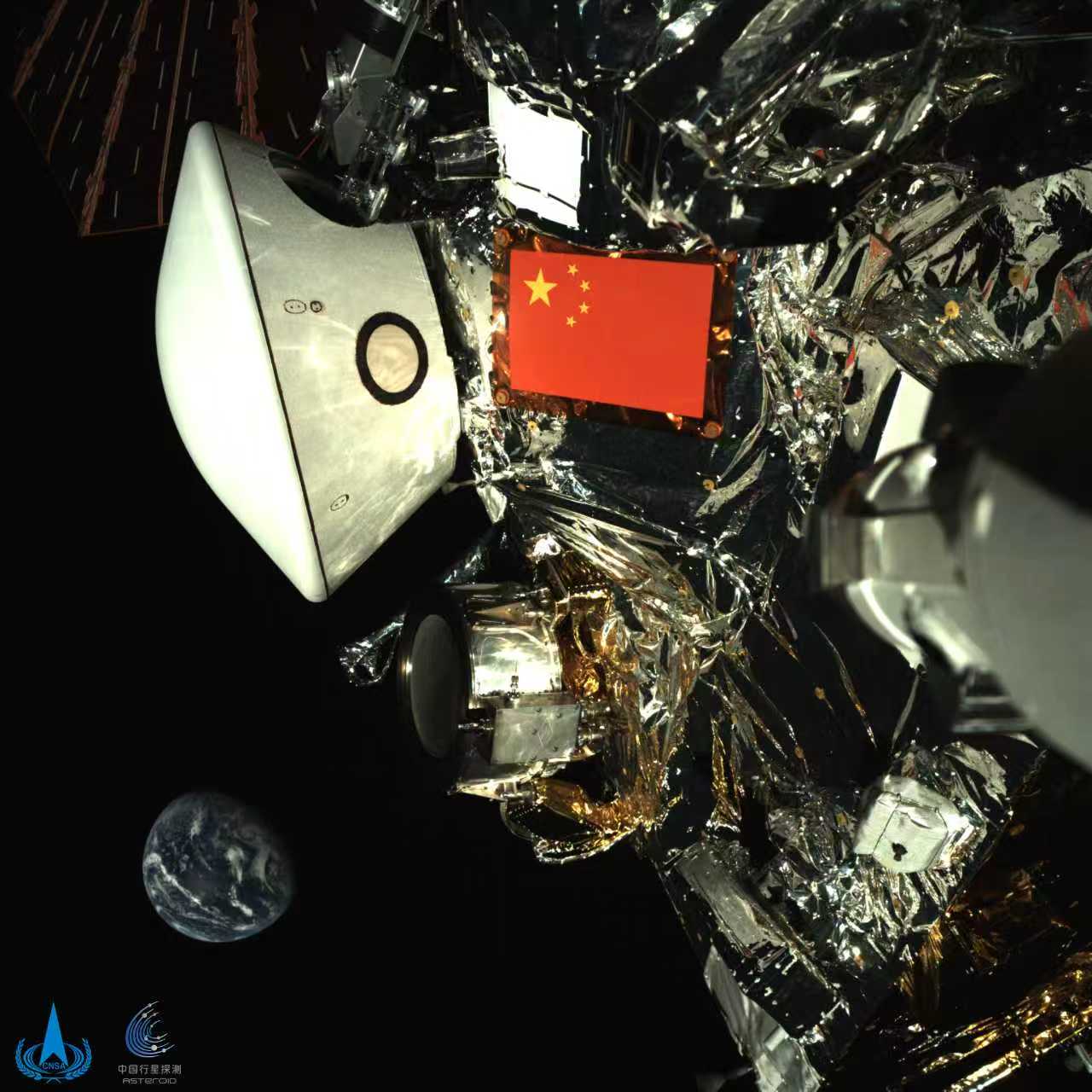
Official updates on the mission have been sparse. CNSA provided an early cruise phase update, revealing an image of one of the spacecraft’s two circular solar arrays, and a further image release Oct. 1, timed to National Day of the People’s Republic of China, with the image taken by monitoring camera mounted on the probe’s robotic arm, showing a first image of the spacecraft body and a prominent Chinese national flag, with the Earth in the background. CNSA has not provided information on trajectory corrections as it had done with the Tianwen-1 Mars mission and some Chang’e lunar missions.
Zhou also reiterated the goals of China’s wider Tianwen program, apparently confirming that the Tianwen-3 and Tianwen-4 missions remain on schedule. Tianwen-3 is a Mars sample return mission scheduled to launch in late 2028, with separate Long March 5 launch vehicles sending lander and ascender and orbiter and return spacecraft stacks towards Mars.
Tianwen-4 will target the Jupiter system, launching around 2030 and using a Venus gravity assist and two Earth flybys to head for Jupiter. The spacecraft will orbit Jupiter and study various moons before later entering into orbit around the Galilean moon Callisto.










Related Posts
Stay Informed With the Latest & Most Important News
Previous Post
Next Post





Advertisement
-
 01Two Black Holes Observed Circling Each Other for the First Time
 -
 02From Polymerization-Enabled Folding and Assembly to Chemical Evolution: Key Processes for Emergence of Functional Polymers in the Origin of Life
 -
 03Astronomy 101: From the Sun and Moon to Wormholes and Warp Drive, Key Theories, Discoveries, and Facts about the Universe (The Adams 101 Series)
 -
 04True Anomaly hires former York Space executive as chief operating officer
 -
 05Φsat-2 begins science phase for AI Earth images
 -
 06Hurricane forecasters are losing 3 key satellites ahead of peak storm season − a meteorologist explains why it matters
 -
 07Binary star systems are complex astronomical objects − a new AI approach could pin down their properties quickly