
Now Reading: Circumplanetary Disk Candidate In The Disk of HD 163296 Traced By Localized Emission From Simple Organics
-
01
Circumplanetary Disk Candidate In The Disk of HD 163296 Traced By Localized Emission From Simple Organics

Circumplanetary Disk Candidate In The Disk of HD 163296 Traced By Localized Emission From Simple Organics

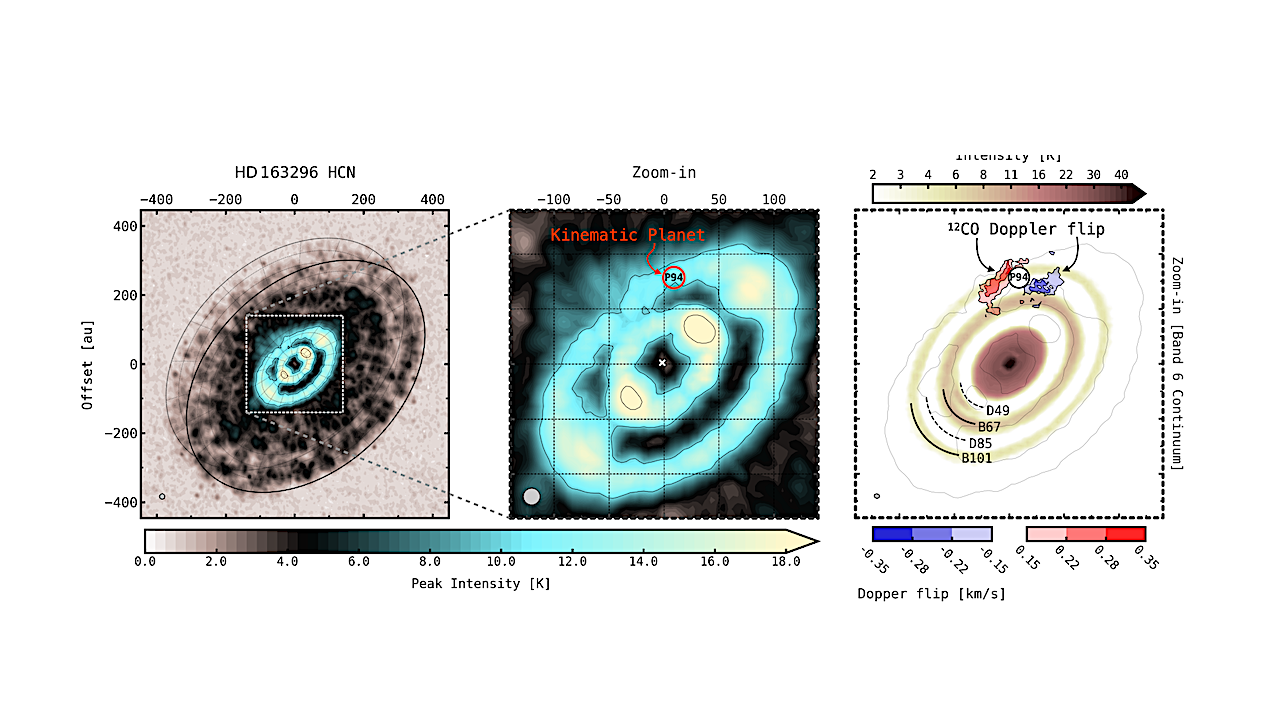
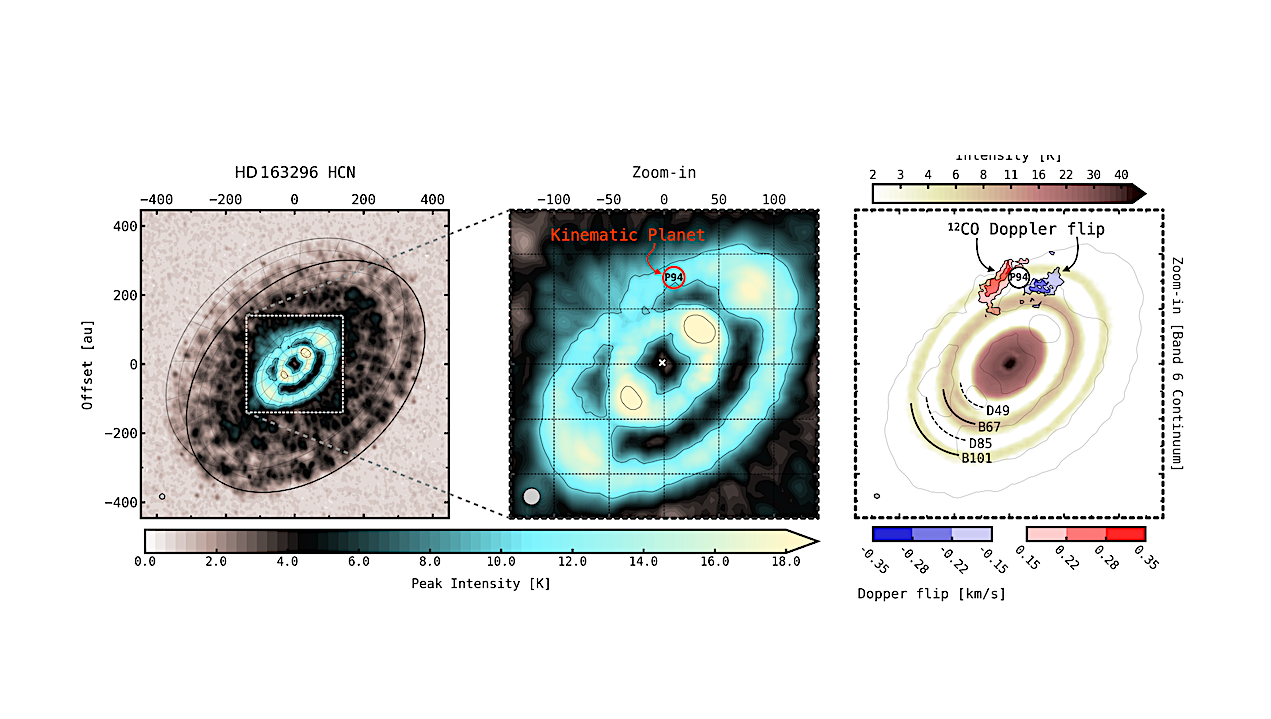
HCN and millimeter dust continuum emission from the disc of HD 163296 as observed with ALMA. The left panel shows the absolute peak intensity of HCN J = 3 → 2 line data from the MAPS project (Oberg et al. ¨ 2021), computed using the Rayleigh-Jeans approximation, while the middle panel provides a zoomed-in view of the central region. For the same section, the right panel displays the millimeter dust continuum emission from DSHARP (Andrews et al. 2018; Isella et al. 2018), with dashed and solid lines marking the radial locations of selected continuum gaps (DXX) and rings (BXX), respectively. Overlaid is the localised 12CO velocity perturbation identified by Izquierdo et al. (2022), along with contours of HCN emission at T = 10 K for reference. The circle labeled P94 marks the location of the planet candidate associated with this velocity feature, which we propose is also responsible for the localised intensity signals observed in the channel maps of HCN and C2H lines (see Sect. 3.2). — astro-ph.EP
Atacama Large Millimeter/submillimeter Array observations suggest that the disc of HD 163296 is being actively shaped by embedded, yet unseen protoplanets, as indicated by numerous gas and dust substructures consistent with planet-disc interaction models.
We report the first detection of simple organic molecules, HCN and C2H, tracing a candidate circumplanetary disc (CPD) in the HD 163296 system, located at an orbital radius of R=88±7 au and azimuth ϕ=46±3∘ (or R=0.75″, PA=350∘ in projected sky coordinates), and originating near the midplane of the circumstellar disc. The signature is localised but spectrally resolved, and it overlaps with a previously reported planet candidate, P94, identified through kinematic perturbations traced by CO lines.
We propose a scenario in which the observed chemical anomalies arise from increased heating driven by the forming planet and ongoing accretion through its CPD, facilitating the thermal desorption of species that would otherwise remain frozen out in the disc midplane, and potentially triggering the activation barriers of chemical reactions that lead to enhanced molecular production.
Based on a first-order dynamical analysis of the HCN spectrum from the CPD–isolated with a 7σ significance–we infer an upper limit on the planet mass of 1.8 MJup, consistent with predictions from CO kinematics and constraints from direct imaging studies. By comparing the CPD sizes derived from our models with theoretical expectations where the CPD radius corresponds to roughly one-third of the planet’s Hill radius, we favor CPD gas temperatures T>150 K, planet masses Mp<1.0 MJup, and CPD radii RCPD<2 au.
Andres F. Izquierdo, Jaehan Bae, Maria Galloway-Sprietsma, Ewine F. van Dishoeck, Stefano Facchini, Giovanni Rosotti, Jochen Stadler, Myriam Benisty, Leonardo Testi
Comments: 18 pages, 11 figures, 2 tables. Accepted for publication in ApJL
Subjects: Earth and Planetary Astrophysics (astro-ph.EP); Solar and Stellar Astrophysics (astro-ph.SR)
Cite as: arXiv:2601.10631 [astro-ph.EP] (or arXiv:2601.10631v1 [astro-ph.EP] for this version)
https://doi.org/10.48550/arXiv.2601.10631
Focus to learn more
Related DOI:
https://doi.org/10.3847/2041-8213/ae2f59
Focus to learn more
Submission history
From: Andres Izquierdo
[v1] Thu, 15 Jan 2026 17:50:13 UTC (12,023 KB)
https://arxiv.org/abs/2601.10631
Astrobiology, exoplanet,










Related Posts
Stay Informed With the Latest & Most Important News
Previous Post
Next Post


Advertisement
-
 01Two Black Holes Observed Circling Each Other for the First Time
 -
 02From Polymerization-Enabled Folding and Assembly to Chemical Evolution: Key Processes for Emergence of Functional Polymers in the Origin of Life
 -
 03Astronomy 101: From the Sun and Moon to Wormholes and Warp Drive, Key Theories, Discoveries, and Facts about the Universe (The Adams 101 Series)
 -
 04True Anomaly hires former York Space executive as chief operating officer
 -
 05Φsat-2 begins science phase for AI Earth images
 -
 06Hurricane forecasters are losing 3 key satellites ahead of peak storm season − a meteorologist explains why it matters
 -
 07Binary star systems are complex astronomical objects − a new AI approach could pin down their properties quickly