
Now Reading: Climate And Ocean Circulation Changes Toward A Modern Snowball Earth
-
01
Climate And Ocean Circulation Changes Toward A Modern Snowball Earth


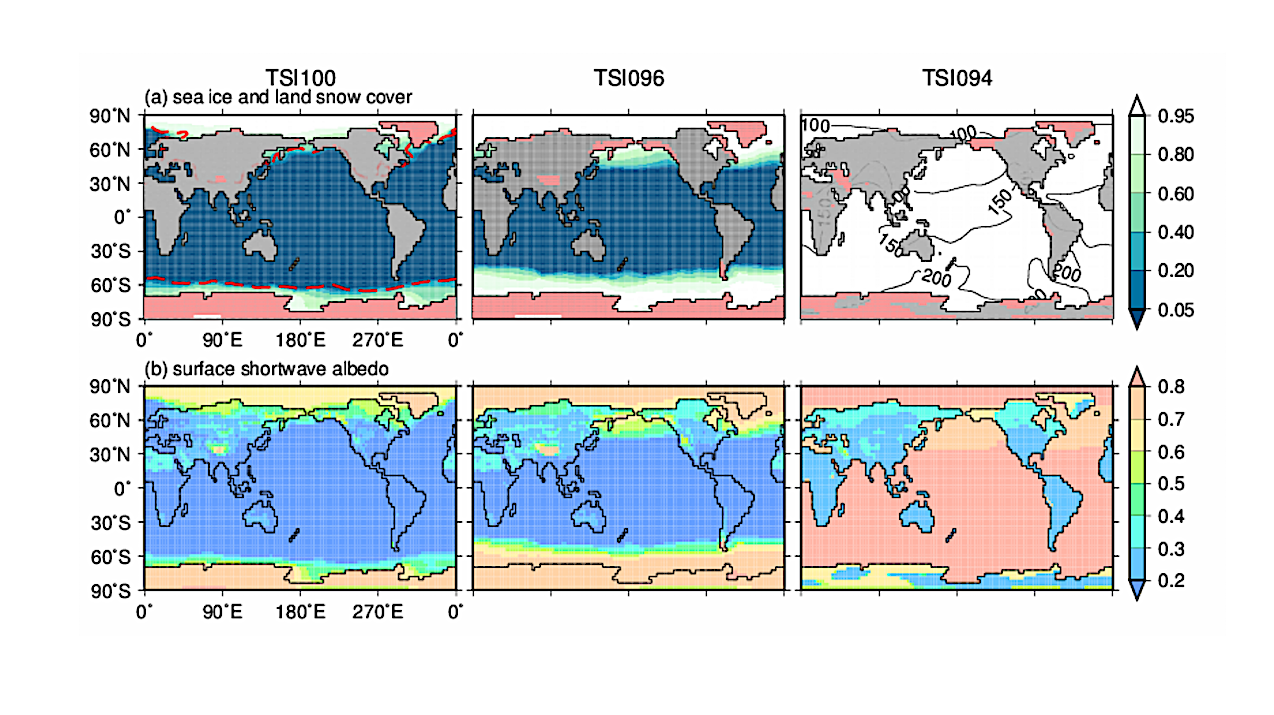
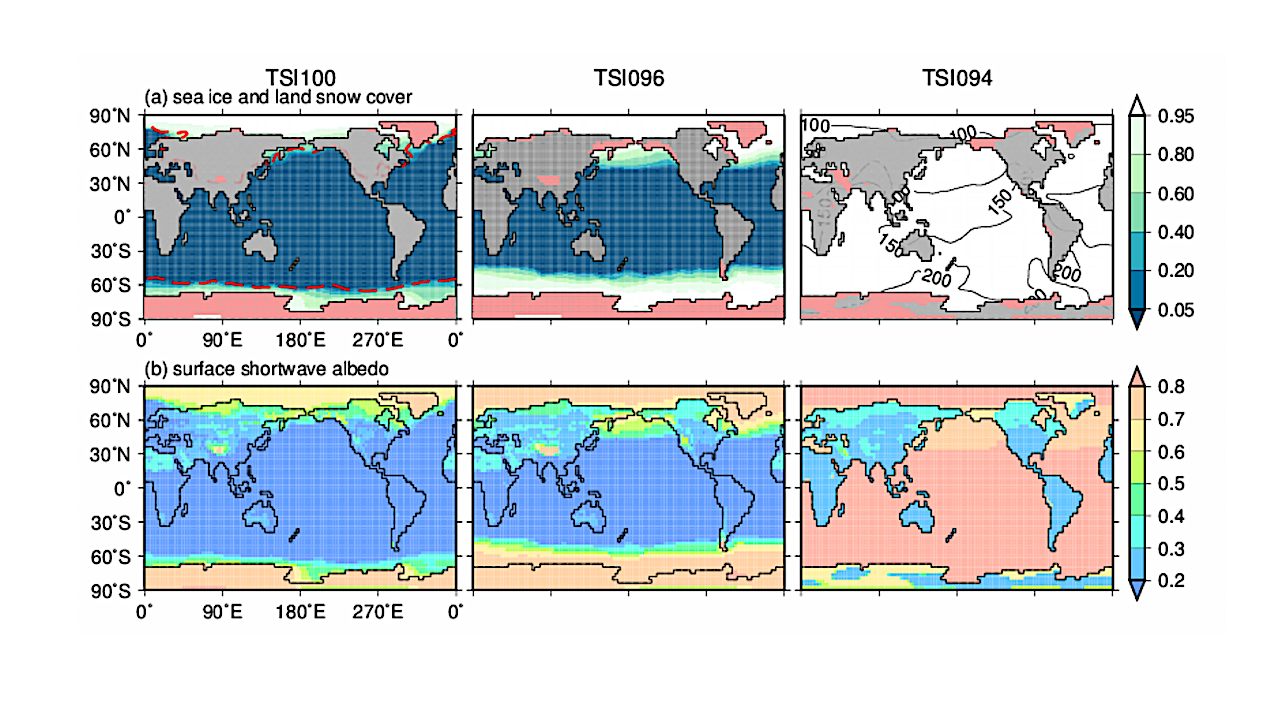
(a) Annual mean sea ice concentration and sea ice thickness at the end of the simulations. Red lines in TSI100 indicate the presentday winter sea ice edge (Hirahara et al., 2014), and the contour in TSI094 indicates the simulated annual mean sea ice thickness (unit: m).
The red shades on the land grid indicate that the monthly minimum snow depth exceeds 1 cm. (b) Annual mean surface shortwave albedo. — physics.geo-ph
It has been hypothesized that the Earth may have experienced snowball events in the past, during which its surface became completely covered with ice. Previous studies used general circulation models to investigate the onset and climate of such snowball events.
Using the MIROC4m coupled atmosphere–ocean climate model, this study examined the changes in the oceanic circulation during the onset of a modern snowball Earth and elucidated their evolution to steady states under the snowball climate.
Abruptly changing the solar constant to 94% of its present-day value caused the modern Earth climate to turn into a snowball state after ~1300 years and initiated rapid increase in sea ice thickness. During onset of the snowball, extensive sea ice formation and melting of sea ice in the mid-latitudes caused substantial freshening of surface waters and salinity stratification.
By contrast, such salinity stratification was absent if the duration between the change in the solar flux and the snowball onset was short. After snowball onset, the global sea ice cover and the buildup of salinity stratification caused drastic weakening in the deep ocean circulation.
However, the meridional overturning circulation resumed within several hundred years after the snowball onset because the density flux by sea ice production weakens the salinity stratification. While the evolution of the oceanic circulation would depend on the continental distribution and the evolution of continental ice sheets, our results highlight the gradual growth of sea ice and associated brine rejection are essential factors for the transient evolution of the oceanic circulation in the snowball events.
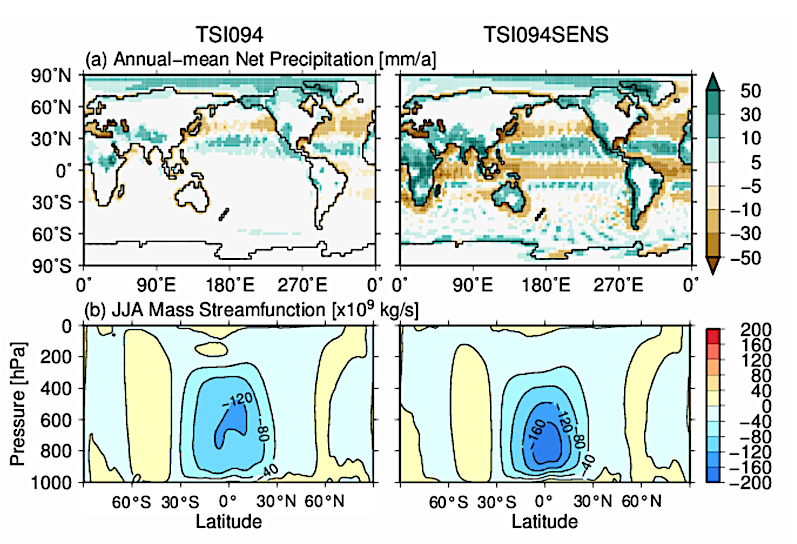
(a) Net precipitation, defined by precipitation minus evaporation (includes ice sublimation), (b) boreal summer meridional atmospheric mass streamfunction (109 kg/s, positive indicates clockwise circulation) in the TSI094 and TSI094SENS experiments. — physics.geo-ph
Takashi Obase, Takanori Kodama, Takao Kawasaki, Sam Sherriff-Tadano, Daisuke Takasuka, Ayako Abe-Ouchi, Masakazu Fujii
Comments: 23 pages, 12 figures, accepted for publication in Climate of the Past (CP)
Subjects: Geophysics (physics.geo-ph); Earth and Planetary Astrophysics (astro-ph.EP); Atmospheric and Oceanic Physics (physics.ao-ph)
Cite as: arXiv:2603.26700 [physics.geo-ph] (or arXiv:2603.26700v1 [physics.geo-ph] for this version)
https://doi.org/10.48550/arXiv.2603.26700
Focus to learn more
Submission history
From: Takanori Kodama
[v1] Tue, 17 Mar 2026 02:51:38 UTC (865 KB)
https://arxiv.org/abs/2603.26700
Astrobiology,










Related Posts
Stay Informed With the Latest & Most Important News


Advertisement
-
 01Two Black Holes Observed Circling Each Other for the First Time
 -
 02From Polymerization-Enabled Folding and Assembly to Chemical Evolution: Key Processes for Emergence of Functional Polymers in the Origin of Life
 -
 03Astronomy 101: From the Sun and Moon to Wormholes and Warp Drive, Key Theories, Discoveries, and Facts about the Universe (The Adams 101 Series)
 -
 04True Anomaly hires former York Space executive as chief operating officer
 -
 05Φsat-2 begins science phase for AI Earth images
 -
 06Hurricane forecasters are losing 3 key satellites ahead of peak storm season − a meteorologist explains why it matters
 -
 07Binary star systems are complex astronomical objects − a new AI approach could pin down their properties quickly