
Now Reading: Cloud-9: a new celestial object found by Hubble
-
01
Cloud-9: a new celestial object found by Hubble



05/01/2026
531 views
5 likes
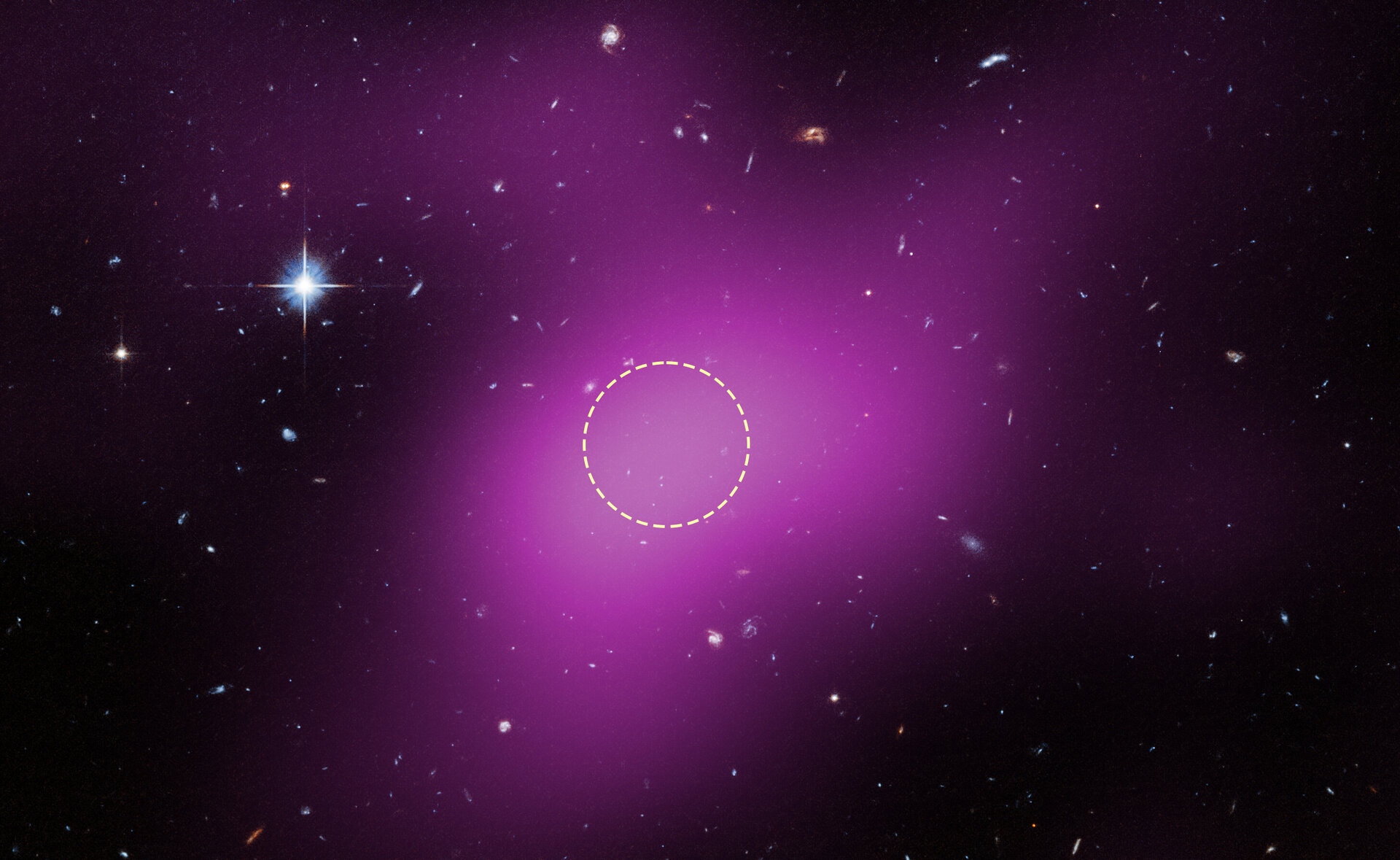
A team using the NASA/ESA Hubble Space Telescope has uncovered a new type of astronomical object – a starless, gas-rich, dark-matter cloud that is considered a ‘relic’ or remnant of early galaxy formation. Nicknamed ‘Cloud-9,’ this is the first confirmed detection of such an object in the Universe.
“This is a tale of a failed galaxy,” said the programme’s principal investigator, Alejandro Benitez-Llambay of the Milano-Bicocca University in Milan, Italy. “In science, we usually learn more from the failures than from the successes. In this case, seeing no stars is what proves the theory right. It tells us that we have found in the local Universe a primordial building block of a galaxy that hasn’t formed.”
“This cloud is a window into the dark Universe,” explained team member Andrew Fox of AURA/STScI for the European Space Agency. “We know from theory that most of the mass in the Universe is expected to be dark matter, but it’s difficult to detect this dark material because it doesn’t emit light. Cloud-9 gives us a rare look at a dark-matter-dominated cloud.”
The object is called a Reionization-Limited H I Cloud, or ‘RELHIC.’ The term ‘H I’ refers to neutral hydrogen, and ‘RELHIC’ describes a natal hydrogen cloud from the Universe’s early days, a fossil leftover that has not formed stars. For years, scientists have been looking for evidence of such a phantom object, which was proposed in theory. But only when they turned Hubble toward the cloud were they able to confirm that it is indeed starless.
“Before we used Hubble, you could argue that this is a faint dwarf galaxy that we could not see with ground-based telescopes. They just didn’t go deep enough in sensitivity to uncover stars,” explained lead author Gagandeep Anand of the Space Telescope Science Institute (STScI), Baltimore, USA. “But with Hubble’s Advanced Camera for Surveys, we’re able to nail down that there’s nothing there.”
The discovery of this relic cloud was a surprise. “Among our galactic neighbors, there might be a few abandoned houses out there,” said STScI’s Rachael Beaton, who is also on the research team.
RELHICs are thought to be dark matter clouds that were not able to accumulate enough gas to form stars. They represent a window into the early stages of galaxy formation. Cloud-9 suggests the existence of many other small, dark matter-dominated structures in the Universe – other failed galaxies. This discovery provides new insights into the dark components of the Universe that are difficult to study through traditional observations, which focus on bright objects like stars and galaxies.
5 billion solar masses
Scientists have been studying hydrogen clouds near the Milky Way for many years, and these clouds tend to be much bigger and irregular than Cloud-9. Compared with other observed clouds, Cloud-9 is smaller, more compact, and highly spherical, making it look very different from other clouds.
The core of this object is composed of neutral hydrogen and is about 4900 light-years in diameter. The hydrogen gas in Cloud-9 is approximately 1 million times the mass of the Sun. But if the pressure of the gas is balancing the gravity of the dark matter cloud, which it appears to be, Cloud-9 must be heavily dominated by dark matter, at about 5 billion solar masses.
Cloud-9 is an example of the structures and the mysteries that don’t involve stars. Just looking at stars doesn’t give the full picture. Studying the gas and dark matter helps provide a more complete understanding of what’s going on in these systems that otherwise wouldn’t be known.
Observationally, identifying these failed galaxies is challenging because nearby objects outshine them. Such systems are also vulnerable to environmental effects like ram-pressure stripping, which can remove gas as the cloud moves through intergalactic space. These factors further reduce their expected numbers.
Failed galaxy
Cloud-9 was discovered three years ago as part of a radio survey by the Five-hundred-meter Aperture Spherical Telescope (FAST) in Guizhou, China, a finding later confirmed by the Green Bank Telescope and the Very Large Array facilities in the United States. Unlike in Western hemisphere culture, the moniker ‘Cloud-9’ has no significance for the Chinese. It was simply named sequentially, having been the ninth gas cloud identified on the outskirts of a nearby spiral galaxy, Messier 94 (M94).
The cloud is close to M94 and appears to have a physical association with the galaxy. High-resolution radio data shows slight gas distortions, possibly indicating interaction between the cloud and galaxy.
Cloud-9 may eventually form a galaxy in the future, depending on if it grows more massive. If it were much bigger, it would have collapsed, formed stars, and become a galaxy that would be no different than any other galaxy we see. If it were much smaller, the gas could have been dispersed and ionized and there wouldn’t be much left. But it’s in a sweet spot where it could also still remain as a RELHIC.
This finding furthers the understanding of galaxy formation, the early Universe, and the nature of dark matter itself. The lack of stars in this object provides a unique window into the intrinsic properties of dark matter clouds. The rarity of such objects and the potential for future surveys is expected to enhance the discovery of more of these ‘failed galaxies’ or ‘relics,’ resulting in insights into the early Universe and the physics of dark matter.
This result has been published in The Astrophysical Journal Letters.
More information
The Hubble Space Telescope is a project of international cooperation between ESA and NASA.
Links










Related Posts
Stay Informed With the Latest & Most Important News
Previous Post
Next Post



Advertisement
-
 01Two Black Holes Observed Circling Each Other for the First Time
 -
 02From Polymerization-Enabled Folding and Assembly to Chemical Evolution: Key Processes for Emergence of Functional Polymers in the Origin of Life
 -
 03Astronomy 101: From the Sun and Moon to Wormholes and Warp Drive, Key Theories, Discoveries, and Facts about the Universe (The Adams 101 Series)
 -
 04True Anomaly hires former York Space executive as chief operating officer
 -
 05Φsat-2 begins science phase for AI Earth images
 -
 06Hurricane forecasters are losing 3 key satellites ahead of peak storm season − a meteorologist explains why it matters
 -
 07Binary star systems are complex astronomical objects − a new AI approach could pin down their properties quickly