
Now Reading: Cold And Eccentric: A High-spectral Resolution View Of 51 Eri b With VLT/HiRISE
-
01
Cold And Eccentric: A High-spectral Resolution View Of 51 Eri b With VLT/HiRISE


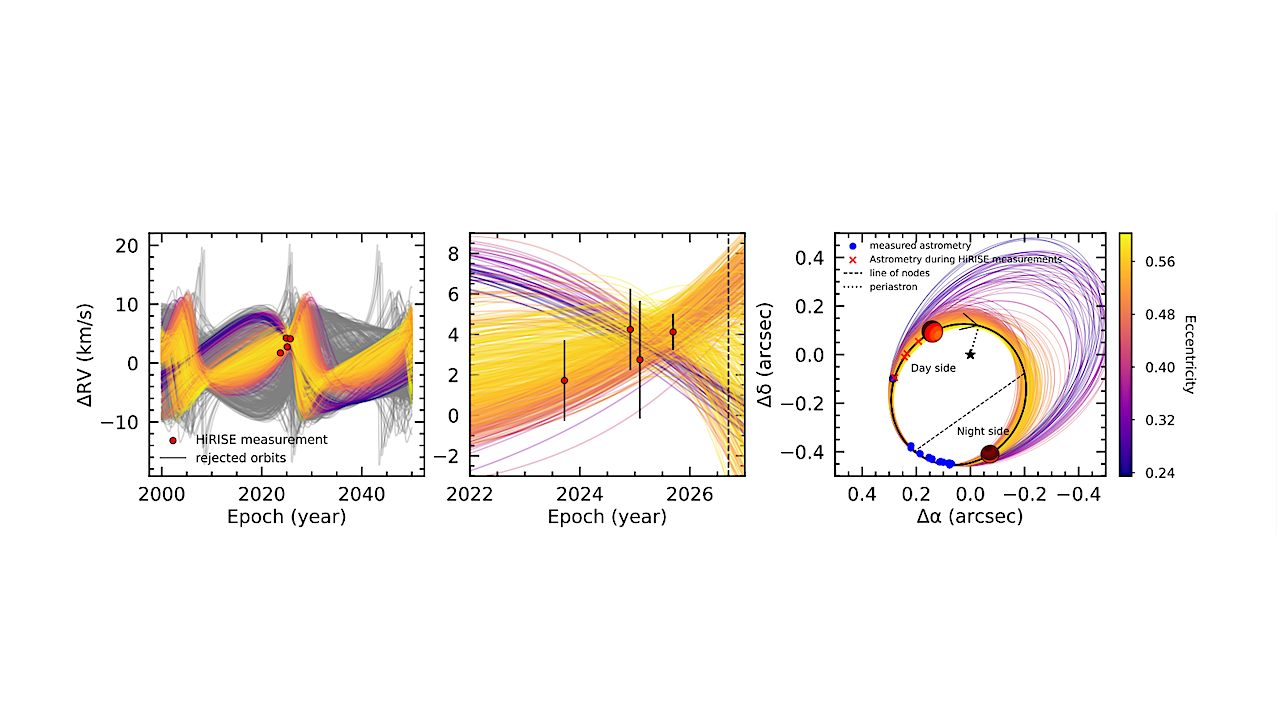

Orbit of 51 Eri b. The left panel shows the predicted RV of the planet as a function of time. The HiRISE RV measurements are overplotted as red dots, along with the rejected orbits in grey from the addition of the RV measurements. The middle panel is a zoomed-in version of the left panel around our RV measurements. In particular, we see that a future RV measurement at the end of 2026 should enable us to reject the last low-eccentric orbital populations. This is illustrated by the dashed vertical line overplotted at the end of 2026. The right panel displays the astrometric orbit of the planet inferred, including the line of nodes and the phase of the planet. The red crosses represent the estimate of the position of the planet during the HiRISE observations. — astro-ph.EP
Discovered almost 10 years ago, the giant planet 51 Eridani b is one of the least separated (0.2 arcsec) and faintest (J = 19.74 mag) directly imaged exoplanets known to date.
Its atmospheric properties have been thoroughly investigated through low- and medium-resolution spectroscopic observations, enabling robust characterization of the planet’s bulk parameters.
However, the planet’s intrinsically high contrast renders high-resolution spectroscopic observations difficult, despite their potential to yield key measurements essential for a more comprehensive characterization. This study seeks to constrain the planet’s radial velocity, enabling a full 3D orbital solution when integrated with previous measurements.
We have obtained 4 high-contrast high-resolution (R = 140000) spectroscopic datasets of the planet, collected over a two-year interval with the HiRISE visitor instrument at the VLT to derive the planet’s radial velocity. Using self-consistent models of atmosphere, we were able to derive the radial velocity of the planet at each of the 4 epochs. These radial velocity measurements were then used in combination with all existing relative astrometry in order to constrain the orbit of the planet.
Our radial velocity measurements allow us to break the degeneracy along the line of sight, making it now possible the unambiguous interpretation of the phase curve of the companion. We further constrain the orbital parameters, particularly the eccentricity, for which we derive e = 0.55 (-0.07, +0.03).
The relatively high eccentricity indicates that the system has experienced dynamical interactions induced by an external perturber. We place constraints on the mass and semi-major axis of a hypothetical, unseen outer planet capable of producing the observed high eccentricities.
A. Denis, A. Vigan, G. Chauvin, A. Lacquement, H. Beust, M. Ravet, J. Costes, A. Radcliffe, S. Martos, W. Balmer, T. Stolkern, P. Palma Bifani, B. Rajpoot, A. Simonnin, S. Petrus, T. Forveille, M. Janson, A. Reiners, N. Godoy, D. Cont, L. Nortmann, K. Hoy, A. Zurlo, H. Anwand-Heerwart, Y. Charles, A. Costille, M. El Morsy, J. Garcia, M. Houllé, M. Lopez, G. Murray, E. Muslimov, G.P.P.L. Otten, J. Paufique, M. Phillips, U. Seemann, A. Viret, G. Zins
Comments: 9 pages, 8 figures, Accepted for publication in A&A
Subjects: Earth and Planetary Astrophysics (astro-ph.EP)
Cite as: arXiv:2602.10260 [astro-ph.EP] (or arXiv:2602.10260v1 [astro-ph.EP] for this version)
https://doi.org/10.48550/arXiv.2602.10260
Focus to learn more
Submission history
From: Allan Denis
[v1] Tue, 10 Feb 2026 20:05:05 UTC (3,121 KB)
https://arxiv.org/abs/2602.10260
Astrobiology,










Related Posts

Stay Informed With the Latest & Most Important News

Advertisement
-
 01Two Black Holes Observed Circling Each Other for the First Time
 -
 02From Polymerization-Enabled Folding and Assembly to Chemical Evolution: Key Processes for Emergence of Functional Polymers in the Origin of Life
 -
 03Astronomy 101: From the Sun and Moon to Wormholes and Warp Drive, Key Theories, Discoveries, and Facts about the Universe (The Adams 101 Series)
 -
 04True Anomaly hires former York Space executive as chief operating officer
 -
 05Φsat-2 begins science phase for AI Earth images
 -
 06Hurricane forecasters are losing 3 key satellites ahead of peak storm season − a meteorologist explains why it matters
 -
 07Binary star systems are complex astronomical objects − a new AI approach could pin down their properties quickly