
Now Reading: Colliding space debris produces radio bursts, raising prospect of ‘debris weather’ alerts
-
01
Colliding space debris produces radio bursts, raising prospect of ‘debris weather’ alerts

Colliding space debris produces radio bursts, raising prospect of ‘debris weather’ alerts

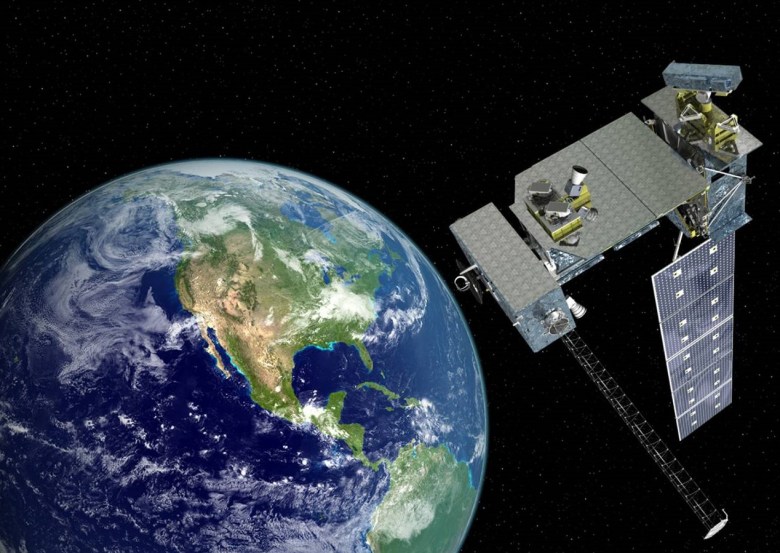
GOLDEN, CO — A university team has found that small orbital debris could emit radio bursts as they collide or approach each other in space. The signal can be detected with large radio dishes on Earth, as well as satellites in orbit.
This new intelligence agency-funded research is focused on gauging the interaction of orbital debris with the surrounding space environment. Scientists made use of non-thermal electromagnetic radiation, thermal and light scattering signals emitted by hypervelocity collisions of space debris with each other and with meteoroids. It opens up the possibility of tracking orbital debris that’s otherwise too small to monitor with today’s technology, and also gives researchers a way to characterize the space debris and detect the formation of clouds of debris fragments.
One aim of the research is to help monitor the onset of Kessler syndrome — a chain reaction of collisions in space that, in turn, generates more space debris, making it far harder for satellite operators to navigate around and avoid hazardous clouds of high-speed rubble.
The work on using hypervelocity impact signals to track and characterize space debris, which has not yet been published in an academic journal,was led by Nilton Rennó, a professor of climate and space sciences and engineering at the University of Michigan in Ann Arbor. The paper was to be presented in October at the National Reconnaissance Office Forum for Innovative Research in Science & Technology conference. That meeting was canceled due to the recent government shutdown, to be rescheduled.
New measurements
The novel approach to help chart where small debris collisions are recurrent is being backed by new measurements with the Deep Space Network (DSN) in collaboration with the Jet Propulsion Laboratory, Rennó told SpaceNews.
Rennó explained that the team is also using signal data of debris and meteoroid collisions gathered in geostationary orbit by theDefense Department’s STPSat-6.
Launched in December 2021 for the U.S. Department of Defense Space Test Program, STPSat-6 was built by Northrop Grumman to deliver operational Nuclear Detonation (NUDET) detection capabilities.

Transition to potential users
Rennó said the study is currently in the third year of support by the Intelligence Advanced Research Projects Activity’s (IARPA) Space Debris Identification and Tracking (SINTRA) program. IARPA is a research and development arm of the Office of the Director of National Intelligence.
Rennó explained that the team is now beginning to focus on making the research practical and available to potential users.
“Our IARPA-funded project has been maturing the concept that electromagnetic radiation generated by debris colliding at hypervelocity, defined as a speed larger than that of sound on the debris, can be used to remotely detect, characterize and track currently non-trackable orbital space debris from the ground or from orbit,” Rennó said.
Distribution of tiny fragments
“The vast majority of space debris are too small to see with current systems, but still energetic enough to pose serious hazards to functioning satellites,” said team member Yun Zhang, an assistant research scientist at the University of Michigan’s Department of Climate and Space Sciences and Engineering.
“What makes this approach unique is its ability to address this small debris population, Zhang told SpaceNews. “Our method uses the electromagnetic signals from debris collisions to reveal the distribution of these tiny fragments that would otherwise be impossible to find.”
Zhang said the work mimics trying to see an unlit match 10 feet away on a dark night: you know it’s there, but you can’t see it. The moment you strike the match, the flame makes it obvious.
“In the same way, the collision-generated signals briefly ‘light up’ the tiny debris in the sky so we can detect them remotely,” Zhang said.
Debris weather alerts
By remotely characterizing the radio signals from individual collisions and map regions of space where small-debris collisions are frequent, “we may be able to form a kind of real-time diagnostic of Earth’s orbital environment and issue ‘debris weather’ alerts to warn satellite operators when certain orbits are becoming unusually hazardous,” said Zhang, “even if individual debris are too small to track one by one.”
The prospect of making the “invisible” debris visible, “we give ourselves a much better chance of keeping that environment usable for future generations,” Zhang said.










Related Posts

Stay Informed With the Latest & Most Important News
Previous Post
Next Post

Advertisement
-
 01Two Black Holes Observed Circling Each Other for the First Time
 -
 02From Polymerization-Enabled Folding and Assembly to Chemical Evolution: Key Processes for Emergence of Functional Polymers in the Origin of Life
 -
 03Astronomy 101: From the Sun and Moon to Wormholes and Warp Drive, Key Theories, Discoveries, and Facts about the Universe (The Adams 101 Series)
 -
 04True Anomaly hires former York Space executive as chief operating officer
 -
 05Φsat-2 begins science phase for AI Earth images
 -
 06Hurricane forecasters are losing 3 key satellites ahead of peak storm season − a meteorologist explains why it matters
 -
 07Binary star systems are complex astronomical objects − a new AI approach could pin down their properties quickly