
Now Reading: Coma Volatile Composition And Thermal Physics In Comet C/2022 E3 (ZTF) Measured Near Closest Approach To Earth With NASA-IRTF
-
01
Coma Volatile Composition And Thermal Physics In Comet C/2022 E3 (ZTF) Measured Near Closest Approach To Earth With NASA-IRTF

Coma Volatile Composition And Thermal Physics In Comet C/2022 E3 (ZTF) Measured Near Closest Approach To Earth With NASA-IRTF

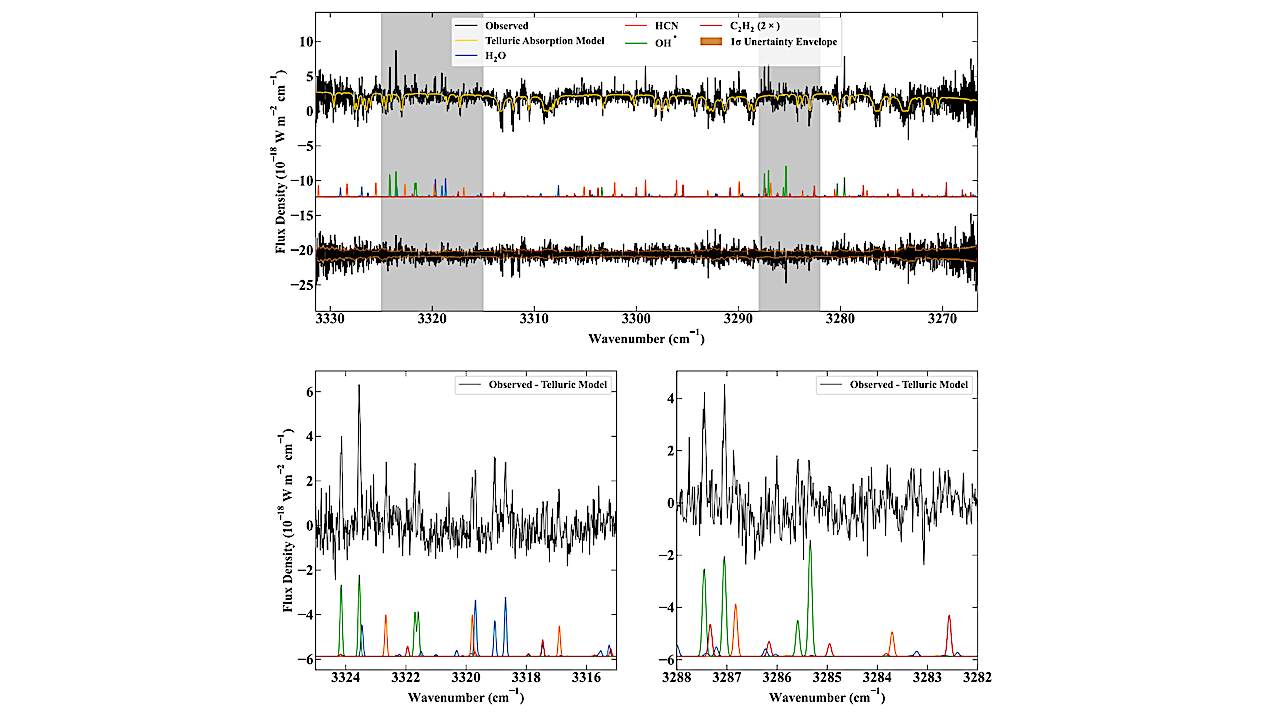
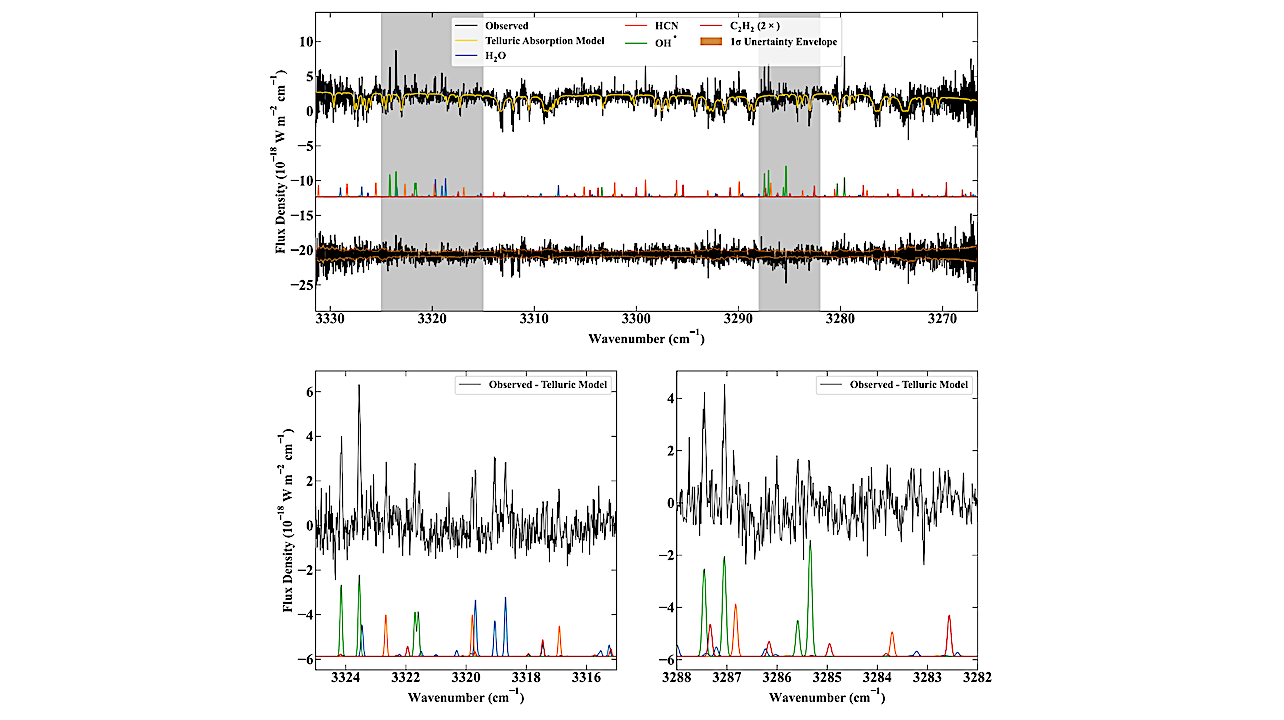
Upper. Detections of H2O, HCN, C2H2, and OH∗ in E3 covering iSHELL echelle order 170–172. The uppermost trace is the observed cometary spectrum with the telluric transmittance model superimposed. Below are individual molecular fluorescence models color-coded by species. The bottom trace shows the residual (cometary spectrum minus all models) with the 1σ uncertainty envelope overlaid and shaded. Lower. Zoomed plots covering the gray shaded regions indicated in the upper panel. In this case, the uppermost trace is the telluric-subtracted comet spectrum, with individual fluorescence models plotted below. We searched for NH2, a potentially confounding species in this spectral region, but did not detect it. Our 3σ upper limit is NH2/H2O 0.03%. — astro-ph.EP
The 2023 perihelion passage of comet C/2022 E3 (ZTF) afforded an opportunity to measure the abundances and spatial distributions of coma volatiles in an Oort cloud comet at high spatial resolution near its close approach to Earth (Δmin∼0.28 au on UT February 1).
We conducted near-infrared spectroscopic observations of C/2022 E3 (ZTF) using iSHELL at the NASA Infrared Telescope Facility on UT 2023 February 9. Our measurements securely detected fluorescent emission from H2O, CO, OCS, CH3OH, CH4, C2H6, C2H2, and HCN.
For each instrumental setting we took exposures with the slit oriented parallel and also perpendicular to the projected Sun-comet vector, thereby enabling a test of the spatial distributions of these molecules. We report rotational temperatures, production rates, and abundance ratios (i.e., mixing ratios) for all sampled species.
Our measurements found that molecular abundances in C/2022 E3 were depleted compared to their average values in Oort cloud comets with the exception of OCS, which was consistent. The H2O production rate varied significantly and was likely tied to nucleus rotation effects.
Measurements at the two slit orientations showed distinct column density and rotational temperature profiles for H2O. Peak temperatures occurred off-nucleus and slower cooling was present in the anti-sunward hemisphere, consistent with the presence of icy grain sublimation in the coma.
Nathan X. Roth, Michael A. DiSanti, Boncho P. Bonev, Neil Dello Russo, Erika L. Gibb, Ronald J. Vervack Jr., Mohammad Saki, Adam J. McKay, Hideyo Kawakita, Stefanie N. Milam, Martin A. Cordiner, K. D. Foster
Subjects: Earth and Planetary Astrophysics (astro-ph.EP)
Cite as: arXiv:2602.07188 [astro-ph.EP] (or arXiv:2602.07188v1 [astro-ph.EP] for this version)
https://doi.org/10.48550/arXiv.2602.07188
Focus to learn more
Submission history
From: Nathan Roth
[v1] Fri, 6 Feb 2026 20:43:52 UTC (2,660 KB)
https://arxiv.org/abs/2602.07188
Astrobiology,










Related Posts

Stay Informed With the Latest & Most Important News
Previous Post
Next Post


Advertisement
-
 01Two Black Holes Observed Circling Each Other for the First Time
 -
 02From Polymerization-Enabled Folding and Assembly to Chemical Evolution: Key Processes for Emergence of Functional Polymers in the Origin of Life
 -
 03Astronomy 101: From the Sun and Moon to Wormholes and Warp Drive, Key Theories, Discoveries, and Facts about the Universe (The Adams 101 Series)
 -
 04True Anomaly hires former York Space executive as chief operating officer
 -
 05Φsat-2 begins science phase for AI Earth images
 -
 06Hurricane forecasters are losing 3 key satellites ahead of peak storm season − a meteorologist explains why it matters
 -
 07Binary star systems are complex astronomical objects − a new AI approach could pin down their properties quickly