
Now Reading: Comet C/2025 K1 (ATLAS) crumbles apart in stunning new telescope images
-
01
Comet C/2025 K1 (ATLAS) crumbles apart in stunning new telescope images


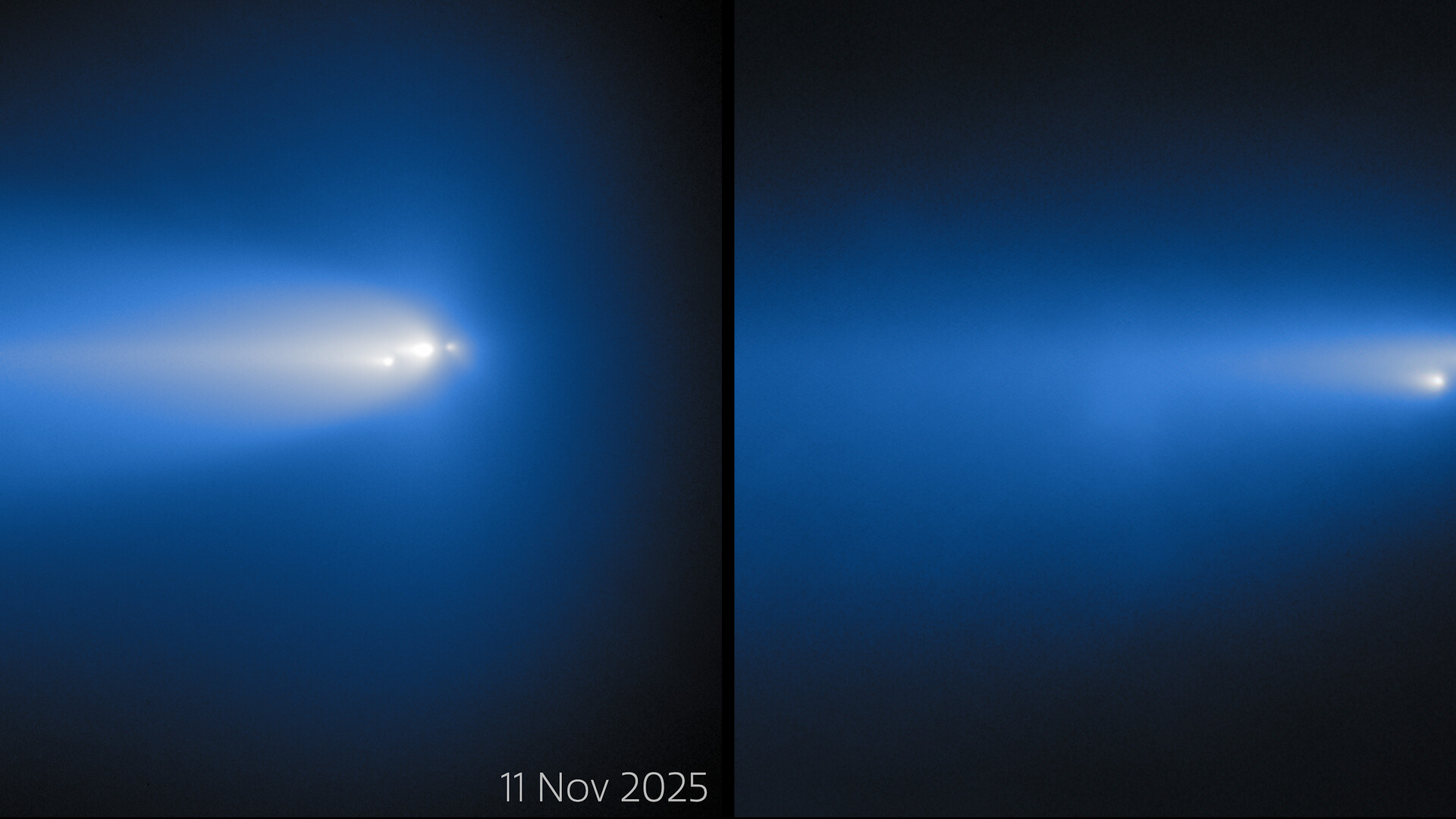
A comet was caught falling apart on camera, using a powerful telescope in Hawaii.
Comet C/2025 K1 (ATLAS) crumbled in high-resolution footage captured by the Gemini North telescope atop Mauna Kea in Hawaii. Glowing pieces of the comet are visible in the 8.1-meter diameter optical/infrared telescope, which is part of a twin pair of telescopes at the International Gemini Observatory.
The comet, which was a loosely held collection of ice and dust, swooped around the sun in October and made its closest approach on Oct. 8. The strong solar gravity and the pressure of the solar wind, or constant stream of particles streaming off our sun, fragmented the comet into several chunks.

For example, astronomer Gianluca Masi, of the Virtual Telescope Project in Italy, imaged the breaking-apart comet in early November using a Celestron C14 Schmidt-Cassegrain telescope on a Paramount ME robotic mount. The images appeared to show “three fragments of the original nucleus and possibly a fourth one,” Masi wrote in a statement accompanying the images.
Astronomers at the Asiago Observatory in Italy also previously showed the comet in two fragments, separated by roughly 1,200 miles (2,000 km), on Nov. 11. They used a 1.82-meter Copernicus telescope to achieve the work.

C/2025 K1 (ATLAS), as the name implies, was found in May 2025 using the Asteroid Terrestrial-impact Last Alert System. It is a solar system comet that likely was formed in the Oort Cloud, which is a large group of icy bodies past the orbit of Neptune. There may be billions of comets like C/2025 K1 (ATLAS) there, which may orbit the sun at a distance for eons until a gravitational “kick” sends them towards the inner solar system.
These long-period comets are especially prized by astronomers studying the early solar system, since Oort Cloud members are more pristine than regular, recurring visitors like Halley’s Comet originating closer to the sun.
Want to see these visitors from the outer solar system for yourself? Skywatchers hoping to capture their own views of distant solar system comets should check out our roundups of the best smart telescopes, cameras and lenses for astrophotography, along with our guide on how to view and photograph comets.
Editor’s Note: If you would like to share your own comet photos with Space.com’s readers, then please send your photo(s), comments, and your name and location to spacephotos@space.com.










Related Posts

Stay Informed With the Latest & Most Important News
Previous Post
Next Post


Advertisement
-
 01Two Black Holes Observed Circling Each Other for the First Time
 -
 02From Polymerization-Enabled Folding and Assembly to Chemical Evolution: Key Processes for Emergence of Functional Polymers in the Origin of Life
 -
 03Astronomy 101: From the Sun and Moon to Wormholes and Warp Drive, Key Theories, Discoveries, and Facts about the Universe (The Adams 101 Series)
 -
 04True Anomaly hires former York Space executive as chief operating officer
 -
 05Φsat-2 begins science phase for AI Earth images
 -
 06Hurricane forecasters are losing 3 key satellites ahead of peak storm season − a meteorologist explains why it matters
 -
 07Binary star systems are complex astronomical objects − a new AI approach could pin down their properties quickly