
Now Reading: Comet SWAN shines with the Pillars of Creation in breathtaking deep space photo
-
01
Comet SWAN shines with the Pillars of Creation in breathtaking deep space photo


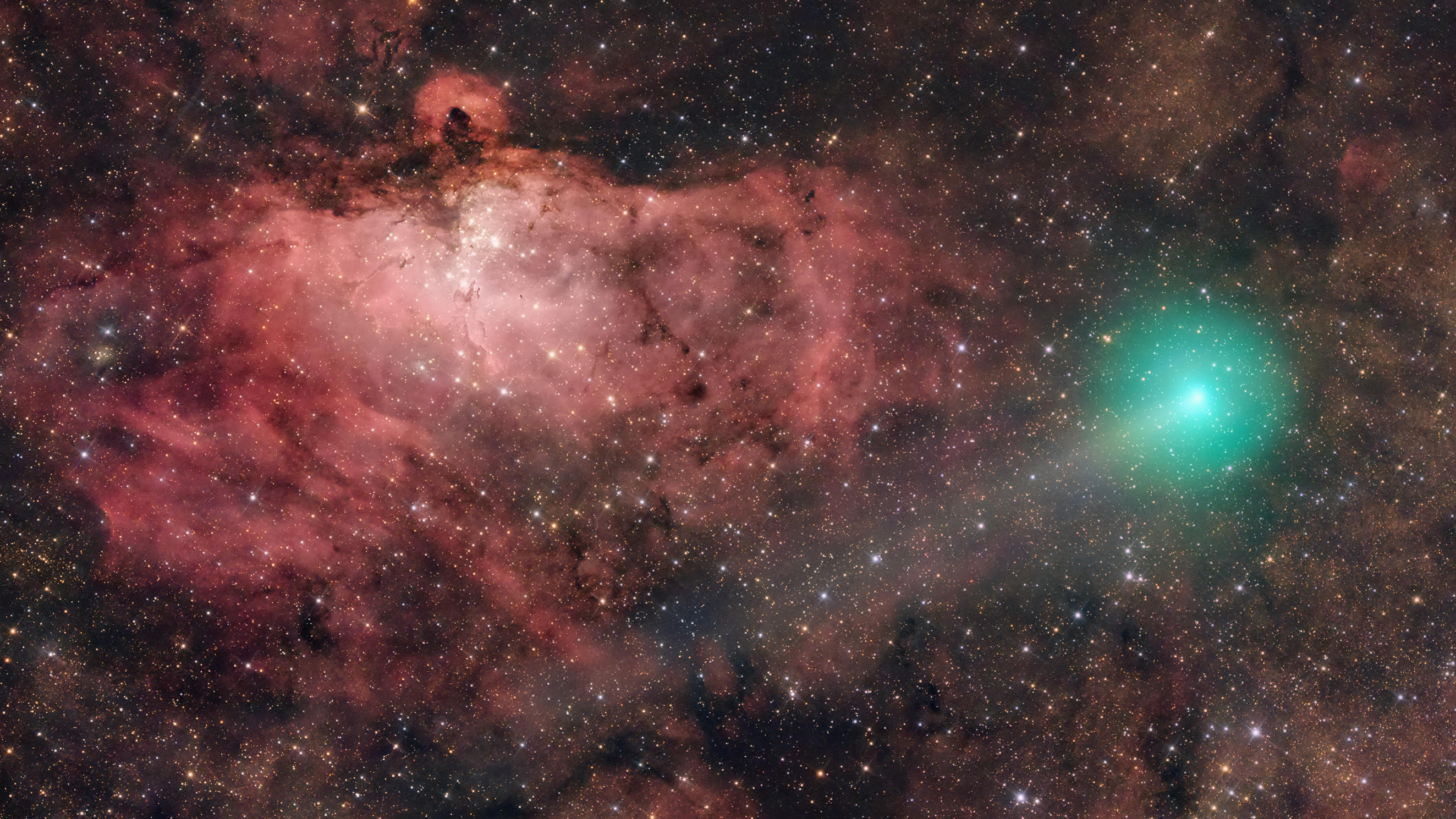

passed in front of the Eagle Nebula and the iconic Pillars of Creation, from his home in the Chilean Atacama Desert on the night of Oct. 17 earlier this year.
Comet C/2025 R2 (SWAN)’s backdrop is dominated by the Eagle Nebula — a vast cosmic structure of dust and hydrogen-rich gas that glows with its own light, having been ionized by the radiation emitted by its population of energetic young stars.
The nebula gets its name from its resemblance to a cosmic bird of prey and is most famous for playing host to the Pillars of Creation — a collection of stunning radiation-sculpted columns made of interstellar dust and gas. The formation has been immortalized in images captured by both the Hubble Space Telescope and the James Webb Space Telescope, along with countless others. Though small, the Pillars of Creation can be spotted nestled in the glowing, star-studded heart of the Eagle Nebula, to the left of C/2025 R2 (SWAN)’s glowing coma in Gasparri’s image.
ZWO ASI533MC Pro

Want to capture a nebula shining thousands of light-years from Earth? The ZWO ASI533MC Pro camera is the best dedicated astro camera out there, in our opinion. Check out our ZWO ASI533MC Pro review for a more in-depth look.
Gasparri captured the scene over the course of 40 X 120-second exposures using a 130 mm Newtonian reflector telescope in the skies over the Atacama Desert, close to the Chilean city of Copiapó, where he works as a professional astronomer. “It was also an amazing sight through the eyepiece, with its characteristic green coma drifting across one of the most observed nebulae in the sky,” Gasparri told Space.com in an email.
C/2025 R2 (SWAN) was discovered by Ukrainian astronomer Vladimir Bezgly on Sept. 10, 2025, in data collected by the Solar and Heliospheric Wind Anisotropies (SWAN) camera on NASA’s Solar and Heliospheric Observer (SOHO) spacecraft. The comet is now heading out towards the far reaches of the solar system, having survived its close approach with the sun on Sept. 12 and won’t return for approximately 1,400 years.
Ensure that you’re prepared to view the next cometary visitor or night sky event by perusing our roundups of the best telescopes and binoculars for exploring the night sky. If you’re an astrophotographer looking to upgrade your gear, then you may also want to read our picks of the top cameras and lenses for capturing the majesty of the post-sunset realm!
Editor’s Note: If you would like to share your astrophotography with Space.com’s readers, then please send your photo(s), comments, and your name and location to spacephotos@space.com.










Related Posts

Stay Informed With the Latest & Most Important News



Advertisement
-
 01Two Black Holes Observed Circling Each Other for the First Time
 -
 02From Polymerization-Enabled Folding and Assembly to Chemical Evolution: Key Processes for Emergence of Functional Polymers in the Origin of Life
 -
 03Astronomy 101: From the Sun and Moon to Wormholes and Warp Drive, Key Theories, Discoveries, and Facts about the Universe (The Adams 101 Series)
 -
 04True Anomaly hires former York Space executive as chief operating officer
 -
 05Φsat-2 begins science phase for AI Earth images
 -
 06Hurricane forecasters are losing 3 key satellites ahead of peak storm season − a meteorologist explains why it matters
 -
 07Binary star systems are complex astronomical objects − a new AI approach could pin down their properties quickly