
Now Reading: Comet visits stargazers on Kitt Peak | Space photo of the day for Feb. 2, 2026
-
01
Comet visits stargazers on Kitt Peak | Space photo of the day for Feb. 2, 2026


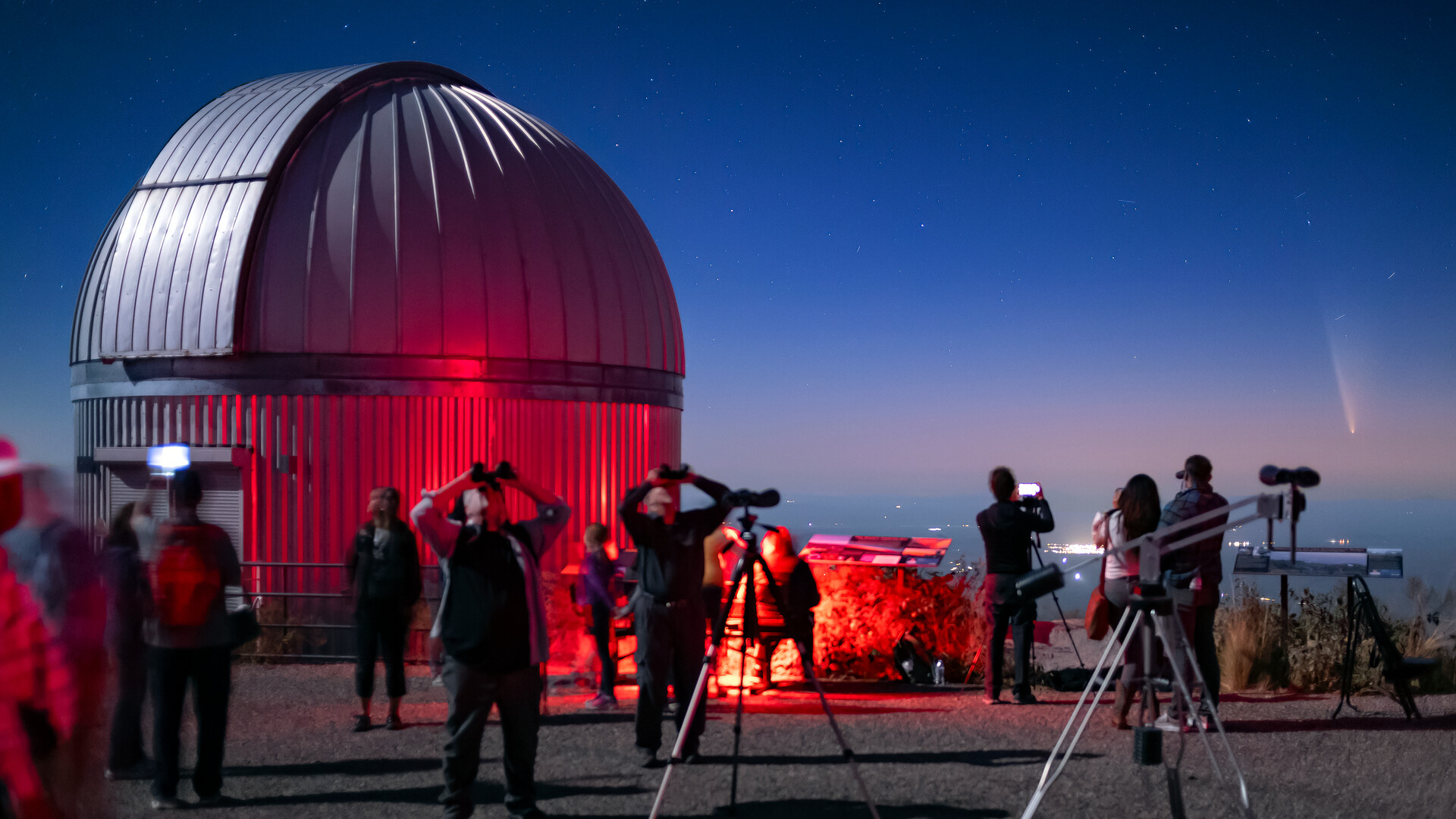
For eager skywatchers, comets offer a rare opportunity to observe some of our solar system’s most dynamic objects. These icy visitors spend most of their existence in the cold outer reaches of the solar system, only occasionally swinging close enough to the sun for their ices to vaporize and flare into a luminous coma and tail.
When that happens, the night sky becomes a type of shared laboratory: researchers gather data, amateur astronomers track changes from night to night and the public gets a rare chance to see an object visibly in motion across the heavens.
What is it?
Few places in the U.S. are better suited for that type of communal skywatching than Kitt Peak National Observatory (KPNO), part of the National Science Foundation’s NOIRLab. Perched on a Sonoran Desert mountaintop on the Tohono O’odham Nation in southern Arizona, Kitt Peak is home to a dense concentration of telescopes and a long legacy of opening the universe to scientists and the public alike.
That community recently came together to observe Comet C/2023 A3 (Tsuchinshan-ATLAS) as it passed through the night sky. Near the 3-foot (0.9 meter) SARA telescope, stargazers used binoculars and telescopes to glimpse the icy traveler.
Where is it?
This image was captured at Kitt Peak National Observatory in Arizona.

Why is it amazing?
Comet C/2023 A3 (Tsuchinshan-ATLAS) has been one of the more widely followed celestial visitors of recent years. The comet, which was discovered in 2023, is believed to have originated in the distant Oort Cloud. It became a major target for observers as it approached the inner solar system, making its closest pass by the sun in late September 2024 and a relatively close pass to Earth in October 2024.
Even when comets don’t behave exactly as predicted — their brightness and tail structure can change quickly — the unpredictability is part of the draw. Each clear night offers a slightly different object to study and a slightly different view to remember.
Want to learn more?
You can learn more about stargazing and comets.










Related Posts

Stay Informed With the Latest & Most Important News
Previous Post
Next Post
Advertisement
-
 01Two Black Holes Observed Circling Each Other for the First Time
 -
 02From Polymerization-Enabled Folding and Assembly to Chemical Evolution: Key Processes for Emergence of Functional Polymers in the Origin of Life
 -
 03Astronomy 101: From the Sun and Moon to Wormholes and Warp Drive, Key Theories, Discoveries, and Facts about the Universe (The Adams 101 Series)
 -
 04True Anomaly hires former York Space executive as chief operating officer
 -
 05Φsat-2 begins science phase for AI Earth images
 -
 06Hurricane forecasters are losing 3 key satellites ahead of peak storm season − a meteorologist explains why it matters
 -
 07Binary star systems are complex astronomical objects − a new AI approach could pin down their properties quickly