
Now Reading: Comparison Of General Circulation Models Of The Venus Upper Atmosphere
-
01
Comparison Of General Circulation Models Of The Venus Upper Atmosphere



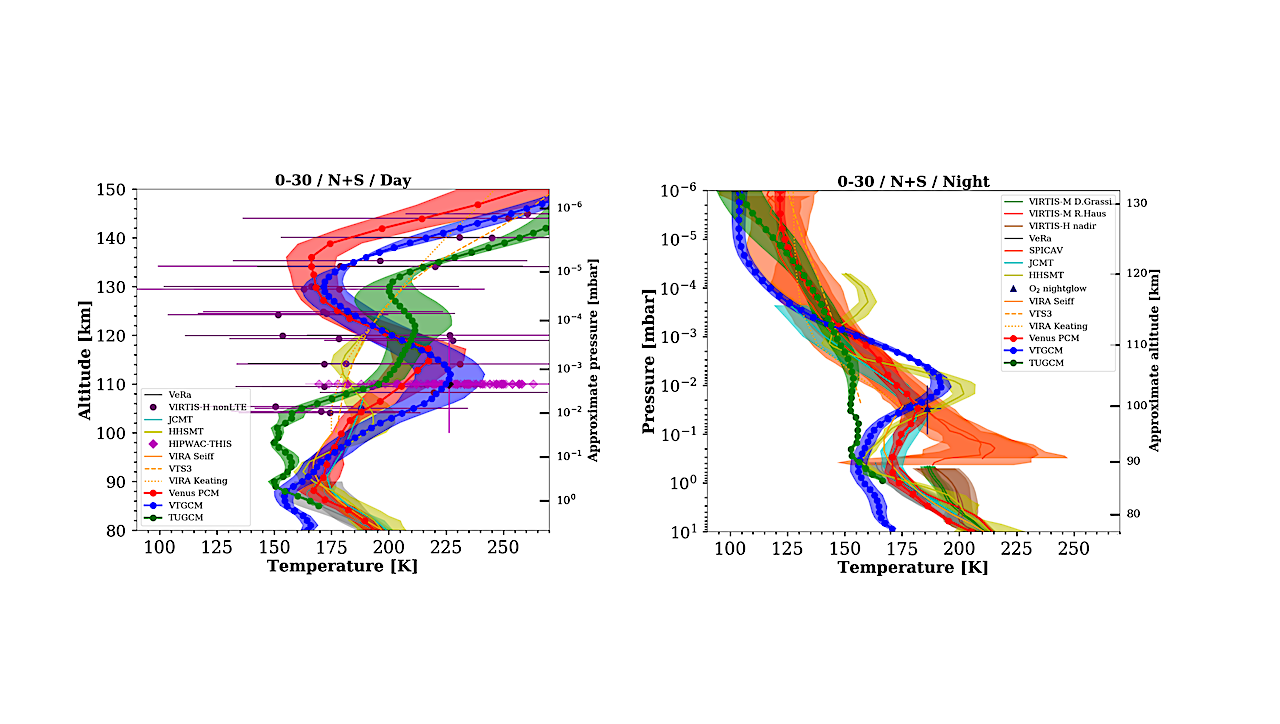
Compilation of available Venus temperature profiles above 80 km both from spacecrafts, ground based telescopes and retrieved from CO non-LTE emissions observed by VIRTIS/VEx versus dayside (7-17 LT; LEFT) and nightside (21-3 LT; RIGHT) model predictions averaged at equatorial latitude from Southern and Northern hemisphere. Corresponding approximate values for altitude/pressure value is given on the right hand side of the panel. Panels are adapted from Fig. 15 in Limaye et al. (2017). Uncertainties (one standard deviation) are either plotted as colored areas for averaged profiles in the same bin (Venus Express datasets, JCMT, HHSMT). The models predicted profiles are in thick solid line with circle marker (VPCM in red, VTGCM in blue and TUGCM in green), their spatial variability over the selected zone are plotted as colored areas. — astro-ph.EP
In the context of future Venusian missions, it is crucial to improve our understanding of Venus upper atmosphere through 3D modeling, notably for spacecraft orbit computation.
This study compares three General Circulation Models (GCMs) of the Venusian atmosphere up to the exosphere: the Venus Planetary Climate Model (Venus PCM), the Venus Thermospheric Global Model (VTGCM) and the Tohoku University GCM (TUGCM), focusing on their nominal simulations (e.g. composition, thermal structure and heating/cooling rates). Similarities and discrepancies among them are discussed in this paper, together with data-models comparison.
The nominal simulations analyzed in this study fail to accurately reproduce the daytime observations of Pioneer Venus, notably overestimating the exospheric temperature. This is linked to an underestimation of the atomic oxygen (O) abundance in the three GCMs, and suggests the need of additional O production in the thermosphere. The selection of solar spectrum is also the main reason for the discrepancies between the models in terms of temperature dependence on solar activity.
A list of recommendations is proposed aiming at improving the modeling of Venus’ upper atmosphere, among them: 1. Standardize the EUV-UV solar spectrum input. 2. Update the near-infrared heating scheme with Venus Express-Era data. 3. Reassess Radiative cooling schemes. 4. Investigate the underestimated atomic Oxygen abundance.
Antoine Martinez, Hiroki Karyu, Amanda Brecht, Gabriella Gilli, Sebastien Lebonnois, Takeshi Kuroda, Aurelien Stolzenbach, Francisco Gonzalez Galindo, Stephen Bougher, Hitoshi Fujiwara
Subjects: Earth and Planetary Astrophysics (astro-ph.EP)
Cite as: arXiv:2512.16693 [astro-ph.EP] (or arXiv:2512.16693v1 [astro-ph.EP] for this version)
https://doi.org/10.48550/arXiv.2512.16693
Focus to learn more
Journal reference: Icarus, March 2026, Volume 447
Related DOI:
https://doi.org/10.1016/j.icarus.2025.116901
Focus to learn more
Submission history
From: Gabriella Gilli Gg
[v1] Thu, 18 Dec 2025 15:58:50 UTC (6,981 KB)
https://arxiv.org/abs/2512.16693
Astrobiology, exoplanet, Venus,










Related Posts
Stay Informed With the Latest & Most Important News

Advertisement
-
 01Two Black Holes Observed Circling Each Other for the First Time
 -
 02From Polymerization-Enabled Folding and Assembly to Chemical Evolution: Key Processes for Emergence of Functional Polymers in the Origin of Life
 -
 03Astronomy 101: From the Sun and Moon to Wormholes and Warp Drive, Key Theories, Discoveries, and Facts about the Universe (The Adams 101 Series)
 -
 04True Anomaly hires former York Space executive as chief operating officer
 -
 05Φsat-2 begins science phase for AI Earth images
 -
 06Hurricane forecasters are losing 3 key satellites ahead of peak storm season − a meteorologist explains why it matters
 -
 07Binary star systems are complex astronomical objects − a new AI approach could pin down their properties quickly