
Now Reading: ‘Completely bonkers’ collision of 2 exoplanets observed
-
01
‘Completely bonkers’ collision of 2 exoplanets observed


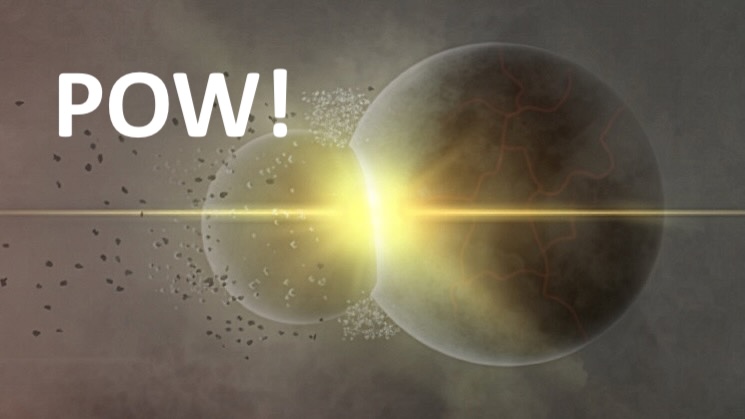

- A grad student was looking through old data when he spied something unusual.
- The data revealed the collision of 2 exoplanets, 11,000 light-years away.
- Astronomers hope to detect about 100 similar collisions in the coming decade, using the new Rubin Observatory in Chile. It’s important because this collision might be similar to the one that formed Earth’s moon. And Earth’s moon is key to life.
Our much-loved EarthSky Community Photos is back, after a bot swarm brought it down a day ago. Please keep sharing your beautiful photos with us.
Collision of 2 exoplanets found in old data
An astronomy grad student at the University of Washington – Anastasios Tzanidakis – was looking through old telescope data when he noticed something odd. It was a seemingly ordinary star, called Gaia20ehk, flickering wildly in brightness. Intrigued, he and his colleagues investigated further. And they determined that the flickering was due to large amounts of hot dust and rocks passing in front of the star. They concluded the flickering of the star must indicate a catastrophic collision between two of its planets, 11,000 light-years away.
Tzanidakis said in a statement:
The star’s light output was nice and flat. But, starting in 2016, it had these three dips in brightness. And then, right around 2021, it went completely bonkers. I can’t emphasize enough that stars like our sun don’t do that. So, when we saw this one, we were like ‘Hello, what’s going on here?’
It’s incredible that various telescopes caught this impact just as the light of the collision reached Earth. There are only a few other planetary collisions of any kind on record, and none that bear so many similarities to the impact that created the Earth and moon.
If we can observe more moments like this elsewhere in the galaxy, it will teach us lots about the formation of our world.
Tzanidakis and his collaborator, James Davenport, published their findings in the peer-reviewed Astrophysical Journal Letters on March 11, 2026.
Chaos in early planetary systems
Stars form from rotating disks of gas and dust. Afterwards, there’s a leftover disk of material called a protoplanetary disk. And at first this disk contains just dust, gas, ice and rocks. But, over millions of years, the materials in the disk coalesce, under gravitational forces. So planets and other small bodies, such as asteroids and comets, form out of the disk.
Conditions with the disk of an early stellar system can be chaotic. Planets can collide and shatter. Or the force of an impact could hurl a planet out of its stellar system. But eventually, over a timescale of 100 million years or so, the new-born solar system settles into a stable state.
Collisions between newly formed extrasolar planets are likely quite common. But catching one in the act is hard. That’s because – in a scenario like the one detected by Anastasios Tzanidakis and colleagues – telescopes can detect the flickering starlight only if the orbiting collision debris is in the line of sight between us and the star.
Star system Gaia20ehk
The star system Gaia20ehk is about 11,000 light-years from Earth. It’s near the direction of the constellation Puppis the Stern. It’s in a stable phase of its evolution, known as the main sequence phase. That means the star is steadily burning hydrogen to helium in its core.

Looking in both visible and infrared
For a long time, as viewed through earthly telescopes, Gaia20ehk shone with a steady light. But starting in 2016, Tzanidakis said, there were three dips in its brightness. Then, in 2021, the star’s brightness became erratic.
Davenport suggested they examine this star at infrared wavelengths. And the results were a revelation. Tzanidakis commented:
The infrared light curve was the complete opposite of the visible light. As the visible light began to flicker and dim, the infrared light spiked. Which could mean that the material blocking the star is hot — so hot that it’s glowing in the infrared.
But what caused the dips in light before 2021? Tzanidakis said:
That could be caused by the two planets spiraling closer and closer to each other. At first, they had a series of grazing impacts, which wouldn’t produce a lot of infrared energy. Then, they had their big catastrophic collision, and the infrared really ramped up.

Could a similar collision have created our moon?
Some scientists think that a similar collision might have created our moon. They say that about 4.5 billion years ago, an object the size of Mars collided into Earth, ripping out material from our young planet to form the moon.
Gaia20ehk is only slightly more massive than our sun. In addition, the orbiting material causing the star’s fluctuating brightness is about one astronomical unit from the star. So whatever happened in this system to create the debris is located in this star system at about the same distance between our sun and Earth-moon system.
The researchers think the hot debris could, at that distance, eventually cool down enough to create a system similar to our Earth and moon. But they won’t know for sure until the dust literally settles, which could take a few million years.
This is a simulation, from 2022, of how the moon may have formed. A body the size of Mars crashed into Earth, early in its formation, ripping out material that eventually became the moon. Simulation via NASA/ Durham University/ Jacob Kegerreis.
Finding more systems with collisions
In the meantime, the Vera C. Rubin Observatory is making periodic scans of the southern hemisphere sky. If something changes in the sky – a supernova, a new comet, a star changing in brightness – astronomers want to be alerted. They want to study what’s going on in real time.
Davenport thinks that Rubin could find as many as 100 collisions in the coming 10 years. If so, observing these events could help astronomers understand the processes that create Earth–moon-like systems, which in turn could inform the search for habitable exoplanets. Davenport commented:
How rare is the event that created the Earth and moon? That question is fundamental to astrobiology. It seems like the moon is one of the magical ingredients that makes the Earth a good place for life. It can help shield Earth from some asteroids. It produces ocean tides and weather that allow chemistry and biology to mix globally. And it might even play a role in driving tectonic plate activity.
Right now, we don’t know how common these dynamics are. But if we catch more of these collisions, we’ll start to figure it out.
Bottom line: Astronomers found that the erratically flickering light from a stable star was due to debris from the collision of two exoplanets.
Source: Gaia-GIC-1: An Evolving Catastrophic Planetesimal Collision Candidate
Rubin Observatory launches real-time alert system
Read more: The tally is in! 6,000 exoplanets now confirmed
The post ‘Completely bonkers’ collision of 2 exoplanets observed first appeared on EarthSky.










Related Posts
Stay Informed With the Latest & Most Important News
Previous Post
Next Post

Advertisement
-
 01Two Black Holes Observed Circling Each Other for the First Time
 -
 02From Polymerization-Enabled Folding and Assembly to Chemical Evolution: Key Processes for Emergence of Functional Polymers in the Origin of Life
 -
 03Astronomy 101: From the Sun and Moon to Wormholes and Warp Drive, Key Theories, Discoveries, and Facts about the Universe (The Adams 101 Series)
 -
 04True Anomaly hires former York Space executive as chief operating officer
 -
 05Φsat-2 begins science phase for AI Earth images
 -
 06Hurricane forecasters are losing 3 key satellites ahead of peak storm season − a meteorologist explains why it matters
 -
 07Binary star systems are complex astronomical objects − a new AI approach could pin down their properties quickly