
Now Reading: Congressional hearing highlights military’s reliance on NOAA weather data
-
01
Congressional hearing highlights military’s reliance on NOAA weather data


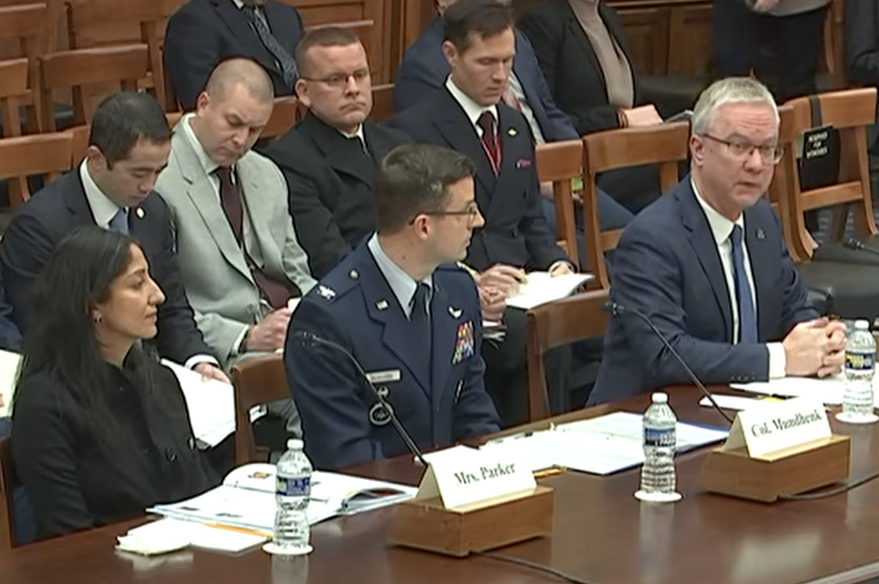

SAN FRANCISCO – A Jan. 13 hearing underscored the importance of ongoing collaboration between the National Oceanic and Atmospheric Administration (NOAA) and the U.S. armed services.
U.S. Air Force and U.S. Navy witnesses discussed their heavy reliance on datasets and weather models provided by NOAA and said their agencies are working closely to ensure NOAA’s next-generation constellations satisfy military requirements.
“The Navy-NOAA partnership is fundamental to the Navy’s warfighting advantage in national security,” Christopher Ekstrom, U.S. Navy Oceanography and Navigation deputy director, said during the hearing of the House Science, Space and Technology Environment subcommittee. “Our ability to produce strategic, operational and tactical meteorological and oceanographic forecast relies heavily on the weather and ocean data received from NOAA.”
Similarly, for the U.S. Air Force, NOAA “support enables warfighters to exploit environmental effects to create dilemmas for our adversaries while optimizing freedom of action for friendly forces and, ultimately, hones the military instrument of power,” said Air Force Weather Operations Division Chief Col. Bryan Mundhenk.
Proposed Cuts
The Trump Administration proposed reducing NOAA’s budget from $6.1 billion in 2025 to $4.5 billion in 2026 and increasing the agency’s focus on “core activities including collecting essential scientific observations like ocean and weather data to support navigation and forecasting,” according to the budget justification submitted to Congress in June.
As a result, NOAA’s National Environmental Satellite, Data and Information Service (NESDIS) modified plans for the next-generation Geostationary Extended Observations (GeoXO) program by canceling contracts for instruments to observe ocean color and atmospheric composition.
Since the administration “requested NOAA satellite programs to focus on the public safety mission, specifically on severe weather and hurricane forecasting,” NESDIS reevaluated the scope of the GeoXO program,” said Irene Parker, NESDIS deputy assistant administrator for systems.
If Congress passes and the President signs the “minibus” appropriations package released Jan. 5 by the leadership of the House and Senate Appropriations Committees, NOAA NESDIS’s 2026 budget would be roughly level with 2025 spending. “The bill also provides $1.67 billion to maintain the current generation of NOAA weather and climate satellites and to invest in next-generation satellites—$135 million above President Trump’s request,” according to a Senate Appropriations Committee summary.
It’s not yet clear how that funding would impact GeoXO or other NOAA programs.
The Jan. 13 hearing revealed that another GeoXO instrument, the Lightning Mapper, is under review. NOAA is conducting a study to compare the effectiveness of space-based lightning mappers with commercial ground-based observations. Once that assessment is completed, a report will be submitted to Congress, Parker said.










Related Posts


Stay Informed With the Latest & Most Important News
Previous Post
Next Post





Advertisement
-
 01Two Black Holes Observed Circling Each Other for the First Time
 -
 02From Polymerization-Enabled Folding and Assembly to Chemical Evolution: Key Processes for Emergence of Functional Polymers in the Origin of Life
 -
 03Astronomy 101: From the Sun and Moon to Wormholes and Warp Drive, Key Theories, Discoveries, and Facts about the Universe (The Adams 101 Series)
 -
 04True Anomaly hires former York Space executive as chief operating officer
 -
 05Φsat-2 begins science phase for AI Earth images
 -
 06Hurricane forecasters are losing 3 key satellites ahead of peak storm season − a meteorologist explains why it matters
 -
 07Binary star systems are complex astronomical objects − a new AI approach could pin down their properties quickly