
Now Reading: CubeSats launch marks breakthrough in space communication technology
-
01
CubeSats launch marks breakthrough in space communication technology


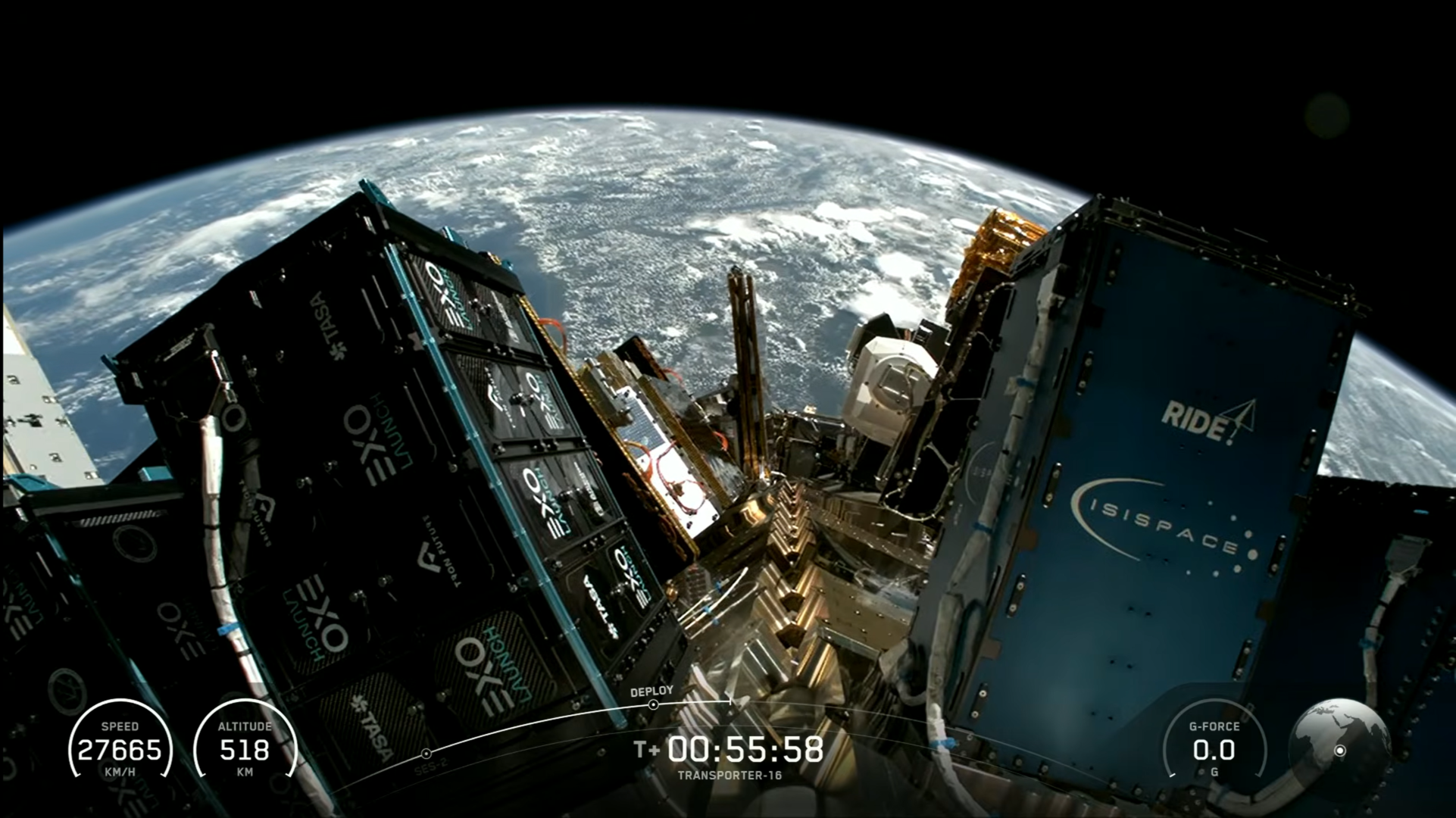

On March 30, 2026, eight CubeSats and a unique payload launched into orbit aboard SpaceX’s Transporter-16 mission, marking a pivotal advancement in how data from space is transmitted and processed. Supported by the European Space Agency (ESA), this initiative aims to develop systems capable of relaying crucial, and sometimes life-saving, information more swiftly and effectively.
The increasing density of satellites and the integration of space technology into daily life have resulted in an upsurge in data exchanged between Earth and space, intensifying the demand for innovative communication strategies. The satellites launched on the Falcon 9 rocket from California’s Vandenberg Space Force Base are designed to explore solutions to these challenges, focusing on laser communication as a high-capacity, secure alternative to traditional radio frequency methods. The CubeSats will implement various demonstrations, including inter-satellite links and optical ground station technologies, to showcase the potential of these advanced communication techniques.
Among the payloads is OptiSat, a CubeSat developed under ESA’s Greek Connectivity Programme on behalf of Greece’s Ministry of Digital Governance. This satellite is set to enhance Greece’s space-based optical capabilities by using TESAT’s SCOT20 laser communication terminal, aimed at complementing radio frequency communications by establishing secure, high-speed links between satellites in low Earth orbit.
Another notable CubeSat, PeakSat, was entirely crafted by the Aristotle University of Thessaloniki and is equipped with Lithuania’s Astrolight’s ATLAS-1 terminal. This satellite will test laser communications both in space and with modified ground stations in Greece.
The ERMIS mission, comprising three CubeSats developed by a consortium led by the National and Kapodistrian University of Athens, is set to evaluate various data transmission capabilities. ERMIS-1 and ERMIS-2, each sized at 6U, will explore 5G connectivity applications for satellite-supported Internet-of-Things solutions and assess inter-satellite radio frequency links. In contrast, the larger 8U ERMIS-3 will focus on precise tracking for laser communications while carrying a camera that can quickly transfer hyperspectral images, which are crucial for fields like precision agriculture.
This launch also includes ESA’s Pioneer Partnership Projects, designed to cultivate new space mission providers. Among these is Mission SaaS, led by Spire Global. The 6U CubeSat will focus on optimizing data link efficiency between satellites, ensuring that time-sensitive information can be relayed to Earth with precision. Also part of this initiative is VIREON, a set of two 16U CubeSats from AAC Clyde Space, tasked with providing value for money medium-resolution Earth observation data to bolster agriculture and resource management.
Additionally, Belgian company EDGX has introduced a compact satellite data processing unit that merges GPU computing with AI optimization. This device, small enough to fit in the palm of a hand, is designed to enable efficient data processing in space while minimizing energy consumption, an important factor for satellite operations.
As these CubeSats embark on their missions, they hold the promise of transforming space communication, heralding a future where data can flow seamlessly between terrestrial and space-based systems, enhancing both environmental monitoring and resource management capabilities.










Related Posts

Stay Informed With the Latest & Most Important News



Advertisement
-
 01Two Black Holes Observed Circling Each Other for the First Time
 -
 02From Polymerization-Enabled Folding and Assembly to Chemical Evolution: Key Processes for Emergence of Functional Polymers in the Origin of Life
 -
 03Astronomy 101: From the Sun and Moon to Wormholes and Warp Drive, Key Theories, Discoveries, and Facts about the Universe (The Adams 101 Series)
 -
 04True Anomaly hires former York Space executive as chief operating officer
 -
 05Φsat-2 begins science phase for AI Earth images
 -
 06Hurricane forecasters are losing 3 key satellites ahead of peak storm season − a meteorologist explains why it matters
 -
 07Binary star systems are complex astronomical objects − a new AI approach could pin down their properties quickly