
Now Reading: Damaged Shenzhou-20 spacecraft survives reentry, Shenzhou-23 arrives at spaceport
-
01
Damaged Shenzhou-20 spacecraft survives reentry, Shenzhou-23 arrives at spaceport


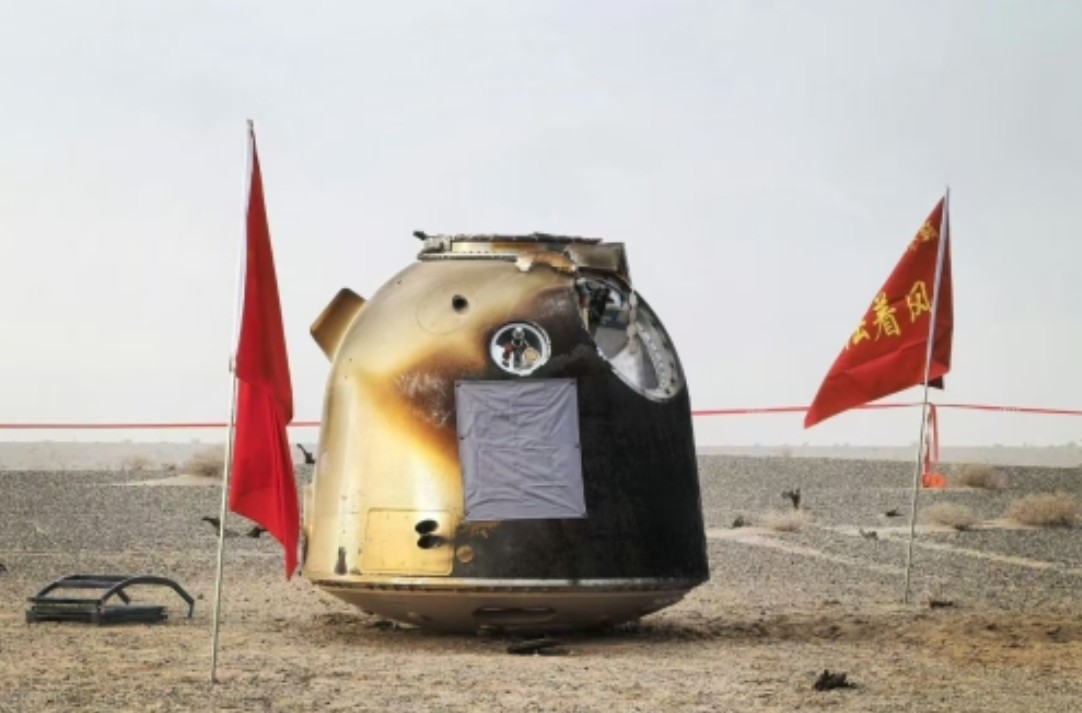

HELSINKI — China’s damaged Shenzhou-20 spacecraft returned safely to Earth after on-orbit internal repairs, concluding the country’s first human spaceflight emergency triggered by a suspected debris impact.
Shenzhou-20 landed at 8:24 p.m. Eastern, Jan. 18 (0134 UTC, Jan. 19) at the Dongfeng landing zone near Jiuquan Satellite launch Center in the Gobi Desert, northwest China, having undocked from Tiangong space station at 1623 UTC Jan. 18.
Images showed the return capsule upright on the ground but the viewport window, damaged by suspected on-orbit debris or a micrometeoroid impact, was covered up after landing. The Shenzhou-20 return module’s exterior was generally normal, and the items inside were in good condition, according to China’s human spaceflight agency, CMSEO.
The spacecraft landed two and a half months later than planned after being assessed unsafe to deliver its crew to Earth due to discovery of a small, penetrating triangular crack in the outer layer of a three-layer viewport window in the crew’s return module. The discovery of the crack triggered China’s first on-orbit human spaceflight crisis and emergency response, seeing a crew transfer to a different spacecraft to return to Earth, the launch of a backup for crew still aboard Tiangong, and an acceleration in production of spacecraft and launch vehicles on the ground to fill an emergency launch gap.
Shenzhou-20 spent 270 days in orbit due to the crisis, whereas most Shenzhou spacecraft spend around 180 days in orbit during the Tiangong space station operational phase. The spacecraft also returned to Earth with Feitian EVA spacesuit B. The suit had supported 11 Chinese astronauts across eight crewed missions, enabling 20 successful EVAs to be conducted since arriving at the then-under-construction Tiangong in July 2021.
The Shenzhou-20 astronauts, who returned to Earth using the Shenzhou-21 spacecraft that had days earlier delivered the new Shenzhou-21 crew to Tiangong in early November, appeared at a press conference Jan. 16, 63 days after their return. It was confirmed that the astronauts discovered the triangular crack in Shenzhou-20’s return module viewport window during a final pre-return check. Commander Chen Dong sent images to Earth, triggering a cascading series of crew transfer and launch decisions.
“We took photographs right away and recorded the situation, and immediately transmitted the data back to the ground,” Chen said. “Based on my visual observation, I initially judged that the crack was on the outermost layer of the spacecraft window. The crack had penetrated that outer layer, but it did not affect the safety of our continued stay in orbit. Afterwards, the two crews, six astronauts in total, carefully observed and discussed the condition of the window together, and fully cooperated with the ground teams to carry out rechecks and confirmation,” said Chen.
Teams on the ground delayed the return of Shenzhou-20, seeing the use of Shenzhou-21 to deliver the Shenzhou-20 astronauts back to Earth, and resulting in the uncrewed Shenzhou-22 being launched to Tiangong, arriving Nov. 25, to provide a lifeboat for the Shenzhou-21 crew.
Shenzhou-21 mission commander Zhang Lu and crewmate Wu Fei conducted an extravehicular activity Dec. 9 (UTC), inspecting the damaged window from outside the spacecraft. The astronauts applied a patch, delivered in Shenzhou-22, to the window from the inside, designed to improve the spacecraft’s heat protection and sealing capabilities during reentry.
An external repair was deemed impractical. Shao Limin of the China Aerospace Science and Technology Corporation (CASC), the state-owned space contractor, stated that while large and medium-sized pieces of debris could be avoided, the strength of the spacecraft’s window structure would be needed to handle small, undetectable pieces, with improvements to be made in the future.
With the activity in orbit completed, China is also working hard on the ground to close a gap in emergency launch capability following the Shenzhou-20 crisis. China Central Television (CCTV) also reported Jan. 19 that the Shenzhou-23 spacecraft had arrived at Jiuquan spaceport, around two months ahead of schedule, in order to reestablish China’s standby emergency launch capability.
Shenzhou-22 had been expected to launch in April or May 2026 with its own crew, with Shenzhou-23 arriving beforehand in order to provide an emergency backup. The Long March 2F rocket to launch Shenzhou-23 is also expected to leave the factory for Jiuquan in the near future. The manufacture of Shenzhou-24 is also being accelerated, with the aim of completing the spacecraft in the summer.
China plans to launch the Tianzhou-10 cargo spacecraft and two crews to Tiangong in 2026 on the Shenzhou-23 and Shenzhou-24 spacecraft. The latter could see the spacecraft carry a first international astronaut aboard a Shenzhou, likely seeing an astronaut from Pakistan stay aboard Tiangong for the 4-5 day handover period, returning to Earth along with two astronauts from Shenzhou-23 crew, who will have completed their own six-month stay in orbit. That would leave one Shenzhou-23 astronaut in orbit to complete China’s first continuous one-year duration spaceflight.










Related Posts

Stay Informed With the Latest & Most Important News
Previous Post
Next Post
Previous Post

Next Post

Advertisement
-
 01Two Black Holes Observed Circling Each Other for the First Time
 -
 02From Polymerization-Enabled Folding and Assembly to Chemical Evolution: Key Processes for Emergence of Functional Polymers in the Origin of Life
 -
 03Astronomy 101: From the Sun and Moon to Wormholes and Warp Drive, Key Theories, Discoveries, and Facts about the Universe (The Adams 101 Series)
 -
 04True Anomaly hires former York Space executive as chief operating officer
 -
 05Φsat-2 begins science phase for AI Earth images
 -
 06Hurricane forecasters are losing 3 key satellites ahead of peak storm season − a meteorologist explains why it matters
 -
 07Binary star systems are complex astronomical objects − a new AI approach could pin down their properties quickly