
Now Reading: Deep space, dim objects: Why asteroid mining caught the Space Force’s eye
-
01
Deep space, dim objects: Why asteroid mining caught the Space Force’s eye


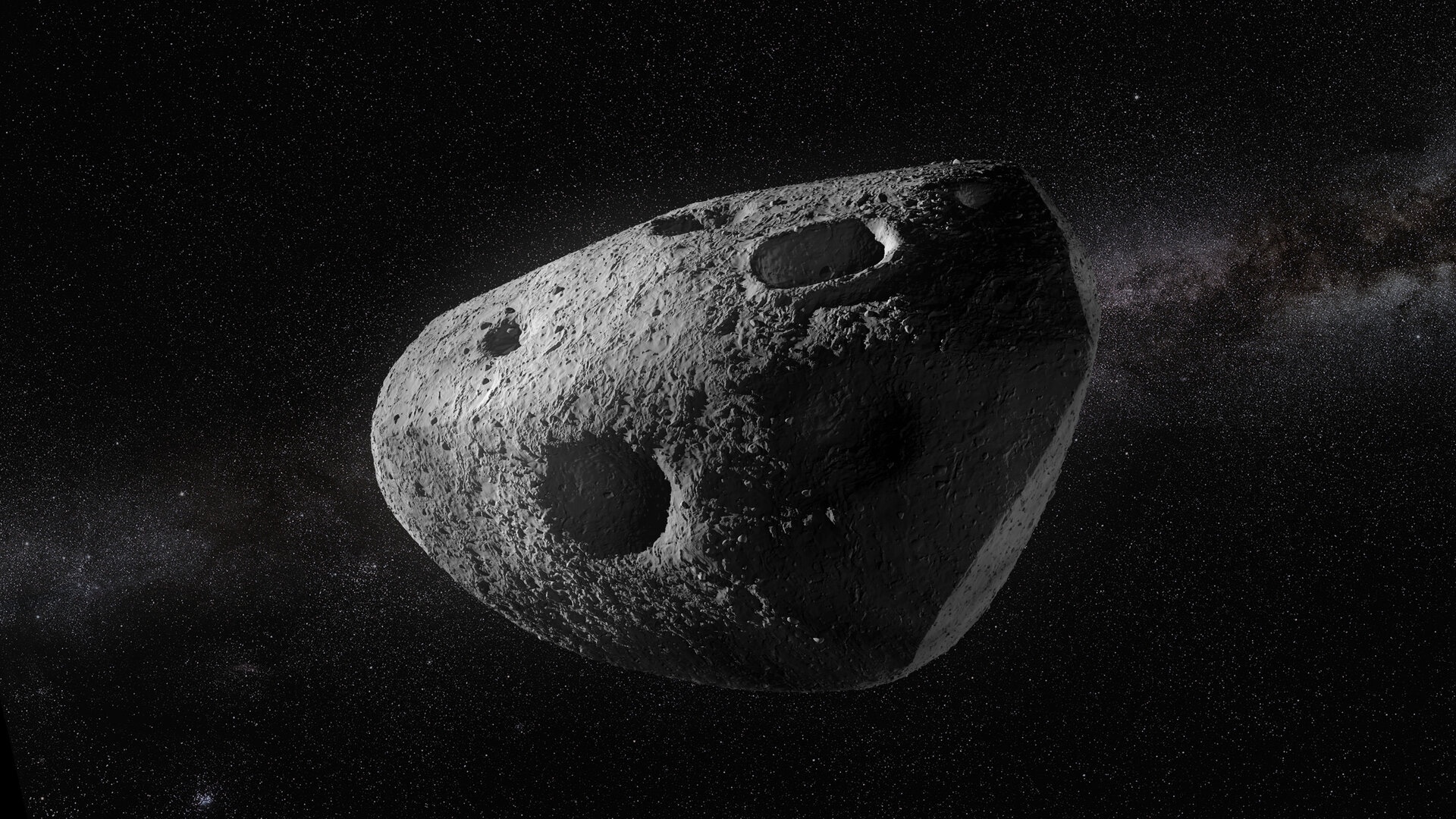

A niche corner of the commercial space sector is attracting attention from United States national security planners, not because of its economic promise, but because of the technical problems it is trying to solve.
Maj. Gen. Stephen Purdy, military deputy to the assistant secretary of the Air Force for space acquisitions, said the Space Force is taking a closer look at companies developing technologies to mine asteroids.
“That was a community I didn’t really pay attention to a couple of years ago. Now I’m paying attention,” Purdy said.
Asteroid mining is often viewed as speculative and commercially distant. But Purdy argued that companies pursuing it are acting as early pathfinders for technical challenges the military expects to face as it expands operations beyond geosynchronous orbit. Those challenges include navigating with limited infrastructure and detecting objects that are faint and difficult to track.
“They’ve been doing deep thinking about dim objects, cislunar and past-lunar areas,” Purdy said. “They’ve brought up national security thoughts and ideas to us, and I’m like, ‘That’s a really good point.’”
In national security space, “dim objects” typically refer to satellites or debris that emit little energy and are hard to see with traditional sensors. Detecting and characterizing them is already difficult in Earth orbit and becomes more complex in cislunar space, the vast region between the Earth and the moon.
Asteroid mining companies face this problem by necessity. Their business models depend on finding small near-Earth asteroids, navigating to them and operating in close proximity. That has pushed them to develop sensors, navigation techniques and algorithms suited for deep space.
“There was one particular space mining company that hit me with three different ‘aha’ moments in the same meeting,” Purdy said.
After those comments, officials from asteroid mining startup AstroForge confirmed to SpaceNews that they had met with Purdy and briefed him on their technology and missions.
California-based AstroForge was founded in early 2022 with the goal of developing spacecraft that can locate, visit, extract, refine and eventually return precious metals from small near-Earth asteroids.
In a social media post, co-founder and CEO Matthew Gialich said Purdy’s remarks highlight how commercial technologies can align with government needs.
AstroForge’s progress has been uneven. In 2023, the company flew an experimental spacecraft intended to demonstrate refining asteroid-like material in orbit. After deployment, the team struggled with communications and was unable to fully demonstrate the payload. A follow-on mission launched in February 2025, carrying a larger probe designed to scout a metal-rich asteroid. That spacecraft lost reliable communications within about 20 hours of launch.
The company has described the mission as a source of hard-earned lessons and has publicly stated plans for a third attempt as early as 2026.
Beyond asteroid mining, Purdy said there are other sectors the Space Force is watching closely, including privately developed space stations and in-space nuclear power systems.
Commercial space stations, he noted, are “not really our mainline business. Although, from a futurist perspective, I have half a foot in the future a lot of times, thinking about what the Space Force might want to go to. So I’m trying to think about what tech might be out there and get our folks thinking about it in case that comes down the pike.” The level of automation in space, he added, “has also been surprising.”
Privately funded stations are being pitched for research, manufacturing, tourism and exploration, particularly as NASA plans to retire the International Space Station later this decade. Their emergence raises questions about whether such platforms could eventually serve dual-use roles, supporting logistics, experimentation, training or contingency operations.
Purdy also pointed to in-space nuclear power and propulsion as an area where the private sector has made progress, and where sustained government investment would be needed to move from demonstrations to operational systems. Nuclear power could enable missions that are impractical with solar energy alone, particularly for spacecraft operating far from the sun or requiring high power levels over long durations.
Taken together, Purdy’s comments suggest a broader shift in how the Space Force views parts of the commercial space economy seen as peripheral. For technologies aimed at operating far from Earth, even speculative business cases may be producing capabilities the military expects it will eventually need.
This article first appeared in the February 2026 issue of SpaceNews Magazine.










Related Posts
Stay Informed With the Latest & Most Important News
Previous Post
Next Post




Advertisement
-
 01Two Black Holes Observed Circling Each Other for the First Time
 -
 02From Polymerization-Enabled Folding and Assembly to Chemical Evolution: Key Processes for Emergence of Functional Polymers in the Origin of Life
 -
 03Astronomy 101: From the Sun and Moon to Wormholes and Warp Drive, Key Theories, Discoveries, and Facts about the Universe (The Adams 101 Series)
 -
 04True Anomaly hires former York Space executive as chief operating officer
 -
 05Φsat-2 begins science phase for AI Earth images
 -
 06Hurricane forecasters are losing 3 key satellites ahead of peak storm season − a meteorologist explains why it matters
 -
 07Binary star systems are complex astronomical objects − a new AI approach could pin down their properties quickly