
Now Reading: Detectability of Atmospheric Biosignatures in Earth Analogs with Varying Surface Boundary Conditions: Prospects for Characterization in the UV, Visible, Near-Infrared, and Mid-Infrared Regions
-
01
Detectability of Atmospheric Biosignatures in Earth Analogs with Varying Surface Boundary Conditions: Prospects for Characterization in the UV, Visible, Near-Infrared, and Mid-Infrared Regions

Detectability of Atmospheric Biosignatures in Earth Analogs with Varying Surface Boundary Conditions: Prospects for Characterization in the UV, Visible, Near-Infrared, and Mid-Infrared Regions

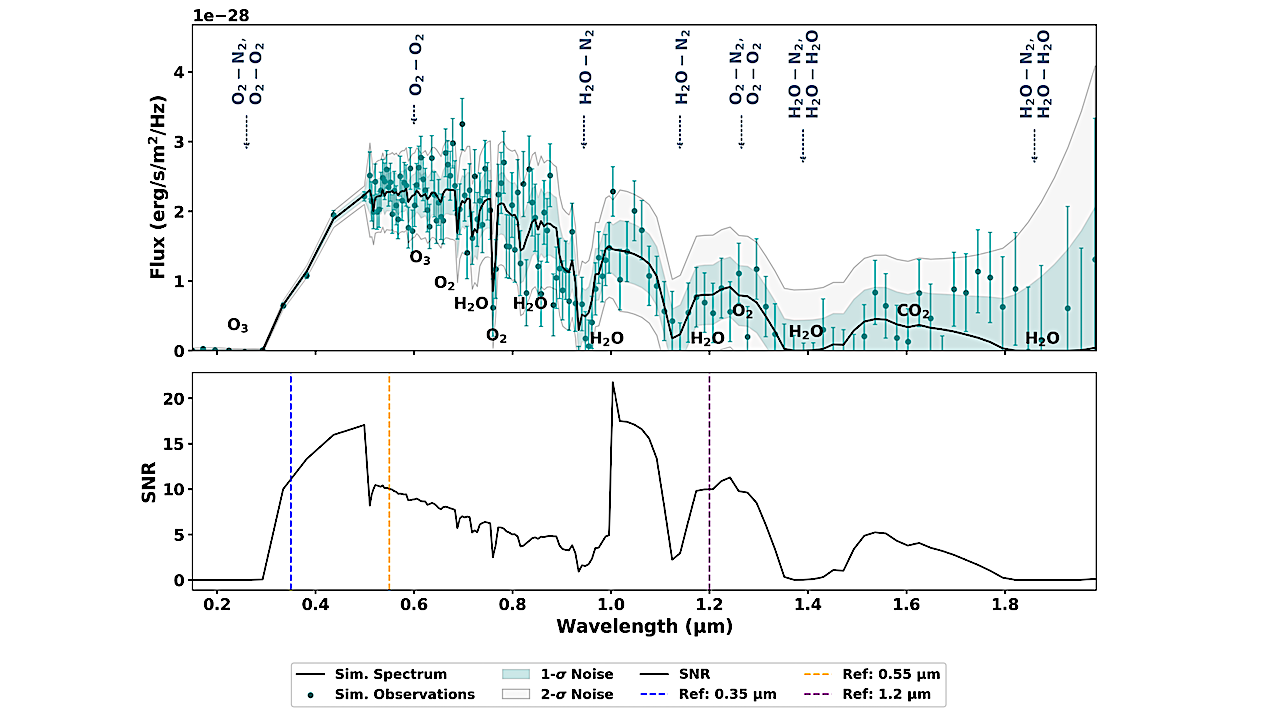
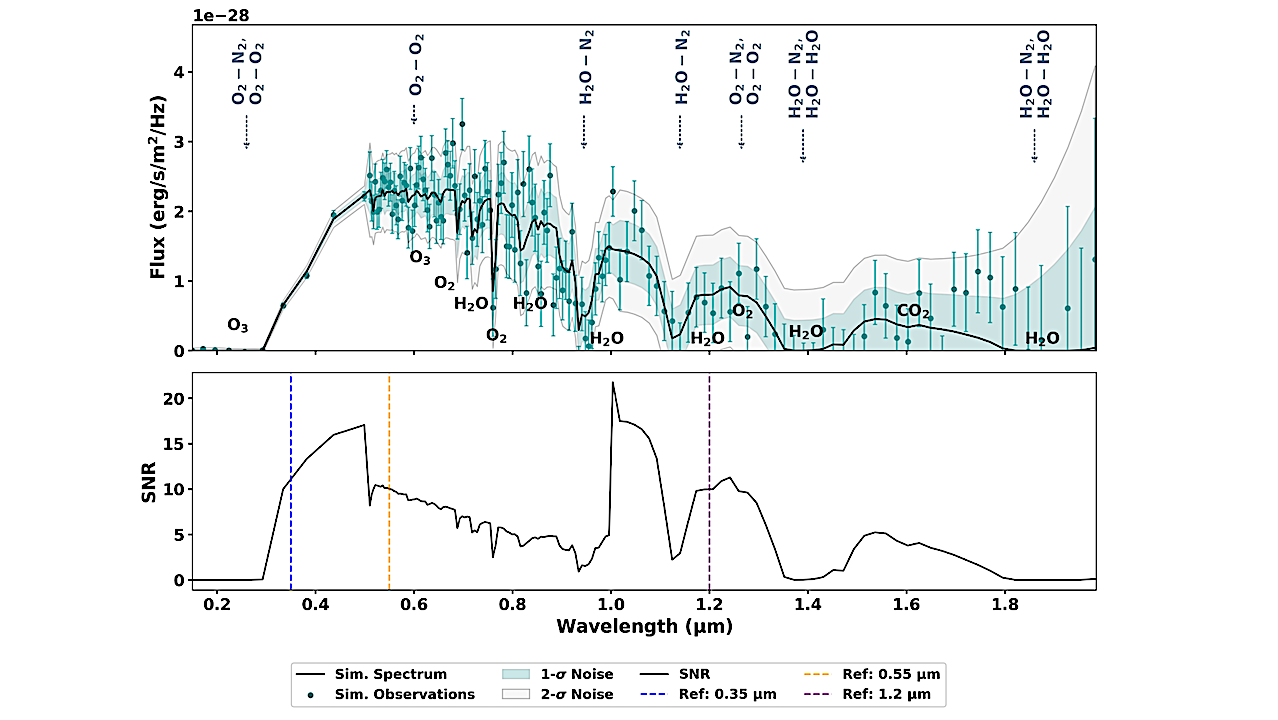
Top: simulated reflection spectra observation of modern Earth analog for the HWO mission concept. The simulated flux is considered for a planetary system at 10 pc distance. The wavelength is between 0.15 and 2 µm. The 1σ and 2σ error bars are represented with cyan and light grey shaded area with solid edges respectively. The black curve is the spectrum from PSG. The cyan scatter plot represents the simulated observation points with corresponding uncertainties. The simulated reflection spectra is considered at a phase angle of 77.8◦ . Molecular features are labeled in black, and CIA features are marked in grey; Bottom: the associated SNR vs wavelength for the reflection spectra. The SNR is assumed to be 10 at three reference wavelengths: 0.35 µm, 0.55 µm and 1.2 µm — astro-ph.EP
The search for potentially habitable exoplanets centers on detecting biosignature molecules in Earth-like atmospheres, which makes it essential to understand their detectability under biologically and geologically influenced conditions.
In this study, we model the reflection and thermal emission spectra of such atmospheres across the UV/VIS/NIR and mid-IR regions and simulate their detectability with future mission concepts such as the Habitable Worlds Observatory (HWO) and the Large Interferometer for Exoplanets (LIFE).
We employ Numerical Weather Prediction (NWP) model data, based on Earth’s atmosphere, to derive temperature pressure profiles and couple them with a 1D photochemical model to assess the detectability of these molecules in Earth analogs located 10 parsecs away. We investigate the dominant reaction pathways and their contributions to the atmospheric composition of an Earth analog, with a focus on how they shape the resulting molecular signatures.
We also examine the role of surface boundary conditions, which indirectly trace the effects of biological and geological processes, on the detectability of these molecules using HWO- and LIFE-type mission concepts. Our findings indicate that O3 is detectable with both mission concepts, while H2O requires specific surface humidity levels for detection with LIFE and shows only potential detectability with HWO. CO2 is detectable with LIFE.
Both N2O and CH4 require continuous surface outgassing for potential detection with LIFE, and CH4 further requires low surface humidity to prevent masking by water features. Our work highlights the feasibility of characterizing the atmospheres of Earth analogs in the UV/VIS/NIR and mid-IR domains using HWO- and LIFE-type mission concepts and offers guidance for the development of future missions operating in these spectral regions.
Dibya Bharati Pradhan, Priyankush Ghosh, Oommen P. Jose, Liton Majumdar
Comments: Accepted for publication in The Astrophysical Journal; 28 pages, 8 figures, and 8 tables
Subjects: Earth and Planetary Astrophysics (astro-ph.EP)
Cite as: arXiv:2512.10277 [astro-ph.EP (or arXiv:2512.10277v1 [astro-ph.EP] for this version)
https://doi.org/10.48550/arXiv.2512.10277
Focus to learn more
Submission history
From: Liton Majumdar
[v1] Thu, 11 Dec 2025 04:34:49 UTC (7,373 KB)
https://arxiv.org/abs/2512.10277
Astrobiology,











Related Posts
Stay Informed With the Latest & Most Important News
Previous Post
Next Post

Advertisement
-
 01Two Black Holes Observed Circling Each Other for the First Time
 -
 02From Polymerization-Enabled Folding and Assembly to Chemical Evolution: Key Processes for Emergence of Functional Polymers in the Origin of Life
 -
 03Astronomy 101: From the Sun and Moon to Wormholes and Warp Drive, Key Theories, Discoveries, and Facts about the Universe (The Adams 101 Series)
 -
 04True Anomaly hires former York Space executive as chief operating officer
 -
 05Φsat-2 begins science phase for AI Earth images
 -
 06Hurricane forecasters are losing 3 key satellites ahead of peak storm season − a meteorologist explains why it matters
 -
 07Binary star systems are complex astronomical objects − a new AI approach could pin down their properties quickly