
Now Reading: Diamond downpours in the outer Solar System
-
01
Diamond downpours in the outer Solar System


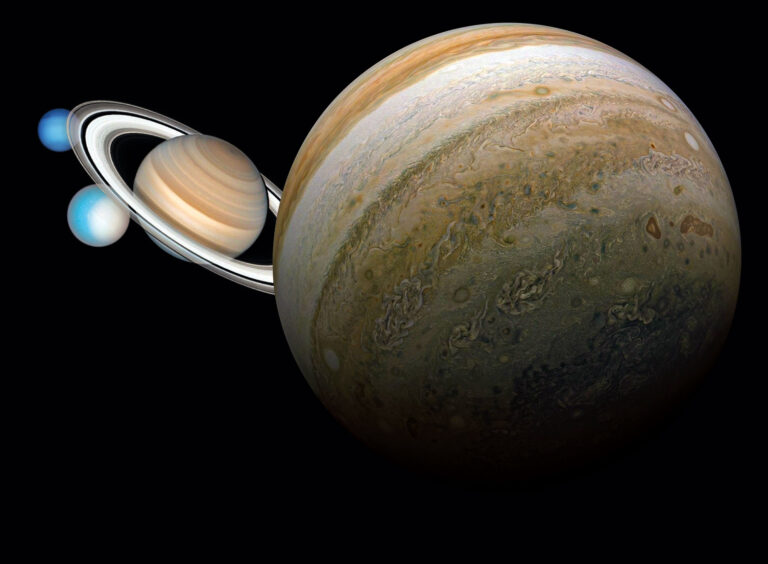
…And now the weather…
“And now the weather” appears every month in Astronomy Now magazine. Enjoy this free sampler from the February issue ahead of Valentine’s Day.
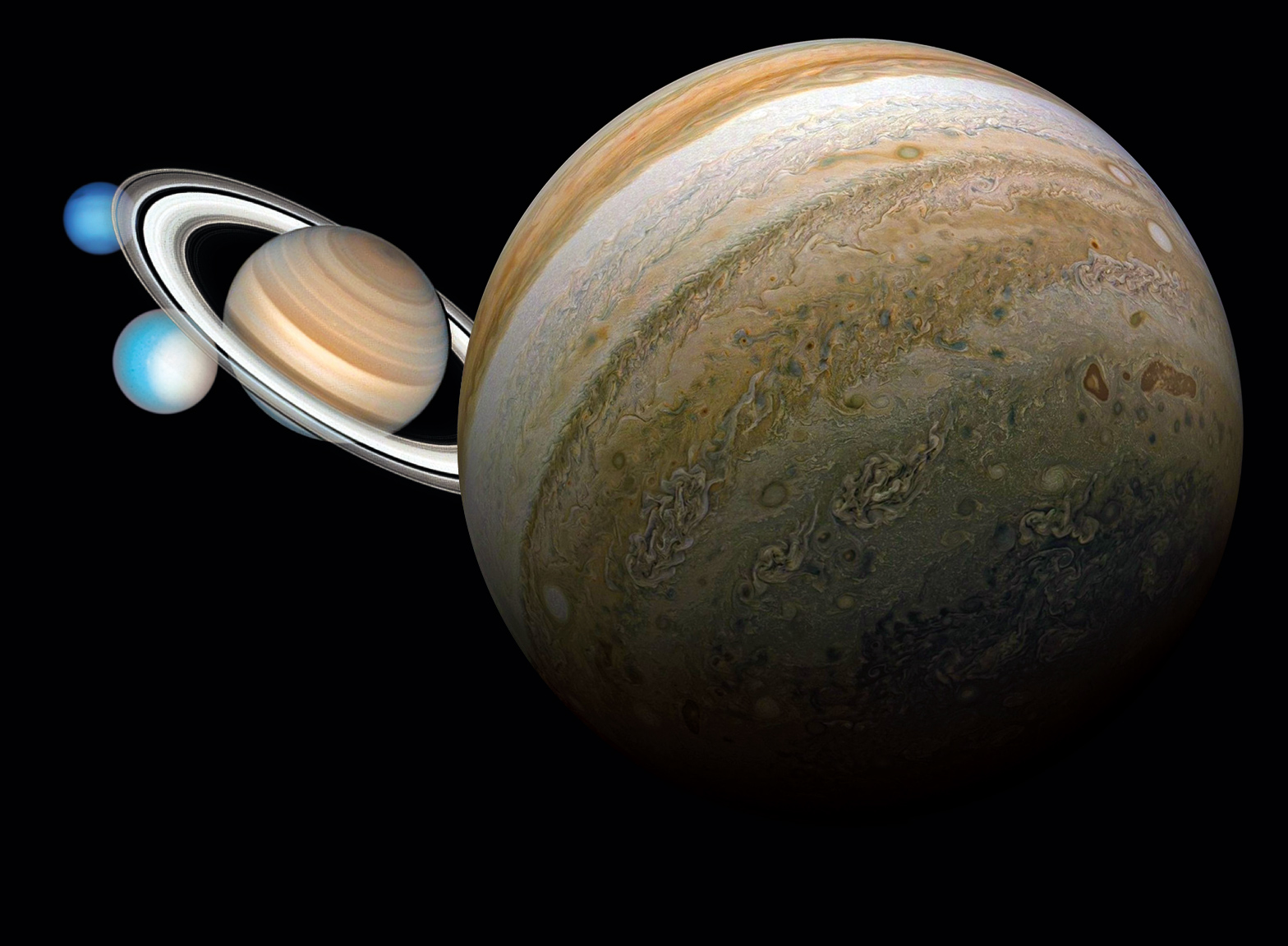
Diamond downpours in the outer Solar System
Here’s some crystal-clear advice for you Valentine’s Day travellers this February. Head for the outer Solar System, where it is a jewellery-lover’s delight with a steady downpour of solid diamonds forecast across all four gas giant planets. You’ll have to travel deep into the planets’ atmospheres to observe this precious phenomenon, however, which to date has only been predicted.
To maximize your chances, head to Uranus and Neptune: their greater quantity of atmospheric methane may lead to more extensive diamond downpours than expected on Jupiter and Saturn.
Starting with pressures just a few tens of Gigapascals, and temperatures hovering between 2,500 and 3000 degrees Celcius, hydrocarbons like methane are crushed into diamond in just a matter of minutes. Hang around long enough and you could be treated to a deluge of thousands of tonnes of centimetre-sized diamonds every year.
As the diamond hail storm sinks deeper, watch out for higher levels of friction-generated heat. In addition, as the diamond chunks drag the surrounding gases and ices down, be aware that local wind currents may be disrupted and cloud formation affected. At the same time, the diamond downpour may trigger currents in the conductive ice, which is set to influence the complex magnetic fields of these planets, so do not rely on your usual compass for navigation!
On Jupiter and Saturn you are advised – with extreme caution – to head to ‘thunderstorm alley’ to boost your chances of catching a sparkling gemstone shower. Use your infrared glasses to identify dark, stormy regions: there, lightning strikes will be turning methane into soot, and as that soot falls through the atmosphere, the increasing pressure will turn it into graphite.
Plunge to a depth of several thousand kilometres and you will start to see chunks of diamond, growing into ‘diamondbergs’ as you go ever deeper. Down to about 30,000 km you will have a choice of some 10 million tonnes of diamonds, but do not go deeper: the hellish temperatures at even greater depths will melt your hoard into a sea of liquid carbon, literally making it rain liquid diamond.
So if you are looking for the ultimate Valentine’s Day experience this February, consider a trip to the diamond-studded atmospheres of your local gas giant to choose your very own, albeit uncut, jewel, fresh from the planetary forge.
Crystal clear where you are? Or is a magnetic storm brewing? Stay tuned for more interplanetary weather reports from around the Solar System and beyond, every month in Astronomy Now magazine!

This weather report was inspired by experimental results using the European X-ray Free Electron Laser facility in Germany. Sources include:
www.nature.com/articles/s41550-023-02147-x and www.nature.com/articles/s41467-023-36841-1










Related Posts
Stay Informed With the Latest & Most Important News
Previous Post
Next Post





Advertisement
-
 01Two Black Holes Observed Circling Each Other for the First Time
 -
 02From Polymerization-Enabled Folding and Assembly to Chemical Evolution: Key Processes for Emergence of Functional Polymers in the Origin of Life
 -
 03Astronomy 101: From the Sun and Moon to Wormholes and Warp Drive, Key Theories, Discoveries, and Facts about the Universe (The Adams 101 Series)
 -
 04True Anomaly hires former York Space executive as chief operating officer
 -
 05Φsat-2 begins science phase for AI Earth images
 -
 06Hurricane forecasters are losing 3 key satellites ahead of peak storm season − a meteorologist explains why it matters
 -
 07Binary star systems are complex astronomical objects − a new AI approach could pin down their properties quickly