
Now Reading: Did Earth life actually begin on Mars? Asteroid impacts could let microbes planet-hop, study suggests
-
01
Did Earth life actually begin on Mars? Asteroid impacts could let microbes planet-hop, study suggests

Did Earth life actually begin on Mars? Asteroid impacts could let microbes planet-hop, study suggests

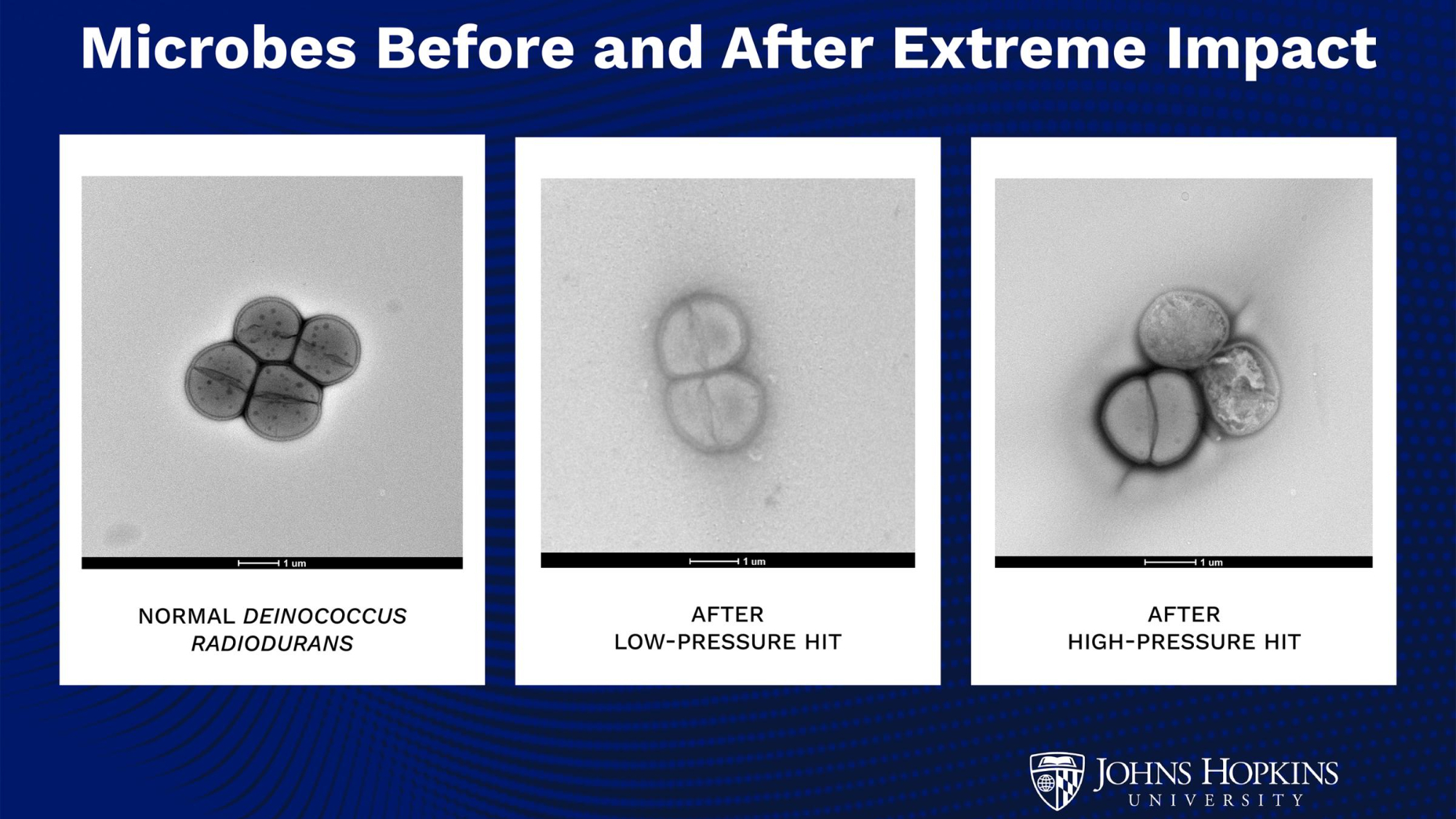
A remarkably hardy bacterium can survive pressures similar to those generated when asteroid impacts blast debris off Mars, a new study has found, suggesting that microbes could endure interplanetary journeys and potentially seed life on other worlds, including Earth.
The findings, published earlier this week in the journal PNAS Nexus, may prompt scientists to reconsider where life could exist across the solar system and could lead to a reassessment of “planetary protection” rules designed to prevent contamination between worlds.

The new findings lend support to a long-debated theory known as lithopanspermia, which proposes that life can spread between planets by hitching a ride on fragments of rock blasted into space by massive impacts. The idea remains unproven, however, and clear evidence of past or present life on Mars remains elusive (though scientists have made some intriguing finds lately).
For the study, Ramesh and his colleagues tested the endurance of Deinococcus radiodurans, an exceptionally resilient bacterium found, among other places, in Chile’s high-altitude deserts. With a thick outer shell and a remarkable ability to repair its own DNA, D. radiodurans is famously tolerant of intense radiation, freezing temperatures, extreme dryness and other harsh conditions similar to those found in space. It has been nicknamed “Conan the bacterium,” after all.
To simulate the forces involved in an asteroid impact, the researchers sandwiched samples of D. radiodurans between two steel plates. Using a gas-powered gun, they fired a projectile at roughly 300 mph (480 kph), subjecting the microbes to pressures between 1 and 3 gigapascals. For comparison, the pressure at the deepest part of Earth’s oceans — the crescent-shaped Mariana Trench in the western Pacific Ocean near Guam — is about 0.1 gigapascal, meaning even the lowest pressure in the experiment was roughly 10 times greater.
Nearly all of the microbes survived impacts generating 1.4 gigapascals of pressure, while about 60% remained alive at 2.4 gigapascals. At lower pressures, the cells showed no signs of damage, though researchers observed ruptured membranes and some internal cellular damage at higher pressures, the study reports.
“We continuously redefine the limits of life,” Madhan Tirumalai, a microbiologist at the University of Houston who was not involved with the new study, told The New York Times. “This paper is another example.”
As the pressure increased, the researchers also detected heightened activity in genes responsible for repairing DNA and maintaining cell membranes.
“We expected it to be dead at that first pressure,” Lily Zhao, a mechanical engineer at JHU who led the experiment, said in the statement. “We started shooting it faster and faster. We kept trying to kill it, but it was really hard to kill.”
The experiment eventually ended, the statement read, because the steel structure holding the plates “fell apart before the bacteria did.”










Related Posts
Stay Informed With the Latest & Most Important News
Previous Post
Next Post

Advertisement
-
 01Two Black Holes Observed Circling Each Other for the First Time
 -
 02From Polymerization-Enabled Folding and Assembly to Chemical Evolution: Key Processes for Emergence of Functional Polymers in the Origin of Life
 -
 03Astronomy 101: From the Sun and Moon to Wormholes and Warp Drive, Key Theories, Discoveries, and Facts about the Universe (The Adams 101 Series)
 -
 04True Anomaly hires former York Space executive as chief operating officer
 -
 05Φsat-2 begins science phase for AI Earth images
 -
 06Hurricane forecasters are losing 3 key satellites ahead of peak storm season − a meteorologist explains why it matters
 -
 07Binary star systems are complex astronomical objects − a new AI approach could pin down their properties quickly