
Now Reading: Direct Constraints From 1.4 Ga Fluid Inclusions Reveal A Fair Climate And Oxygenated Atmosphere
-
01
Direct Constraints From 1.4 Ga Fluid Inclusions Reveal A Fair Climate And Oxygenated Atmosphere

Direct Constraints From 1.4 Ga Fluid Inclusions Reveal A Fair Climate And Oxygenated Atmosphere

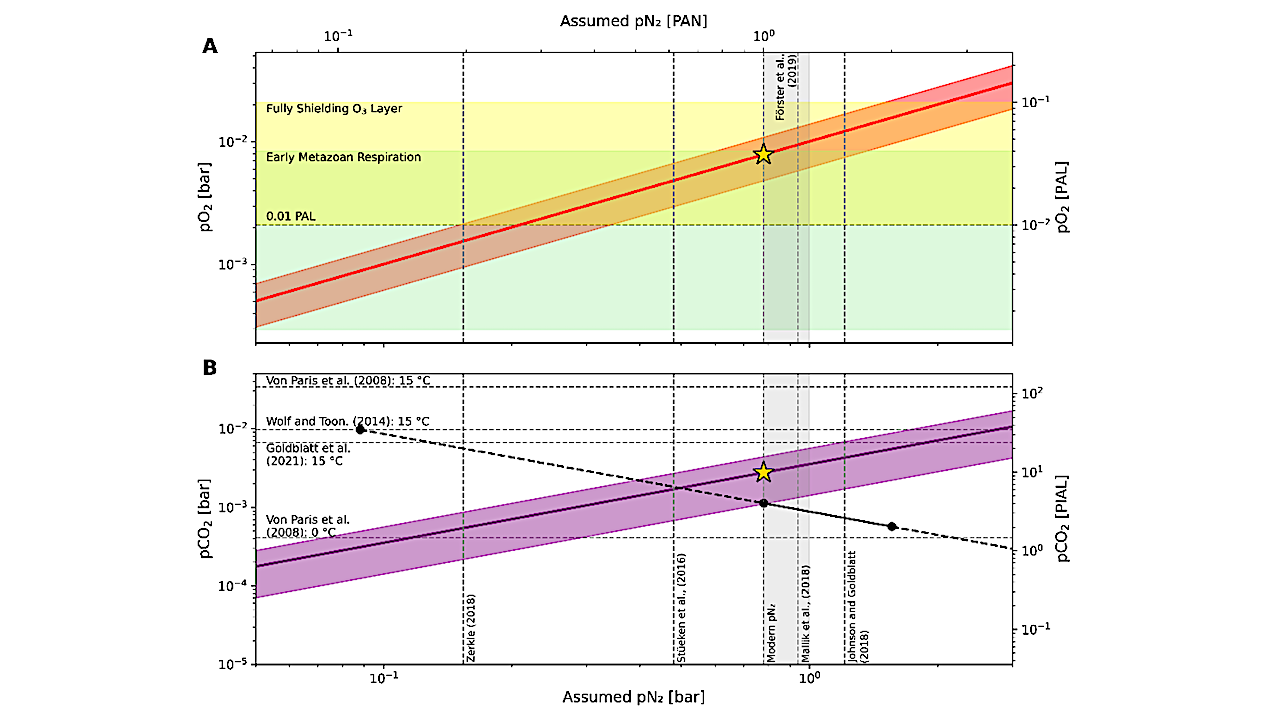
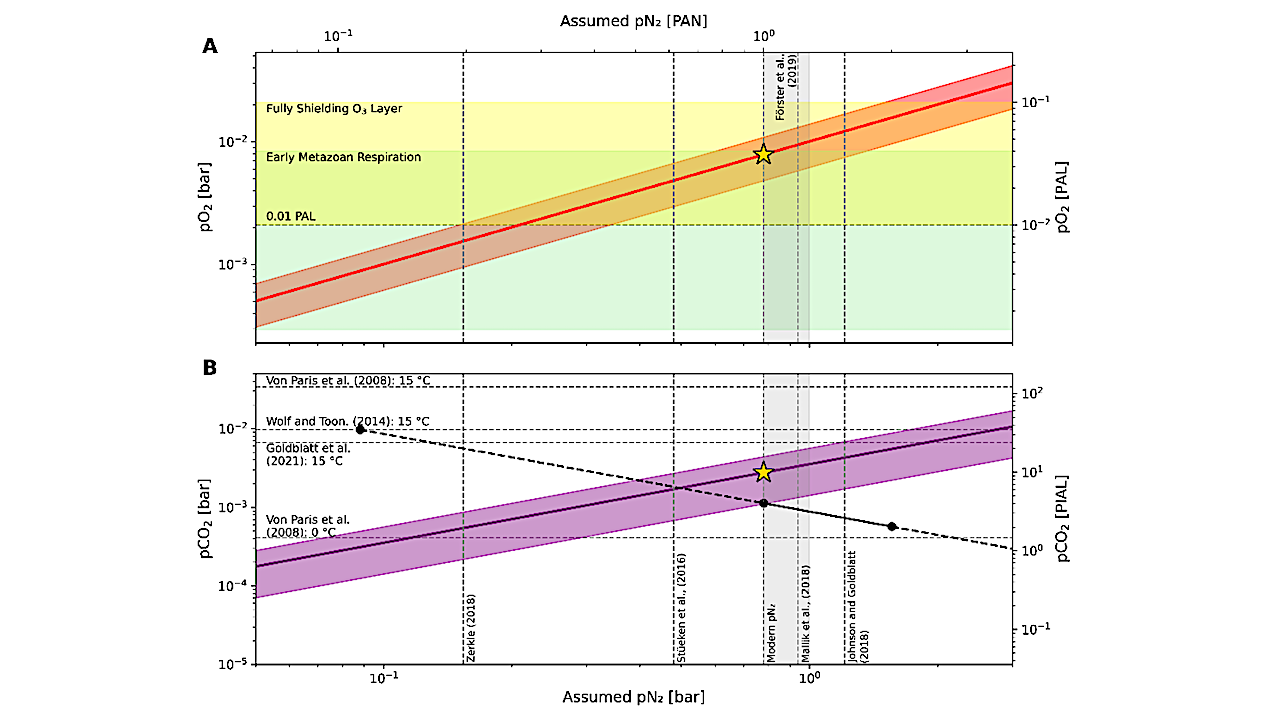
(A) Predicted pO2 (red line) and (B) pCO2 (purple line) values are compared for a range of possible assumed pN2. Vertical dashed lines and colored bands reflect pN2 estimates for 1.44 Ga. from existing models (22–26). For O2, the green and yellow bands reflect the thresholds for early animal respiration and full O3 shielding, respectively (31, 32). The pO2 safely exceeds these thresholds (0.01 PAL) if pN2 exceeded 0.2 bar. For CO2, horizontal dashed lines reflect estimated CO2 contents necessary to achieve the specified temperature (33–35). The diagonal line extrapolates from Archean atmospheric models that account for the effect of total atmospheric pressure on the required CO2 to keep the planet warm (35). Based on these points, our data suggests modern-like climates were possible if pN2 exceeded 0.5 bar. — PNAS
The Mesoproterozoic eon, often regarded as mundane and static, lays the foundation for dramatic transformations in Earth’s physical and biological evolution during the subsequent Neoproterozoic.
A conspicuous absence of glaciation suggests a billion years of warm climates, yet the relationship between temperature and greenhouse gas concentrations remains enigmatic. Separately, contradictory estimates of atmospheric oxygen levels convolute our understanding of how they influenced biological evolution.
Our gas analyses from 1.4 Ga primary fluid inclusions directly constrain Mesoproterozoic oxygen and carbon dioxide concentrations to 3.7% modern levels and 10 times preindustrial levels, respectively.
Our results show this was a period of equable climate and that atmospheric oxygen concentrations, at least transiently, surpassed the metabolic requirements of early animals long before their emergence.
Astrobiology











Related Posts
Stay Informed With the Latest & Most Important News
Previous Post
Next Post


Advertisement
-
 01Two Black Holes Observed Circling Each Other for the First Time
 -
 02From Polymerization-Enabled Folding and Assembly to Chemical Evolution: Key Processes for Emergence of Functional Polymers in the Origin of Life
 -
 03Astronomy 101: From the Sun and Moon to Wormholes and Warp Drive, Key Theories, Discoveries, and Facts about the Universe (The Adams 101 Series)
 -
 04True Anomaly hires former York Space executive as chief operating officer
 -
 05Φsat-2 begins science phase for AI Earth images
 -
 06Hurricane forecasters are losing 3 key satellites ahead of peak storm season − a meteorologist explains why it matters
 -
 07Binary star systems are complex astronomical objects − a new AI approach could pin down their properties quickly