
Now Reading: Disentangling The Hemispheres Of Teegarden’s Star b With LIFE
-
01
Disentangling The Hemispheres Of Teegarden’s Star b With LIFE


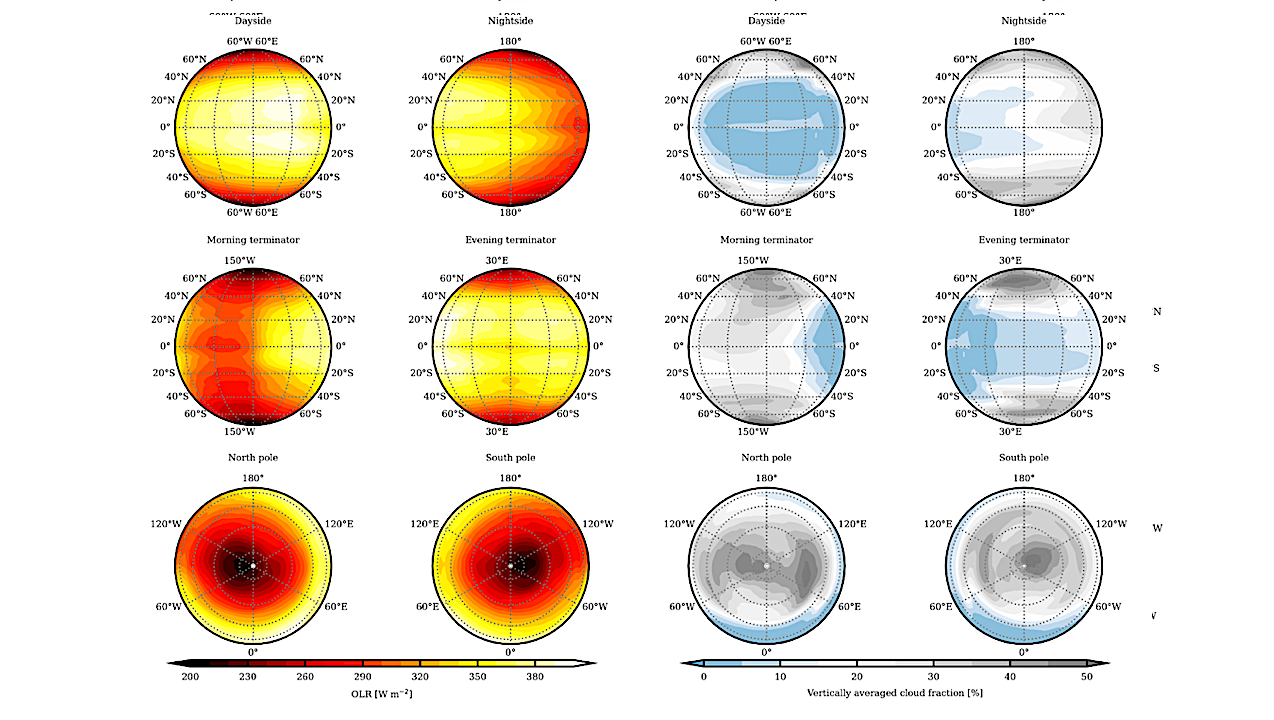
[LEFT] Outgoing longwave radiation of six potentially visible hemispheres of the planet. Teegarden’s Star is one of the most promising targets for the first observations of LIFE, as a non-transiting rocky planet with similar bulk properties to the Earth, and a relatively quiescent M-dwarf host star. [RIGHT} Cloud fraction averaged over all pressure levels.]
We use LIFEsim, a software developed by the ETH LIFE team, along with thermal emission maps obtained from a suite of three-dimensional global climate model (GCM) simulations, to explore the sensitivity of LIFE to the observation geometry. We find that 3 days of observation in broadband would be enough to disentangle the hemispheres of the planet with a 1sigma or 3sigma confidence level with a baseline or optimistic scenario respectively.
Doing the same for a fast-rotator in the habitable zone of a G-class star would be prohibitively challenging. Given enough observation time, the sensitivity of LIFE may allow some spatial resolution of Teegarden’s Star b to be achieved, which may directly link to the presence of water clouds and therefore an active hydrology.
Ryan Boukrouche, Markus Janson
Subjects: Earth and Planetary Astrophysics (astro-ph.EP); Instrumentation and Methods for Astrophysics (astro-ph.IM)
Cite as: arXiv:2512.19231 [astro-ph.EP] (or arXiv:2512.19231v1 [astro-ph.EP] for this version)
https://doi.org/10.48550/arXiv.2512.19231
Focus to learn more
Submission history
From: Ryan Boukrouche
[v1] Mon, 22 Dec 2025 10:12:31 UTC (10,414 KB)
https://arxiv.org/abs/2512.19231
Astrobiology, SETI,











Related Posts
Stay Informed With the Latest & Most Important News
Previous Post
Next Post
Previous Post
Next Post

Advertisement
-
 01Two Black Holes Observed Circling Each Other for the First Time
 -
 02From Polymerization-Enabled Folding and Assembly to Chemical Evolution: Key Processes for Emergence of Functional Polymers in the Origin of Life
 -
 03Astronomy 101: From the Sun and Moon to Wormholes and Warp Drive, Key Theories, Discoveries, and Facts about the Universe (The Adams 101 Series)
 -
 04True Anomaly hires former York Space executive as chief operating officer
 -
 05Φsat-2 begins science phase for AI Earth images
 -
 06Hurricane forecasters are losing 3 key satellites ahead of peak storm season − a meteorologist explains why it matters
 -
 07Binary star systems are complex astronomical objects − a new AI approach could pin down their properties quickly