
Now Reading: Eight more satellites added to IRIDE space programme
-
01
Eight more satellites added to IRIDE space programme




31/03/2026
282 views
11 likes
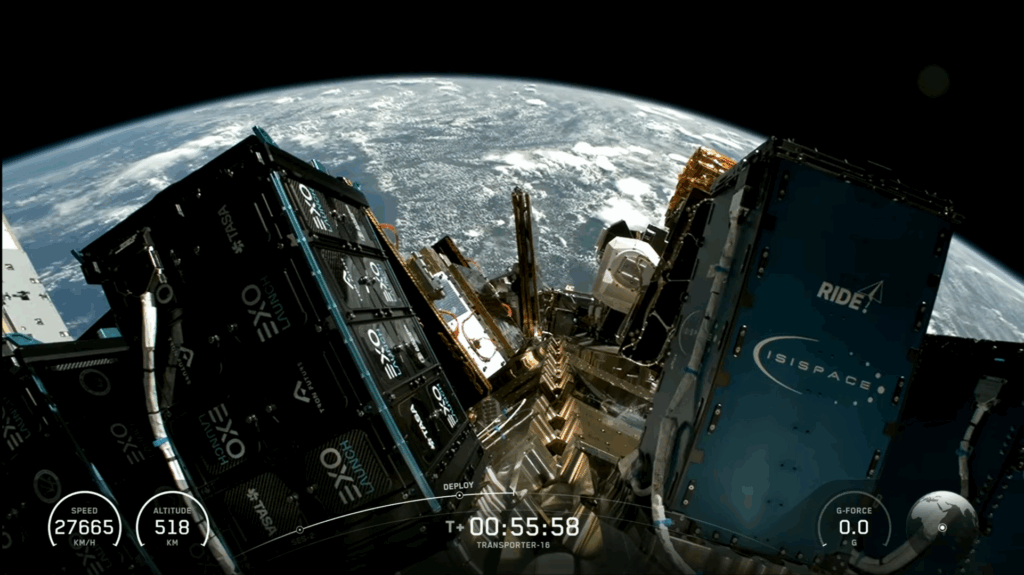
Eight satellites have been added to Italy’s IRIDE Earth observation programme, following launch on board a Falcon-9 rocket. The successful launch brings the total number of satellites in orbit for the Italian programme to 24.
The eight new satellites are part of IRIDE’s Eaglet II constellation. Each one carries a multispectral sensor, which captures images of Earth’s surface, as well as an Automatic Identification System (AIS) to support vessel traffic services. The data will be used to provide core services for Italian public authorities, from monitoring Italy’s coastal areas, to land use and cover, and providing maps during emergency situations.
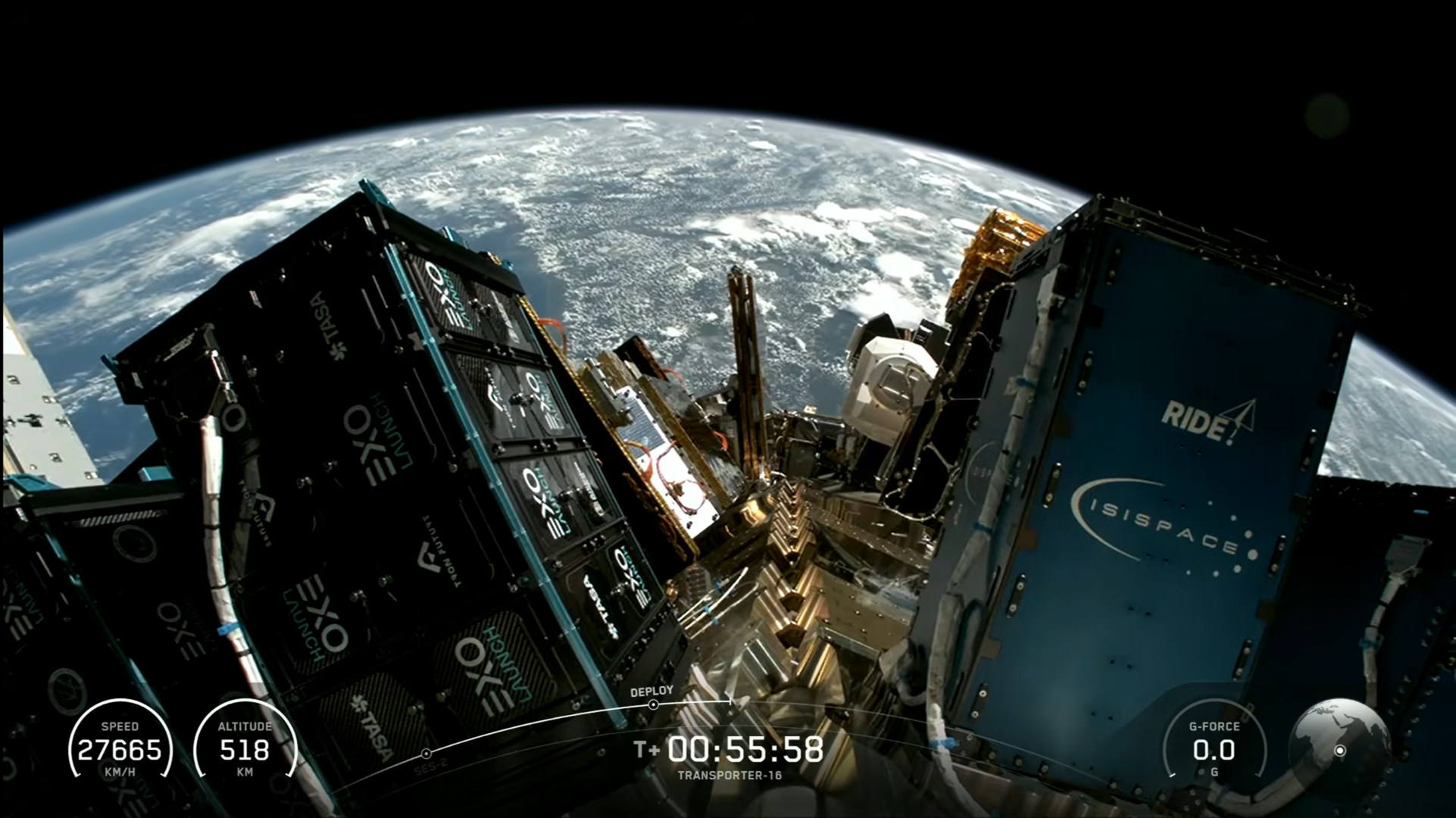
The launch on board SpaceX’s Transporter-16 took place at 13:02 CEST (04:02 local time) on Monday 30 March, from the Vandenberg Space Force Base in California. The satellites join the first batch of Eaglet II satellites, which were placed in orbit in November 2025.
The Eaglet II constellation
The Eaglet II constellation is one of six constellations that will make up the IRIDE satellite system. It now has a total of 16 satellites in orbit. A further eight satellites will be added to the Eaglet II constellation later this year. Eaglet II satellites detect radiation reflected off Earth’s surfaces in the visible light spectrum.
OHB Italia is responsible for the design, testing and operation of the new Eaglet II satellites. The signal from all satellites was confirmed just a few hours after launch – a key measure of a mission’s successful launch – at OHB’s Mission Control Centre in Rome. The process of commissioning – switching on and calibrating the satellites’ instruments in orbit – will now begin.
The other IRIDE constellation already in orbit is Hawk for Earth Observation (HEO), which consists of eight satellites.
Coordinated by the European Space Agency (ESA) with support from the Italian Space Agency (ASI), the IRIDE programme is an ambitious space initiative funded by Italy’s National Recovery and Resilience Plan (PNRR), which is designed to modernise and revitalise Italy’s economy in the wake of the COVID-19 pandemic.
Simonetta Cheli, Director of ESA’s Earth Observation Programmes, said, “This launch doubles the dimension of the Eaglet II constellation, adding eight satellites to the eight already launched last November, which achieved the goal set by Italy’s National Recovery and Resilience Plan seven months ahead of schedule. This underlines the strength of the collaboration between ESA, ASI, the Italian government and the entire national space industry, on this highly complex project. Reaching this new milestone was possible thanks to the contribution of all the teams involved. I would like to particularly congratulate OHB Italia, Telespazio, Optec, Aresys, and all the companies involved in the creation of the constellation, as well as, of course, my team managing its implementation.”
What is the IRIDE programme?
The IRIDE Earth observation system is an initiative by the Italian government to deliver comprehensive satellite data to support the monitoring of a range of phenomena – including ground motion, land cover, water resources, coastal areas and more. As well as the satellite system, IRIDE also provides ground infrastructure to process geospatial data.
The satellite images and information are used in applications and services to support public authorities in making decisions based on data from space, providing information for a wide range of environmental, emergency and security services for Italy. The programme will also provide analytical data for the development of commercial applications by startups, small and medium-sized businesses, and industry sectors.
While the name IRIDE stands for ‘International Report for an Innovative Defence of Earth’, the word ‘iride’ also means ‘iris’ in Italian, reflecting the observational nature of this mission, which carries advanced optical instruments, as well as radar sensors.
Italy’s eyes on Earth
Each satellite in the Eaglet II constellation carries a multispectral, high-resolution optical instrument, as well as an AIS instrument. OHB Italia is the prime contractor for the satellite.
They will orbit at an altitude between 467 km and 625 km above Earth’s surface and provide images with ground resolution of about 2 m.
The mission life for the Eaglet II constellation is about three years and, when complete, it will consist of 24 satellites. Each satellite is the size of a domestic microwave oven and weighs about 25 kg.
Eaglet II is the second of six constellations for IRIDE. The first, Hawk for Earth Observation (HEO) was launched in 2025.
A further four constellations will be launched as part of the IRIDE programme with a total of 68 satellites under development. The other IRIDE satellites will be launched in a staggered approach achieving full deployment by 2027.
Results of European collaboration
Teodoro Valente, President of ASI, noted, “The IRIDE constellation is progressing toward its objectives and is consolidating Italy’s role and technological leadership in Earth observation. The synergy between ASI and ESA enables us to create a constellation that will be able to respond to the challenges of monitoring and protecting our increasingly complex environmental needs, while also providing key services to the public administration.”
Roberto Aceti, CEO of OHB Italia, said, “The continuity of launches, adherence to schedules, and satellite performance demonstrate the technological maturity achieved and the ability to transform a strategic vision into an operational system serving the country. This challenging objective was achieved thanks in part to the high level of professionalism of our entire network of partners and subcontractors who supported and assisted us throughout the implementation process.”










Related Posts
Stay Informed With the Latest & Most Important News
Previous Post
Next Post



Advertisement
-
 01Two Black Holes Observed Circling Each Other for the First Time
 -
 02From Polymerization-Enabled Folding and Assembly to Chemical Evolution: Key Processes for Emergence of Functional Polymers in the Origin of Life
 -
 03Astronomy 101: From the Sun and Moon to Wormholes and Warp Drive, Key Theories, Discoveries, and Facts about the Universe (The Adams 101 Series)
 -
 04True Anomaly hires former York Space executive as chief operating officer
 -
 05Φsat-2 begins science phase for AI Earth images
 -
 06Hurricane forecasters are losing 3 key satellites ahead of peak storm season − a meteorologist explains why it matters
 -
 07Binary star systems are complex astronomical objects − a new AI approach could pin down their properties quickly