
Now Reading: Electron Temperature Relations And The Direct N, O, Ne, S And Ar abundances Of 49959 Star-forming Galaxies In DESI Data Release 2
-
01
Electron Temperature Relations And The Direct N, O, Ne, S And Ar abundances Of 49959 Star-forming Galaxies In DESI Data Release 2

Electron Temperature Relations And The Direct N, O, Ne, S And Ar abundances Of 49959 Star-forming Galaxies In DESI Data Release 2

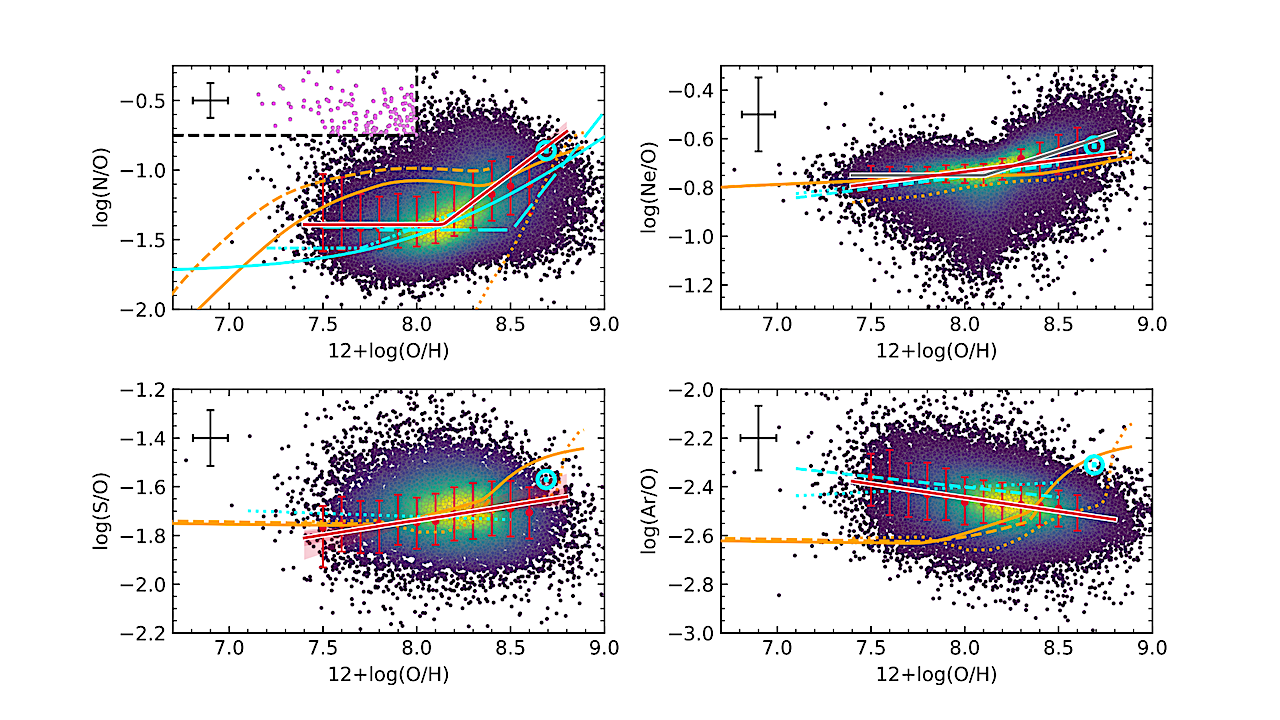

The abundance ratios, log(X/O), versus metallicity for nitrogen (top-left), neon (top-right), sulphur (bottom-left) and argon (bottom-right). The blue lines shows literature relations derived by Izotov et al. (2006), Andrews & Martini (2013), Nicholls et al. (2017) and Berg et al. (2012, 2019). The orange lines show the predicted relations from chemical evolution models for the Solar neighbourhood, Milky Way halo and bulge stars by Kobayashi et al. (2020). The cyan ⊙-sign shows the solar abundance ratio (Asplund et al. 2021). The pink datapoints in the top-left panel show a selection of galaxies with low metallicity and high N/O ratios as discussed in the text. All data points are coloured by the Gaussian kernel density of the plotted distribution. Typical uncertainties are shown by the black error bars in the top-left corner of each panel. — astro-ph.GA
We present the largest direct-method abundance catalogue of galaxies to date, containing measurements of 49959 star-forming galaxies at z<0.96 from DESI Data Release 2. By directly measuring electron temperatures across multiple ionization zones, we provide constraints on a number of electron temperature relations finding good consistency with previous literature relations. Using these temperature measurements, we derive reliable abundances for N, O, Ne, S and Ar and measure the evolution of abundances and abundance ratios of as a function of metallicity and other galaxy properties.
Our measurements include direct oxygen abundances for 49766 galaxies, leading to the discovery of the two most metal-poor galaxies in the nearby Universe, with oxygen abundances of 12+log(O/H)=6.77+0.03−0.03 dex (1.2% Z⊙) and 12+log(O/H)=6.81+0.04−0.04 dex (1.3% Z⊙). We identify a rare outlier population of 139 galaxies with high N/O ratios at low metallicity, reminiscent of galaxy abundances observed in the early Universe.
We find these high N/O galaxies are more massive than typical galaxies at the same metallicity. We find the Ne/O ratio is constant at low metallicity but increases significantly at 12+log(O/H)>8.105±0.004 dex. We show that the S/O and Ar/O abundance ratios are strongly correlated, consistent with the expected additional Type Ia enrichment channel for S and Ar.
In this work we present an initial survey of the key properties of the sample, with this dataset serving as a foundation for extensive future work on galaxy abundances at low redshift.
D. Scholte, F. Cullen, J. M. Moustakas, H. Zou, A. Saintonge, K. Z. Arellano-Cordova, T. M. Stanton, B. Andrews, J. Sui, J. Aguilar, S. Ahlen, D. Bianchi, D. Brooks, F. J. Castander, T. Cheng, T. Claybaugh, A. de la Macorra, B. Dey, P. Doel, K. Douglass, S. Ferraro, J. E. Forero-Romero, E. Gaztañaga, S. Gontcho A Gontcho, G. Gutierrez, R. Joyce, A. Kremin, O. Lahav, M. Landriau, L. Le Guillou, P. Martini, A. Meisner, R. Miquel, W. J. Percival, C. Poppett, F. Prada, I. Pérez-Ràfols, G. Rossi, E. Sanchez, D. Schlegel, Z. Shao, J. Silber, D. Sprayberry, G. Tarlé, B. A. Weaver
Comments: 20 pages, 12 figures. Submitted to MNRAS
Subjects: Astrophysics of Galaxies (astro-ph.GA)
Cite as: arXiv:2601.02463 [astro-ph.GA](or arXiv:2601.02463v1 [astro-ph.GA] for this version)
https://doi.org/10.48550/arXiv.2601.02463
Focus to learn more
Submission history
From: Dirk Scholte
[v1] Mon, 5 Jan 2026 19:00:00 UTC (7,422 KB)
https://arxiv.org/abs/2601.02463
Astrobiology, Astrochemistry,










Related Posts

Stay Informed With the Latest & Most Important News
Previous Post
Next Post





Advertisement
-
 01Two Black Holes Observed Circling Each Other for the First Time
 -
 02From Polymerization-Enabled Folding and Assembly to Chemical Evolution: Key Processes for Emergence of Functional Polymers in the Origin of Life
 -
 03Astronomy 101: From the Sun and Moon to Wormholes and Warp Drive, Key Theories, Discoveries, and Facts about the Universe (The Adams 101 Series)
 -
 04True Anomaly hires former York Space executive as chief operating officer
 -
 05Φsat-2 begins science phase for AI Earth images
 -
 06Hurricane forecasters are losing 3 key satellites ahead of peak storm season − a meteorologist explains why it matters
 -
 07Binary star systems are complex astronomical objects − a new AI approach could pin down their properties quickly