
Now Reading: ESA to decide by June on Europe’s Gateway contributions
-
01
ESA to decide by June on Europe’s Gateway contributions


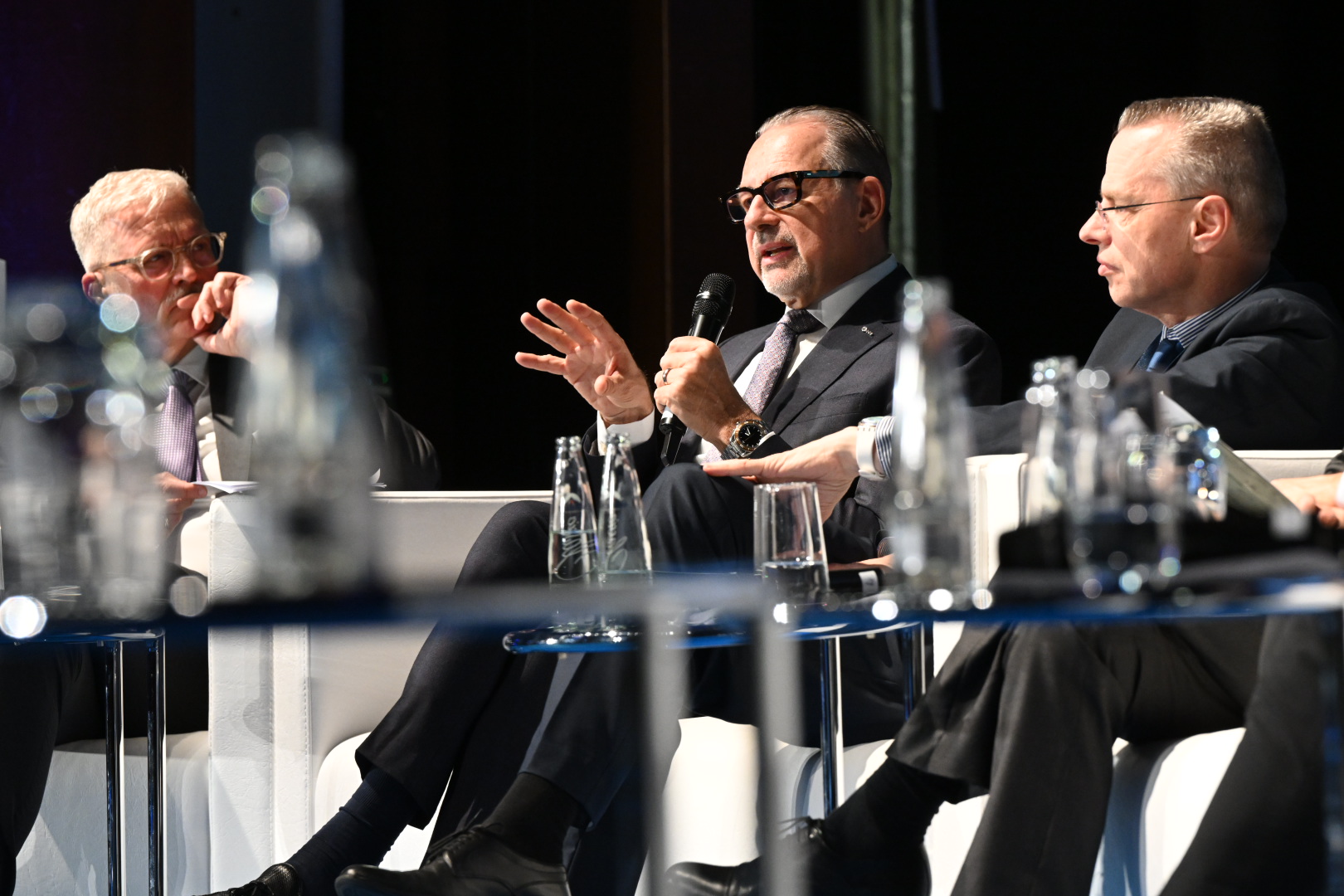

MUNICH — For more than a year, questions have swirled about Artemis changes and the Gateway’s role in U.S. lunar ambitions. Following NASA’s March 24 decision to halt work on Gateway, the lunar-orbiting station that had been intended to support astronauts before and after lunar surface missions, Europe now faces the challenge of redefining its contributions to the program.
That job falls to Josef Aschbacher, the director general of the European Space Agency. He told SpaceNews at the Munich Space Summit that the office is working to determine the depth of change and what it means for European space companies.
He said he plans to present to the ESA June Council with a plan forward.
Europe is involved in Artemis through three primary areas: the European Service Module, Gateway contributions and astronaut flight opportunities linked to those contributions.
The European Service Module (ESM) provides propulsion, power and other critical support to the Orion spacecraft. ESA currently has contracts through ESM-6, four of which have already been delivered to NASA.
ESA’s contributions to Gateway included the I-Hab habitation module, developed with major contributions from JAXA and contracted to Thales Alenia Space Italy; Lunar View, a refueling and docking module previously known as the ESPRIT Refueling Module and contracted to Thales Alenia Space France; and Lunar Link, a communications system between the Gateway and other lunar assets, mounted on HALO (NASA’s Habitation and Logistics Outpost), previously known as ESPRIT HLCS and also contracted to Thales Alenia Space France.
In parallel, NASA maintained direct bilateral industrial contracts with specific European companies. HALO, for example, was subcontracted to Thales Alenia Space Italy and delivered from Turin in March 2025.
European astronaut participation in future Artemis missions was also closely linked to Gateway’s development.
With the cancellation now confirmed, the question is how Europe will adjust its role. SpaceNews interviewed Aschbacher to discuss next steps for ESA.
The interview has been edited for clarity and brevity.
SpaceNews: What will happen to the European Service Modules? The first four have been delivered, but Artemis 3 in its new configuration is not the same as originally planned.
Josef Aschbacher: Following NASA’s new Artemis 3 flight configuration — it will demonstrate the docking of one or two lunar landers in low Earth orbit — the ESM will need some adaptations to ensure that it works correctly, as it will operate in low Earth orbit conditions. This will require some additional work.
I have already asked our teams to look into the necessary adaptations. We are working very closely with the NASA teams. We will soon be able to have a precise assessment, but I don’t expect major issues at this stage.
Will you need to go to the U.S. to work on the modules that have already been delivered?
That is exactly part of the assessment, whether we can do it there or not. We assume that it can be done there, but this has yet to be confirmed.
Artemis 4 was meant to fly with an upgraded version of the Space Launch System, which has recently been canceled. Will you need to change ESM-4, which has already been delivered?
It really depends on the architecture that NASA is developing. The ESA teams are working closely with NASA and industry.
All these discussions are happening right now as we speak. I can assure you that we are putting a lot of pressure on this process because it has to move very fast in order to make sure that the timelines are met.
The lunar Gateway has been suspended. ESA was directly involved with three elements: Lunar I-Hab, Lunar View and Lunar Link. What is going to happen to these components?
What do you do if there is a change in architecture? First, you need to see how far development has progressed. Can these developments be continued and finalized, and therefore allow the Gateway to be developed, maybe in a modified way, maybe without some elements?
The other option is whether developments that have already taken place can be utilized in a different way and redirected. And of course the third point we need to look into is how much funding is still unspent and can therefore be used for other purposes.
So all this analysis is ongoing. I cannot tell you the results at this stage because this still needs to be completed.
I will discuss the options and scenarios with my member states. We will decide on a way forward and then proceed accordingly. We are also coordinating with the other Gateway partners, Canada, Japan and the UAE.
There will be many meetings in the next few weeks, but I am planning to come back to the ESA June Council with a plan for the way forward.
Attached to the Gateway agreement there was the participation of one European astronaut in the Artemis 4 mission. What will happen to that part of the agreement?
Indeed, the Gateway context also included astronaut flights as a contribution from NASA. NASA will define the architecture and the future Artemis flights, and then I will discuss with NASA which opportunities are available.
The agreement that we have with NASA states that investments made by the partners, and we have the same agreement as Canada and Japan, are taken into account in any future evolution of the Gateway. So these discussions obviously need to take place now.










Related Posts


Stay Informed With the Latest & Most Important News
Previous Post
Next Post



Advertisement
-
 01Two Black Holes Observed Circling Each Other for the First Time
 -
 02From Polymerization-Enabled Folding and Assembly to Chemical Evolution: Key Processes for Emergence of Functional Polymers in the Origin of Life
 -
 03Astronomy 101: From the Sun and Moon to Wormholes and Warp Drive, Key Theories, Discoveries, and Facts about the Universe (The Adams 101 Series)
 -
 04True Anomaly hires former York Space executive as chief operating officer
 -
 05Φsat-2 begins science phase for AI Earth images
 -
 06Hurricane forecasters are losing 3 key satellites ahead of peak storm season − a meteorologist explains why it matters
 -
 07Binary star systems are complex astronomical objects − a new AI approach could pin down their properties quickly