
Now Reading: ESA weighing options to address exploration funding shortfall
-
01
ESA weighing options to address exploration funding shortfall


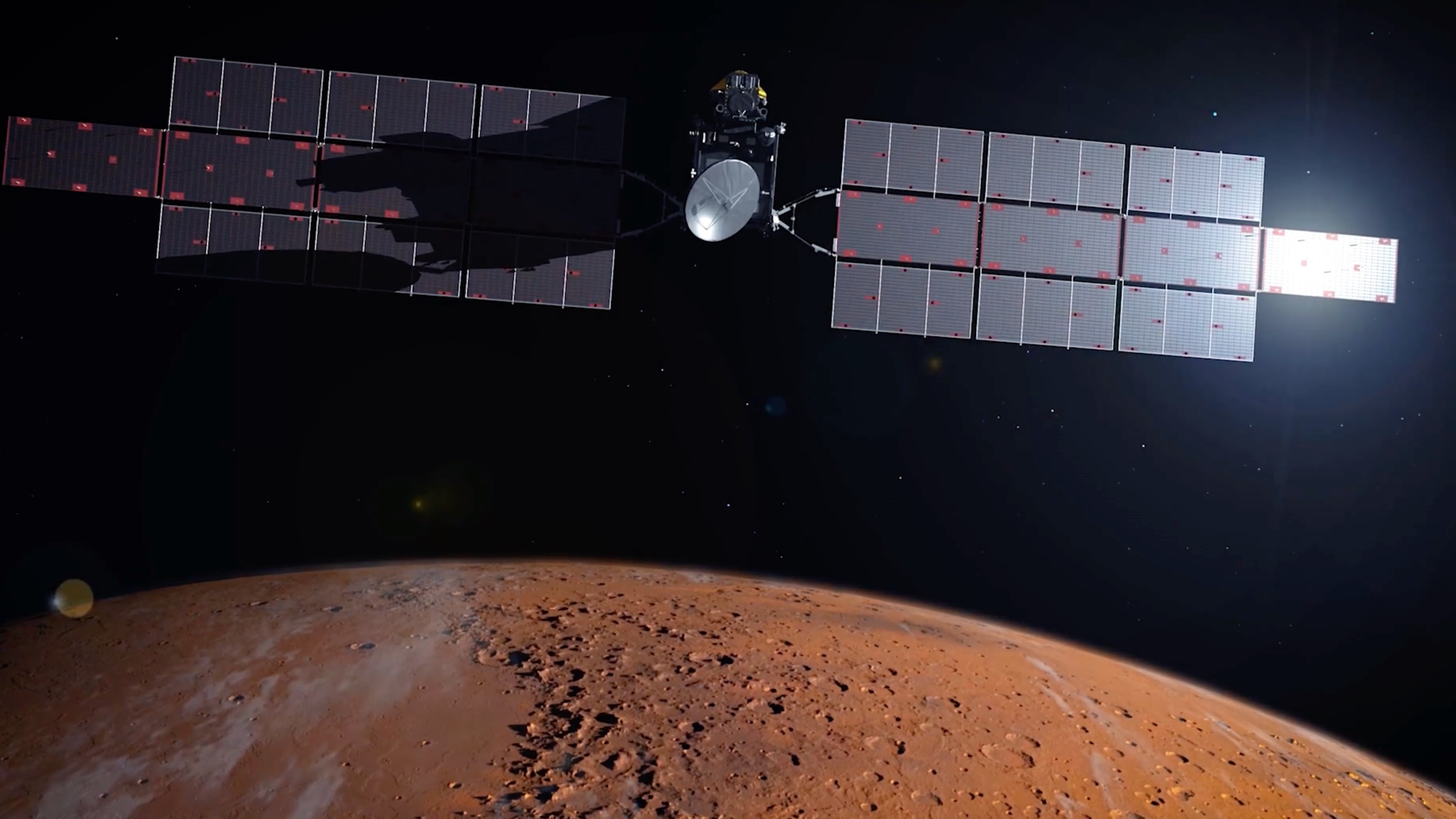

WASHINGTON — The European Space Agency expects to decide in February how to address a 20% funding shortfall in its exploration program.
At the agency’s ministerial conference last month, ESA’s member states agreed to provide more than 22 billion euros ($25.8 billion) for agency programs over the next three years. ESA issued a revised total of 22.3 billion euros on Dec. 2, slightly above its proposal of 22.25 billion euros.
Agency leaders highlighted the outcome of the ministerial at a Dec. 18 briefing after a meeting of the ESA Council. “I would like to use this occasion to thank my member states for the trust they have given to the ESA executive to provide the funding,” ESA Director General Josef Aschbacher said. “I’m very humbled and very proud.”
Not all parts of ESA benefited from the record funding. The agency’s human and robotic exploration directorate, which includes human spaceflight as well as lunar and Mars exploration, received only about 80% of its requested funding, a shortfall of nearly 800 million euros.
Daniel Neuenschwander, ESA’s director of human and robotic exploration, said the agency is reviewing how to accommodate the shortfall. “This is right now under assessment with the member states, and we will be in a position to give you more elements in February,” he said, after reviews by program boards.
One potential target for cuts is ZefERO, a proposed repurposing of the Earth Return Orbiter that ESA has been developing for the joint NASA-ESA Mars Sample Return (MSR) program. The orbiter was designed to collect samples placed in Mars orbit by a NASA mission and return them to Earth.
With the future of MSR increasingly uncertain because of high costs and potential NASA budget cuts, ESA asked member states at the ministerial to back a proposal to convert the orbiter into a standalone mission, dubbed ZefERO, focused on science and communications. “This will be assessed right now internally and then proposed as a way forward to the member states,” Neuenschwander said.
Neuenschwander said at the conclusion of the ministerial in November that other elements of the human and robotic exploration program, including a commercial low Earth orbit cargo service and the Argonaut lunar lander, had been confirmed.
ESA budget documents show that of the exploration funding subscriptions made at the ministerial, 704 million euros went to low Earth orbit activities and 620 million euros to lunar activities, compared with 445.3 million euros for Mars. The remainder went to exploration science or other programs, or was unallocated within exploration.
Elsewhere in the agency, Aschbacher said ESA is moving ahead with a new initiative funded at the ministerial, the European Resilience from Space (ERS) program. He said the program, which includes elements in communications, navigation and Earth observation, received 1.277 billion euros in subscriptions, with ESA leaving open the option for member states to provide additional funding until next November.
“It was a clear oversubscription in all three components,” Aschbacher said, despite reports that the program had suffered a shortfall.
ESA is still awaiting high-level requirements for the Earth observation element of ERS from the European Commission. The funding provided by member states at the ministerial is intended as a first step toward a future imaging satellite constellation that ESA and the European Union would co-fund. Simonetta Cheli, ESA’s director of Earth observation, said ESA expects to receive those requirements early next year.
“We will be going at full speed” on the program, Aschbacher said. “We will be going as fast as we can.”
Meeting with Isaacman
Aschbacher also used the briefing to congratulate Jared Isaacman, whose nomination as NASA administrator was confirmed by the U.S. Senate the previous day.
“I look forward to working closely with NASA and the new NASA administrator, as we have many projects and activities ongoing,” he said.
Aschbacher said later that he had not spoken with Isaacman during the yearlong confirmation process but would seek a meeting now that Isaacman is in place. That could take place during the Artemis 2 launch, scheduled as soon as early February, or the launch of the Crew-12 mission to the International Space Station, which includes ESA astronaut Sophie Adenot and is scheduled as soon as mid-February.
“There’s a lot to discuss,” Aschbacher said, citing cooperation in exploration and science between the agencies without identifying specific issues. “There are really many items to discuss.”










Related Posts
Stay Informed With the Latest & Most Important News
Previous Post
Next Post

Advertisement
-
 01Two Black Holes Observed Circling Each Other for the First Time
 -
 02From Polymerization-Enabled Folding and Assembly to Chemical Evolution: Key Processes for Emergence of Functional Polymers in the Origin of Life
 -
 03Astronomy 101: From the Sun and Moon to Wormholes and Warp Drive, Key Theories, Discoveries, and Facts about the Universe (The Adams 101 Series)
 -
 04True Anomaly hires former York Space executive as chief operating officer
 -
 05Φsat-2 begins science phase for AI Earth images
 -
 06Hurricane forecasters are losing 3 key satellites ahead of peak storm season − a meteorologist explains why it matters
 -
 07Binary star systems are complex astronomical objects − a new AI approach could pin down their properties quickly