
Now Reading: ESA’s CryoSat Satellite Expands Role by Measuring Earth’s Magnetic Field
-
01
ESA’s CryoSat Satellite Expands Role by Measuring Earth’s Magnetic Field


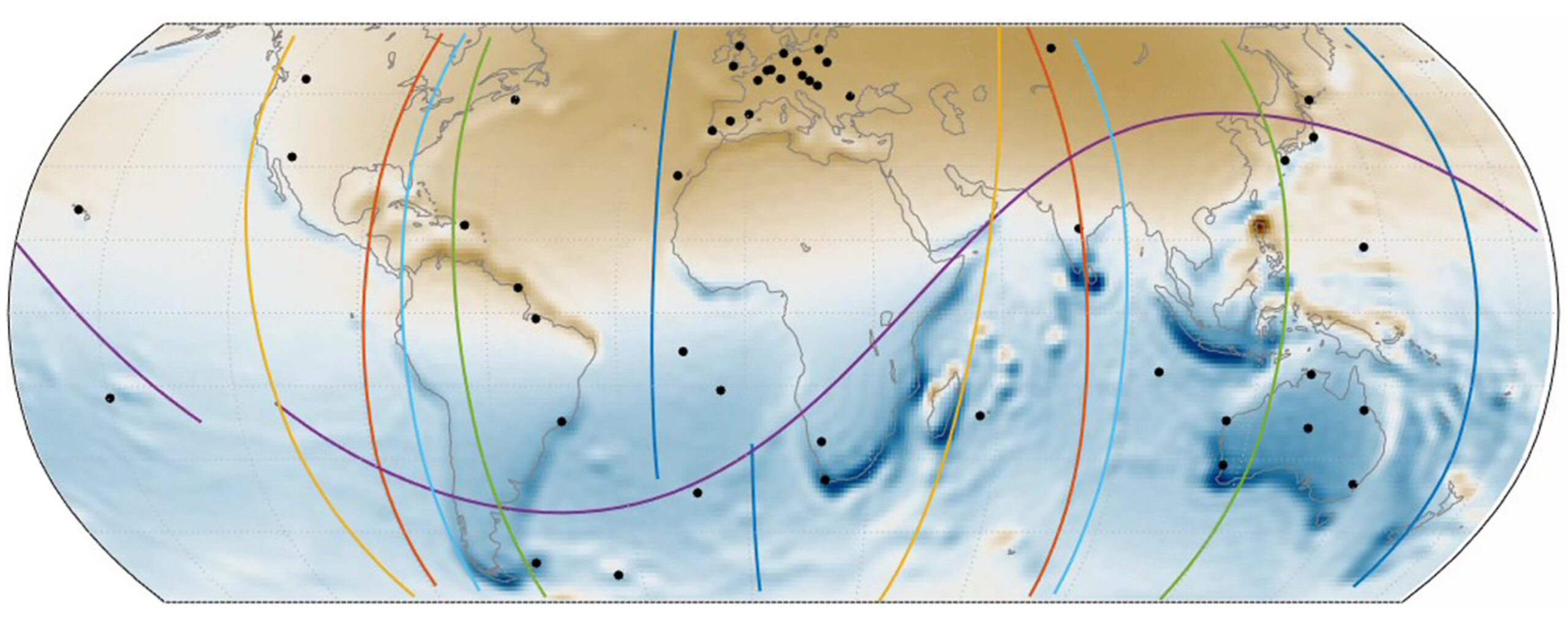

In a remarkable twist for satellite technology, the European Space Agency’s (ESA) CryoSat mission has demonstrated an unexpected capability: accurately measuring fluctuations in Earth’s magnetic field. While CryoSat has long been recognized as an important tool for observing polar ice dynamics, a software upgrade has now transformed it into an instrument that contributes valuable data about geomagnetic phenomena.
Originally launched nearly 16 years ago, CryoSat primarily focuses on gathering precise measurements of ice thickness in polar regions using advanced radar technology. Its recent software enhancement adjusted the satellite’s platform magnetometer, a component initially intended to assist with positioning rather than scientific measurement. This repurposing not only extends CryoSat’s capabilities but also complements the work of ESA’s dedicated magnetic field mission, Swarm, which serves as the primary source of geomagnetic data within the agency’s Earth Explorer program.
The upgrade effectively creates a second magnetometry mission alongside Swarm, allowing for a more nuanced understanding of the Earth’s magnetic environment. As CryoSat and the future NanoMagSat—an upcoming magnetic field-measuring satellite—work in concert, they enhance the broader efforts of ESA to monitor our planet’s behavior and changes.
ESA’s Mission Manager for Swarm, Anja Stromme, highlighted the significance of using CryoSat’s platform magnetometer in an innovative manner to measure external variations in magnetic fields. The data produced from this new functionality is already proving to be of great quality, filling gaps left by other non-magnetic missions and aiding the geomagnetic research community.
The utility of CryoSat’s new skills became evident earlier this year, during a powerful geomagnetic storm sparked by a significant X-class solar flare on January 18. This event released a torrent of high-energy particles, leading to one of the most intense radiation storms ever recorded. The subsequent auroras could be seen at unusually low latitudes, extending as far south as Mexico.
During this storm, CryoSat contributed crucial data, which along with Swarm’s observations, provided comprehensive insights into the disturbance. Researchers employed a novel data analysis method to visualize the magnetic storm’s impact, showcasing CryoSat’s newfound role in scientific analysis.
Tommaso Parrinello, ESA’s CryoSat Mission Manager, expressed enthusiasm about this innovative repurposing of existing technology, emphasizing its value for scientific inquiry. He noted that the formerly operational system, used for stabilizing the satellite, is now generating useful scientific datasets at no additional cost. With considerable potential still ahead for both CryoSat and Swarm as they continue their missions beyond their expected lifetimes, the scientific community looks forward to more discoveries stemming from this dual-capacity satellite collaboration.










Related Posts
Stay Informed With the Latest & Most Important News
Previous Post
Next Post


Advertisement
-
 01Two Black Holes Observed Circling Each Other for the First Time
 -
 02From Polymerization-Enabled Folding and Assembly to Chemical Evolution: Key Processes for Emergence of Functional Polymers in the Origin of Life
 -
 03Astronomy 101: From the Sun and Moon to Wormholes and Warp Drive, Key Theories, Discoveries, and Facts about the Universe (The Adams 101 Series)
 -
 04True Anomaly hires former York Space executive as chief operating officer
 -
 05Φsat-2 begins science phase for AI Earth images
 -
 06Hurricane forecasters are losing 3 key satellites ahead of peak storm season − a meteorologist explains why it matters
 -
 07Binary star systems are complex astronomical objects − a new AI approach could pin down their properties quickly