
Now Reading: Estimation Of The Tidal Heating In The TRAPPIST-1 Planets. Influence Of The Internal Structure
-
01
Estimation Of The Tidal Heating In The TRAPPIST-1 Planets. Influence Of The Internal Structure

Estimation Of The Tidal Heating In The TRAPPIST-1 Planets. Influence Of The Internal Structure

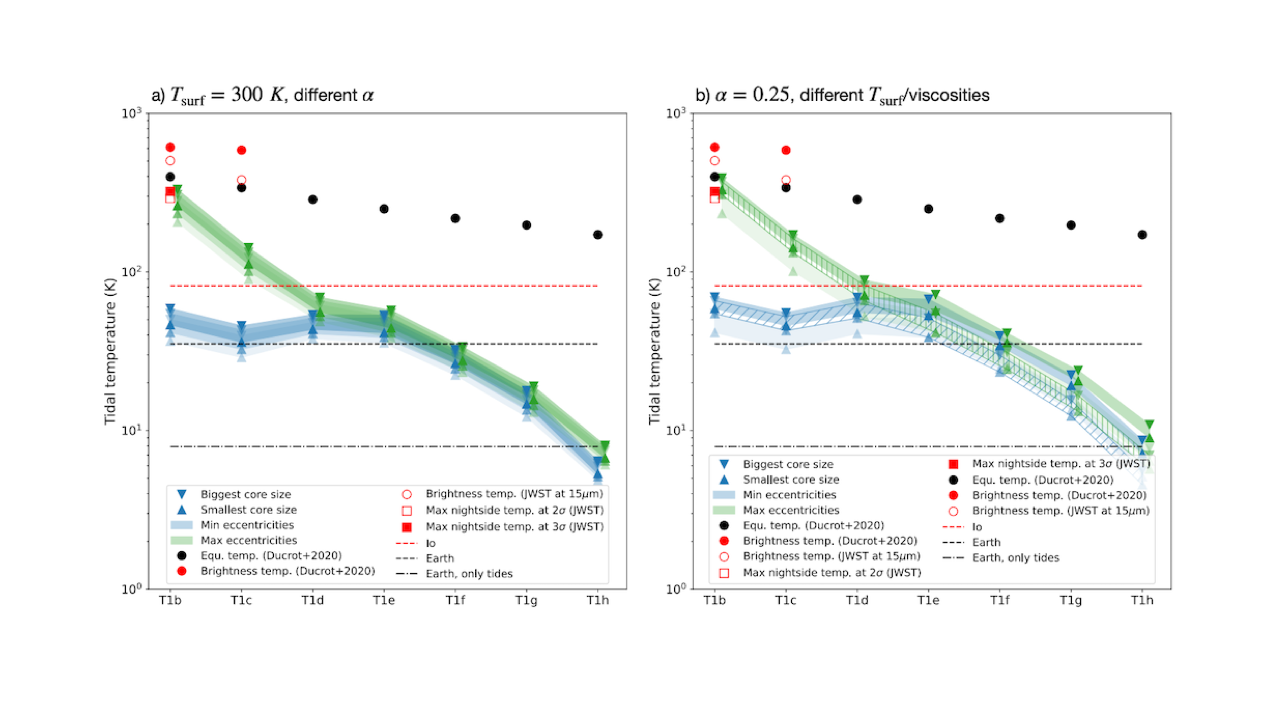
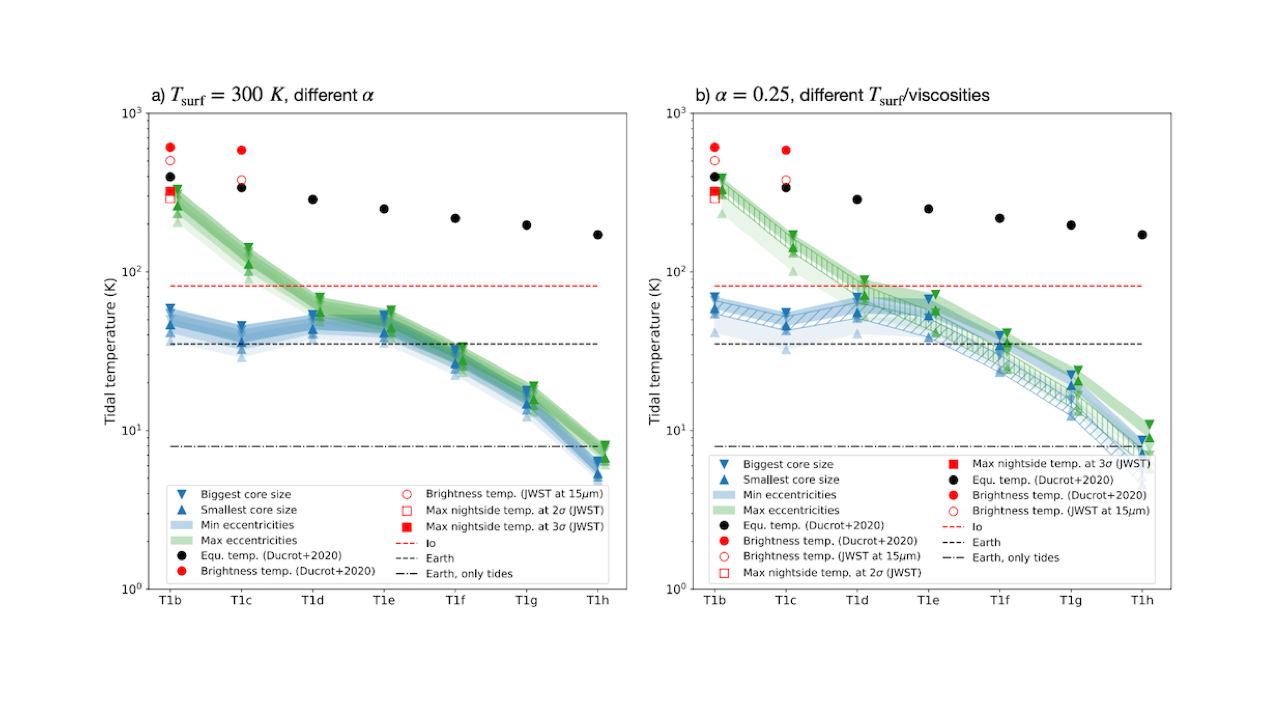
C.1: Same as Figure 4 but for the tidal temperature. These values are compared with the equilibrium temperature of all planets (full black circles) and the brightness temperature of T-1b and c (full red circles) estimated in Ducrot et al. (2020). We also give the recently acquired brightness temperatures measured by the JWST: the temperature of planet b comes from Greene et al. (2023), and that of planet c from Zieba et al. (2023). — astro-ph.EP
With the arrival of JWST observations of the TRAPPIST-1 planets, it is timely to reassess the contribution of tidal heating to their heat budget. JWST thermal phase curves could reveal endogenic heating through an anomalously high nightside temperature, providing an opportunity to estimate tidal heating.
In this study, we revisit the tidal heating of these planets and propose a simple method to compute the tidal heating profile across a broad range of parameters. Our approach leverages a known formulation for synchronously rotating planets on low-eccentricity orbits and the fact that the profile shape depends solely on internal structure.
We calculate the tidal heating contributions for all T-1 planets, with a particular focus on the impact of internal structure and eccentricity uncertainties on their total heat budget.
Although the masses and radii of these planets are well constrained, degeneracies remain in their internal structure and composition. For volatile-poor planets of silicate-rock compositions, we investigate the role of core iron content by exploring a range of core sizes. For each structure, we compute the degree-two gravitational Love number, k2, and the corresponding tidal heating profiles.
We assume sub-solidus temperatures profiles that are decoupled from interior heat production, which means our estimates are conservative and likely represent minimum values.
We find that the tidal heat flux for T-1b and c can exceed Io’s heat flux, with uncertainties primarily driven by eccentricity. These high fluxes may be detectable with JWST. For T-1f to g, the tidal flux remains below Earth’s geothermal flux, suggesting that tidal heating is unlikely to be the dominant energy source. For planets d and e, however, tidal heating likely dominates their heat budget, potentially driving intense volcanic and tectonic activity, which could enhance their habitability prospects.
Emeline Bolmont, Mariana Sastre, Alexandre Revol, Mathilde Kervazo, Gabriel Tobie
Comments: 14 pages, 6 figures. Accepted in A&A
Subjects: Earth and Planetary Astrophysics (astro-ph.EP)
Cite as: arXiv:2601.03408 [astro-ph.EP] (or arXiv:2601.03408v1 [astro-ph.EP] for this version)
https://doi.org/10.48550/arXiv.2601.03408
Focus to learn more
Submission history
From: Emeline Bolmont
[v1] Tue, 6 Jan 2026 20:51:06 UTC (1,672 KB)
https://arxiv.org/abs/2601.03408
Astrobiology,










Related Posts
Stay Informed With the Latest & Most Important News
Previous Post
Next Post



Advertisement
-
 01Two Black Holes Observed Circling Each Other for the First Time
 -
 02From Polymerization-Enabled Folding and Assembly to Chemical Evolution: Key Processes for Emergence of Functional Polymers in the Origin of Life
 -
 03Astronomy 101: From the Sun and Moon to Wormholes and Warp Drive, Key Theories, Discoveries, and Facts about the Universe (The Adams 101 Series)
 -
 04True Anomaly hires former York Space executive as chief operating officer
 -
 05Φsat-2 begins science phase for AI Earth images
 -
 06Hurricane forecasters are losing 3 key satellites ahead of peak storm season − a meteorologist explains why it matters
 -
 07Binary star systems are complex astronomical objects − a new AI approach could pin down their properties quickly