
Now Reading: Estonian Astrobiology Day 2026
-
01
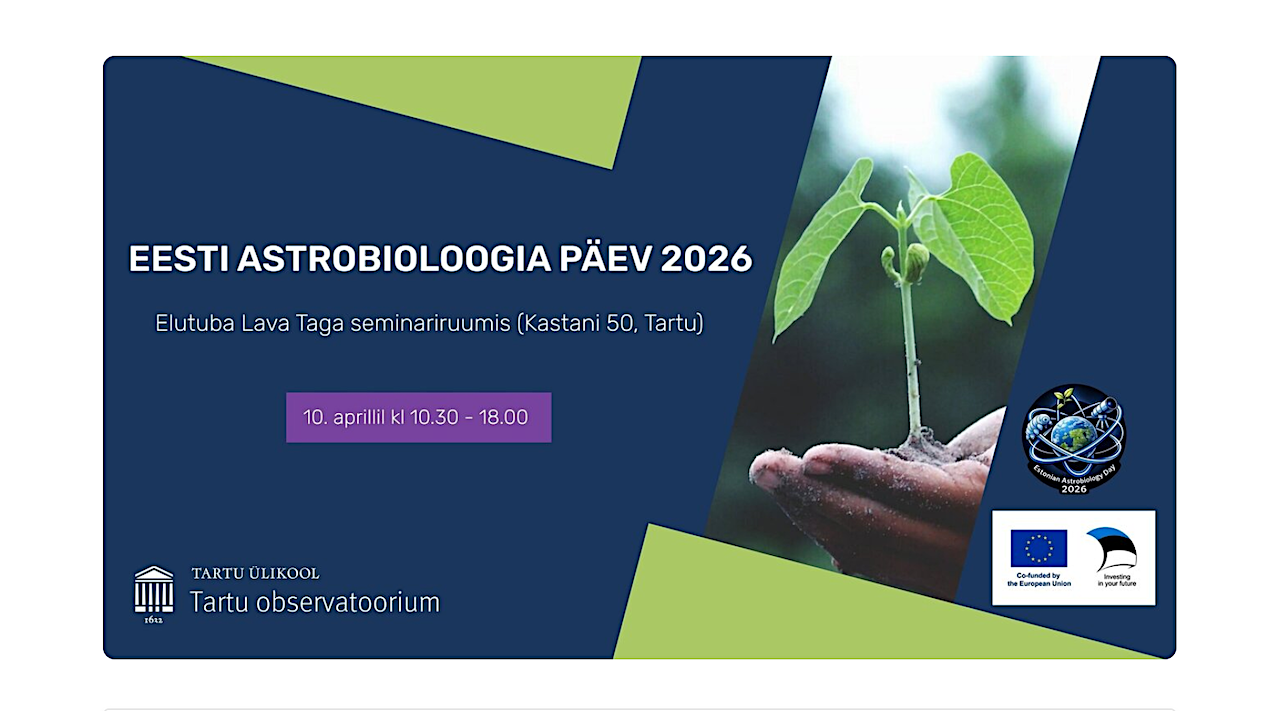
Estonian Astrobiology Day 2026



Estonian Astrobiology Day 2026
The first Estonian Astrobiology Day will take place on 10 April. The aim of the event is to create a community of astrobiology enthusiasts in Estonia, bringing together researchers, students, and anyone interested in the origin of life and its distribution in the universe.
Astrobiology is a rapidly developing interdisciplinary field. The goal of the event is to bring together people and ideas from this area, create new opportunities for collaboration, and provide an overview of the current state and future of astrobiology in Estonia and Europe.
The scientific programme includes invited talks by international guest speakers:
Dr Ruth-Sophie Taubner (Graz, Space Research Institute) will present the challenges and opportunities for Astrobiologists in small countries like Austria or Estonia, and give an insight into the European associations EANA and AbGradE.
Dr Wolf Geppert (Stockholm University) will provide a broader overview of European astrobiology, including existing networks, collaboration opportunities, and available funding schemes.
In addition, researchers from the University of Tartu will introduce astrobiology-related research and opportunities in Tartu, ranging from current research directions to student projects and supervision possibilities. The programme also includes contributed talks by registered participants, offering a platform for early-career researchers, students, and enthusiasts to present their ideas and work.
In the second half of the day, a poster session will take place, designed to encourage informal discussions and interaction. This session provides an excellent opportunity to network, explore potential collaborations, ask questions, and exchange ideas in a relaxed atmosphere.
Please register in advance to participate in the event.
The event will be held in English and is open to everyone interested.
The schedule will be announced soon.
The event is organised from the project “Cooperation between universities to promote doctoral studies” (2021-2027.4.04.24-0003), which is co-funded by the European Union.










Related Posts
Stay Informed With the Latest & Most Important News



Advertisement
-
 01Two Black Holes Observed Circling Each Other for the First Time
 -
 02From Polymerization-Enabled Folding and Assembly to Chemical Evolution: Key Processes for Emergence of Functional Polymers in the Origin of Life
 -
 03Astronomy 101: From the Sun and Moon to Wormholes and Warp Drive, Key Theories, Discoveries, and Facts about the Universe (The Adams 101 Series)
 -
 04True Anomaly hires former York Space executive as chief operating officer
 -
 05Φsat-2 begins science phase for AI Earth images
 -
 06Hurricane forecasters are losing 3 key satellites ahead of peak storm season − a meteorologist explains why it matters
 -
 07Binary star systems are complex astronomical objects − a new AI approach could pin down their properties quickly