
Now Reading: Europa’s Ice Thickness And Subsurface Structure Characterized By The Juno Microwave Radiometer
-
01
Europa’s Ice Thickness And Subsurface Structure Characterized By The Juno Microwave Radiometer

Europa’s Ice Thickness And Subsurface Structure Characterized By The Juno Microwave Radiometer

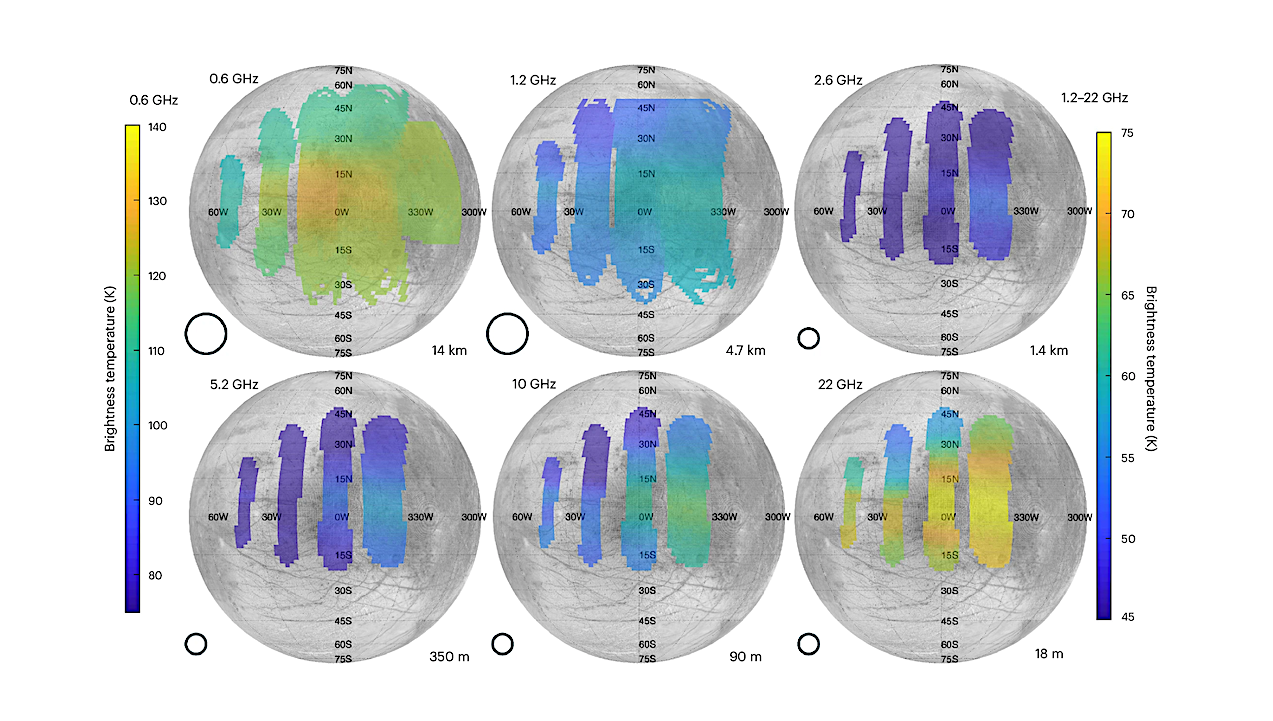
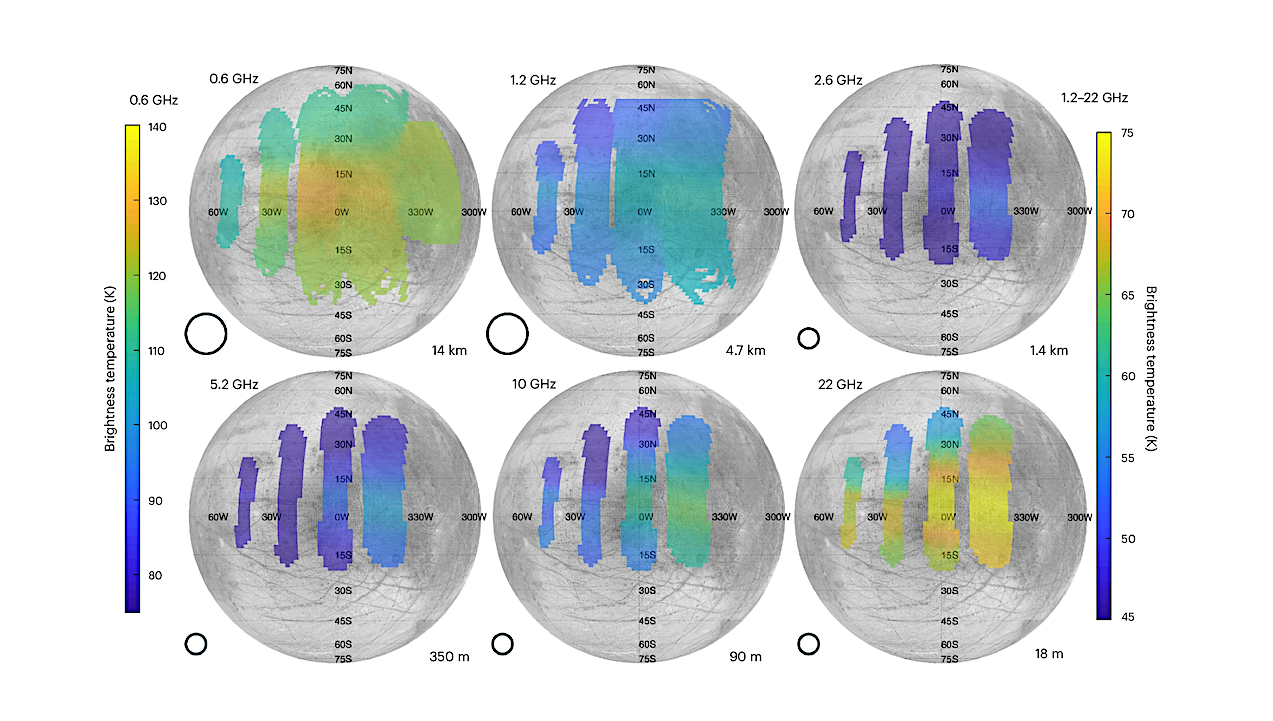
The 0.6-GHz data are much brighter due to reflected synchrotron emission and are, therefore, shown with a different colour scale. The terminator was at approximately 10° W longitude, with the right-hand side in sunlight for these maps. The approximate sounding depth (50% contribution for pure, solid ice) is shown in the lower right of each map, and a typical beam size is shown in the lower left of each map. — Nature
Jupiter’s moon Europa is thought to harbour a saltwater ocean beneath a variously disrupted ice shell, and it is, thus, one of the highest priority astrobiology targets in the Solar System.
Estimates of the ice-shell thickness range from 3 km to over 30 km, and observations by the Galileo spacecraft indicated widespread regions of ice disruption (chaotic terrain) leading to speculation that the ice shell may contain subsurface cracks, faults, pores or bubbles.
If persistent, subsurface cracks could provide pathways for habitability by facilitating the transport of oxygen and nutrients between the surface and the ocean. Here we report on observations of Europa’s subsurface ice shell obtained by the Juno microwave radiometer in 2022. For the idealized case of pure water ice, the data are consistent with the existence of a thermally conductive ice shell with a thickness of 29 ± 10 km and with the presence of cracks, pores or other scatterers extending to depths of hundreds of metres below the surface with a characteristic size smaller than a few centimetres in radius.
An ice-shell salinity of 15 mg kg−1, as indicated by models based on terrestrial marine ice, would reduce our estimate of the thickness of the ice shell by about 5 km, substantially less than our 10 km uncertainty. The low volume fraction, small size and shallow depth of the scatterers indicate that the fracture interfaces observed at Europa’s surface are alone unlikely to be capable of carrying nutrients between the surface and the ocean.
Astrobiology











Related Posts
Stay Informed With the Latest & Most Important News



Advertisement
-
 01Two Black Holes Observed Circling Each Other for the First Time
 -
 02From Polymerization-Enabled Folding and Assembly to Chemical Evolution: Key Processes for Emergence of Functional Polymers in the Origin of Life
 -
 03Astronomy 101: From the Sun and Moon to Wormholes and Warp Drive, Key Theories, Discoveries, and Facts about the Universe (The Adams 101 Series)
 -
 04True Anomaly hires former York Space executive as chief operating officer
 -
 05Φsat-2 begins science phase for AI Earth images
 -
 06Hurricane forecasters are losing 3 key satellites ahead of peak storm season − a meteorologist explains why it matters
 -
 07Binary star systems are complex astronomical objects − a new AI approach could pin down their properties quickly