
Now Reading: Europa’s ocean ‘quiet and lifeless,’ new research suggests
-
01
Europa’s ocean ‘quiet and lifeless,’ new research suggests


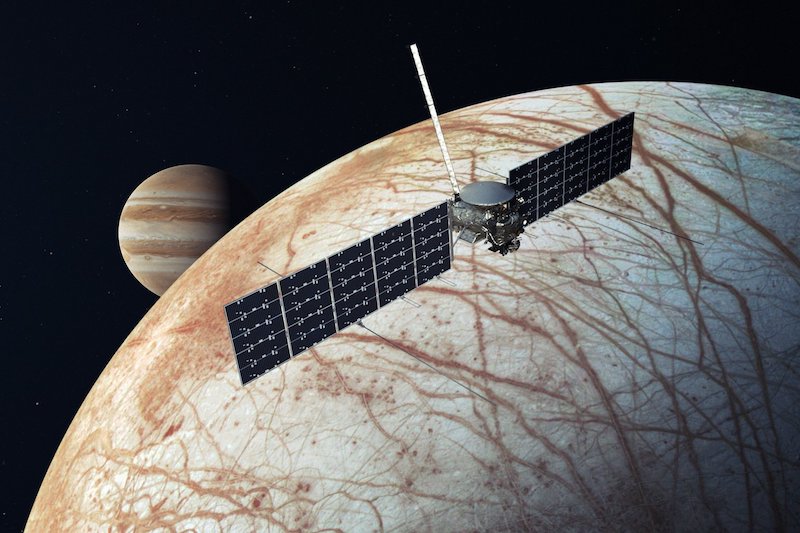
- Jupiter’s moon Europa has a global water ocean beneath its icy surface. Could there be life there?
- The seafloor of the ocean might not be geologically active enough to support life, such as through hydrothermal vents, a new study suggests.
- It’s not the final word on Europa, however; other studies have hinted at potential habitability, including in lakes within the icy shell above the ocean.
EarthSky’s 2026 lunar calendar shows the moon’s phase for every day of the year. Get yours today!
Is Europa’s ocean habitable?
Is there life on Jupiter’s moon Europa The prospect has excited the public and scientists alike ever since the Galileo spacecraft found the first evidence for a salty ocean beneath its icy crust in the mid-late 1990s. But a new study casts doubt on the ocean being habitable. The researchers, from Washington University in St. Louis, said on January 6, 2026, that the seafloor likely lacks the geologic activity needed to sustain life.
In fact, the study says that Europa’s seafloor might be “quiet and lifeless.” The findings are based on Europa’s size, its rocky core and Jupiter’s gravitational influence. It’s not the final word yet however, and NASA’s Europa Clipper should be able to give us some more definitive answers to the many questions regarding Europa’s habitability after it arrives in 2030.
The new peer-reviewed findings were published in Nature Communications on January 6, 2026.
New paper alert!tl;dr: the seafloor of Europa is probably tectonically inert, meaning little to no active fracturing that could expose fresh rock to seawater.Without such water–rock reactions the prospect for there being life within Europa just took a big hit.A thread:
— Paul Byrne (@theplanetaryguy.bsky.social) 2026-01-06T17:55:13.348Z
A ‘quiet and lifeless’ seafloor?
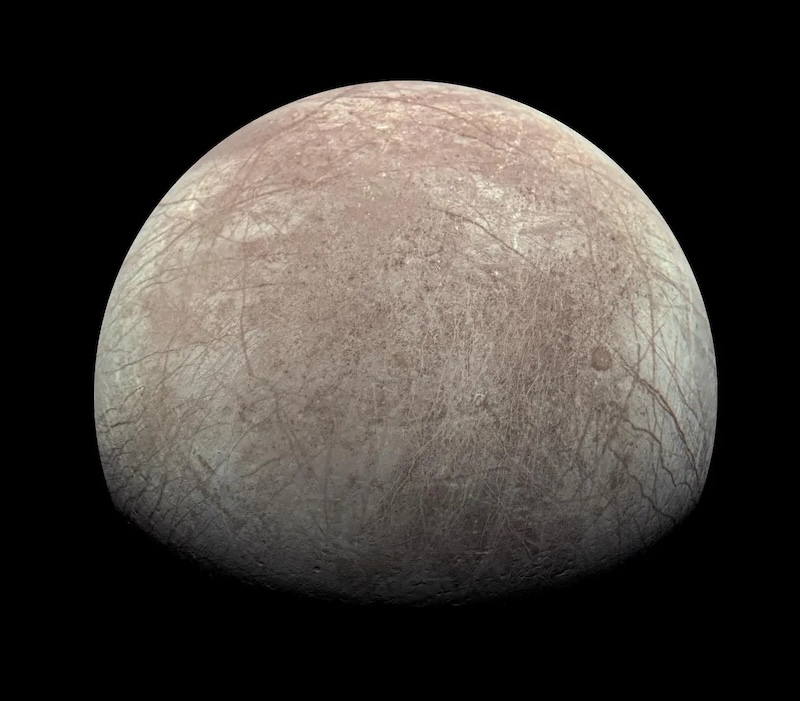
Europa’s ocean is global, and actually contains more water than all the oceans on Earth. It is also salty like Earth’s oceans. But is it habitable?
Scientists are still trying to answer that question. Indeed, Europa has become one of the highest priority targets in the search for life elsewhere in the solar system. Some studies have suggested that yes, Europa’s ocean could be a potential home for life of some kind.
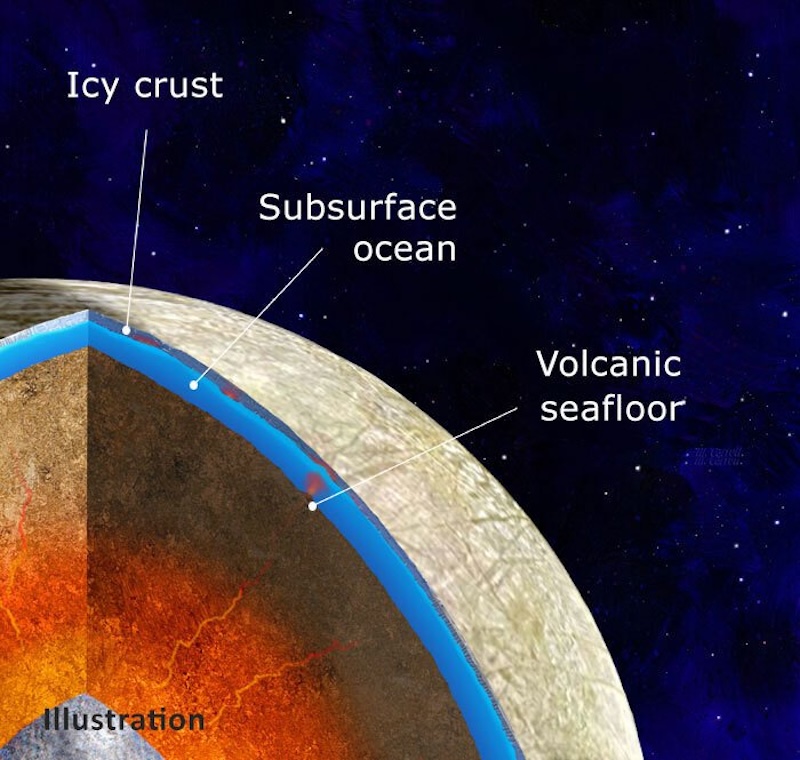
The new study, however, throws some cold water on the idea. It suggests that the seafloor is likely mostly – if not completely – geologically inactive. A lack of hydrothermal vents or other geologic activity such as fracturing in the seafloor to expose fresh rock to seawater would mean a lack of chemical nutrients to provide food to microbial life.
As lead author Paul Byrne, an associate professor at Washington University in St. Louis, explained:
I’m really interested to know what that seafloor looks like. For all of the talk about the ocean itself, there has been little discussion about the seafloor. If we could explore that ocean with a remote-control submarine, we predict we wouldn’t see any new fractures, active volcanoes or plumes of hot water on the seafloor. Geologically, there’s not a lot happening down there. Everything would be quiet.
The findings are similar to those of two other studies from 2024.
Some tidal heating, but not enough?
Much of the heat that is inside Europa would come from tidal heating. This happens as Jupiter’s powerful gravity pulls and squeezes the interior of Europa. There must be some heating still occurring inside Europa, as the ocean is liquid and not frozen. The same thing happens on Jupiter’s largest inner moon Io, which is why it is so volcanically active.
But there might not be enough tidal heating on Europa to help drive geologic activity inside the moon. Byrne said:
Europa likely has some tidal heating, which is why it’s not completely frozen. And it may have had a lot more heating in the distant past. But we don’t see any volcanoes shooting out of the ice today like we see on Io, and our calculations suggest that the tides aren’t strong enough to drive any sort of significant geologic activity at the seafloor.
If the seafloor really is that quiet and inactive, it lessens the chances for life to exist in the ocean. Byrne added:
The energy just doesn’t seem to be there to support life, at least today.
‘That’s why we explore’
The possibility of Europa being lifeless doesn’t disappoint Byrne. He said:
I’m not upset if we don’t find life on this particular moon. I’m confident that there is life out there somewhere, even if it’s 100 light-years away. That’s why we explore, to see what’s out there.

Still hope for life on Europa
It should be noted that this is one study, and not the final word on Europa. There is evidence for active geology on its icy surface, for example. And a previous study from 2021 suggested that there might indeed be enough tidal heating for volcanic (hydrothermal) activity on the seafloor.
Some other recent studies say that Europa’s ice shell is likely thicker than previously thought. That would make it more difficult for carbon or other molecules needed for life to penetrate the ice to the ocean below, or vice versa. However, a study from 2023 revealed deposits of carbon dioxide on its surface that likely did come from its ocean below.
There is also growing evidence for lakes of water within the ice shell itself, that might be potentially habitable. Europa’s unusual double ridges also hint at bodies of water with the ice shell.
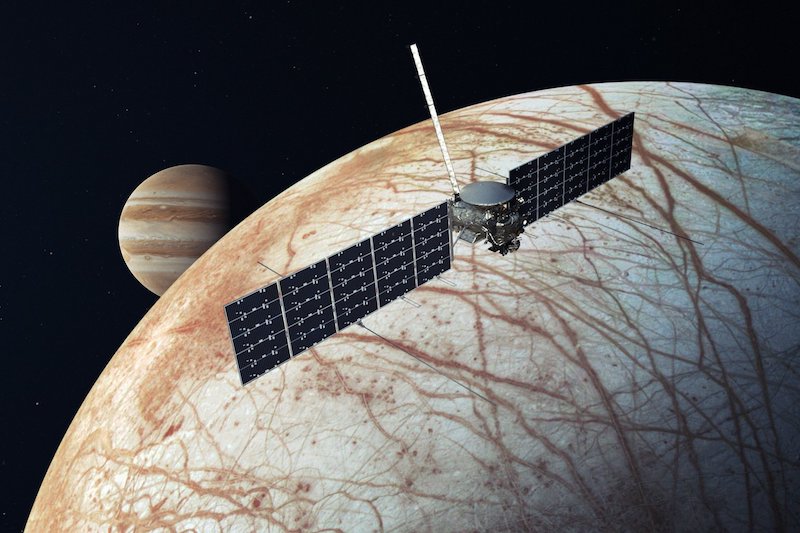
NASA’s Europa Clipper will arrive at Europa in 2030. The detailed study of Europa by that mission should provide more concrete data on just what conditions are like inside this fascinating ocean world.
Bottom line: Is Europa’s ocean habitable? A new study suggests it might be ‘quiet and lifeless,’ with little to no geologic activity on the seafloor.
Source: Little to no active faulting likely at Europa’s seafloor today
Via Washington University in St. Louis
Read more: Strange ‘spider’ on Europa hints at water lurking below
Read more: Do Europa’s odd ridges indicate life?
The post Europa’s ocean ‘quiet and lifeless,’ new research suggests first appeared on EarthSky.










Related Posts
Stay Informed With the Latest & Most Important News
Previous Post
Next Post


Advertisement
-
 01Two Black Holes Observed Circling Each Other for the First Time
 -
 02From Polymerization-Enabled Folding and Assembly to Chemical Evolution: Key Processes for Emergence of Functional Polymers in the Origin of Life
 -
 03Astronomy 101: From the Sun and Moon to Wormholes and Warp Drive, Key Theories, Discoveries, and Facts about the Universe (The Adams 101 Series)
 -
 04True Anomaly hires former York Space executive as chief operating officer
 -
 05Φsat-2 begins science phase for AI Earth images
 -
 06Hurricane forecasters are losing 3 key satellites ahead of peak storm season − a meteorologist explains why it matters
 -
 07Binary star systems are complex astronomical objects − a new AI approach could pin down their properties quickly