
Now Reading: European eyes on Artemis
-
01
European eyes on Artemis



31/03/2026
334 views
10 likes
When the four astronauts of Artemis II lift off to travel towards the Moon for the first time in over 50 years, Europe will be travelling with them – not only through the European Service Module that powers their spacecraft, but also through teams of engineers and medical specialists monitoring every move from Earth.
From ESA centres in the Netherlands and Germany to NASA’s Mission Control Center in Houston, European experts will follow the mission around the clock, analysing data, anticipating risks and ensuring that both the crew and their spacecraft remain safe throughout the journey.
Houston – Mission Evaluation Room
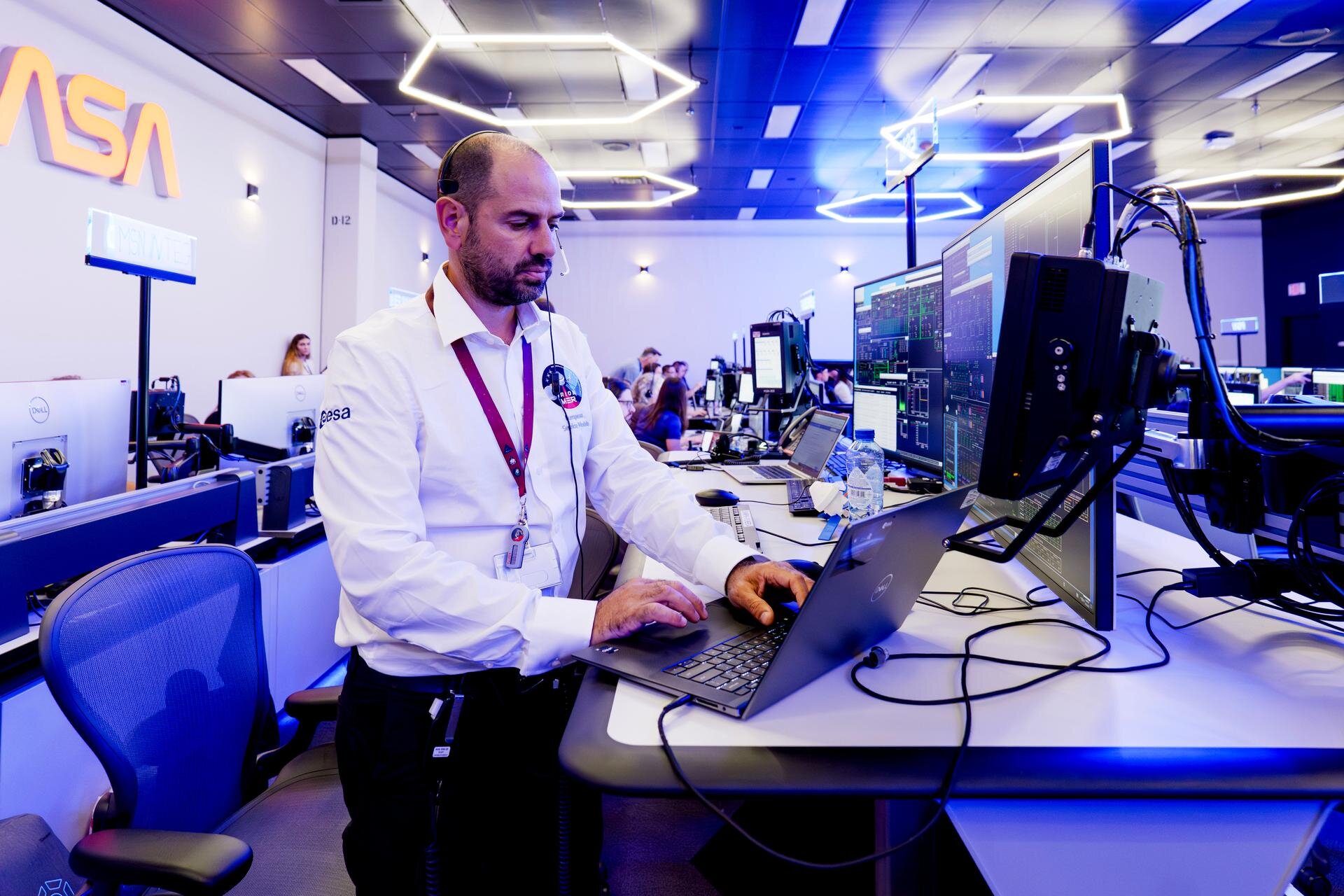
Just next door to the historic Apollo flight control room at NASA’s Johnson Space Center sits the Mission Evaluation Room (MER). Here, over 200 specialists from NASA, ESA, Airbus and Lockheed Martin will analyse Orion’s performance in detail and advise flight controllers in real time.
European engineers monitor pressures, temperatures, voltages, fuel levels and more from their module, particularly during dynamic phases of the mission such as engine burns. While flight controllers operate the spacecraft, the MER team know the spacecraft inside-out and provide deep subsystem knowledge and long-term analysis.
“Our job in MER is not only to monitor but also to anticipate,” says Luca Fossati, ESM mission and flight operations system engineer at ESA. “If we see something that isn’t behaving exactly as it should – even if it’s not yet an anomaly – we try to prevent it. Our goal is to look ahead and avoid problems before they happen.”
Also in Houston, representatives from ESA’s Space Medicine Team will observe mission operations alongside international partners from NASA, the Canadian Space Agency (CSA), and the Japanese Aerospace Exploration Agency (JAXA). From a dedicated observation room with access to real-time data and communications, they will follow medical activities, wearable systems such as EveryWear, and decision-making processes, strengthening coordination with ESA’s European Astronaut Centre and advancing Europe’s deep-space medical operations expertise.
The Netherlands – Eagle Room
At ESA’s ESTEC technical centre in the Netherlands, a room known as Eagle serves as Europe’s mission evaluation hub for the European Service Module. Engineers monitor the spacecraft around the clock, using dedicated consoles for spacecraft operations, propulsion, avionics, thermal control and life-support resources, mechanisms and power, and safety.
The teams analyse a continuous stream of live telemetry from the spacecraft and stand ready to respond to any anomaly. Eagle is directly connected to the Mission Evaluation Room at NASA’s Johnson Space Center in Houston, together forming a transatlantic network of experts who know Orion better than anyone else.
“Because we built the spacecraft, we know every bit of it, down to the last sensor. That’s why, in case of anomalies, we can confidently evaluate whether the mission is safe to continue and how to make any necessary adjustments during flight,” shares Michael Flach, orbital propulsion subsystem architect for the European Service Module at Airbus.
Operating from Europe also keeps the team closely linked to the industrial partners in 10 ESA Member States who built the module. From Eagle, engineers can coordinate directly with supplier companies if needed, while continuing work on future European Service Modules and other exploration missions.
Germany – EveryWear
At ESA’s European Astronaut Centre (EAC) near Cologne, Germany, another team prepares to support the mission: the engineers behind EveryWear, a secure medical tracking application developed in Europe and used for nearly a decade on the International Space Station.
Originally developed by MEDES for the French space agency CNES, EveryWear allows astronauts to log nutrition and medication intake, complete medical questionnaires and communicate privately and securely with flight surgeons. For Artemis II, the software has been adapted from the Station’s iOS-based tablets to Orion’s Windows-based systems.
Security is at the heart of the system. All medical data are encrypted at the source and can only be accessed by the intended recipient using a private key. As there are no ESA astronauts on Artemis II, the EAC team will not have access to crew medical data. Instead, this European-developed software equips NASA and CSA flight surgeons with the secure tools they need to monitor their astronauts’ health throughout the mission.
“Our four team members will be on console throughout the mission, ready to answer any questions from the crew or flight control team,” explains Salvi Verma, EveryWear operations team lead at ESA. “The ideal scenario is that the software performs perfectly and we are simply listening in – but we are prepared to resolve any issue quickly.”
Europe on console
Together, the Houston MER, ESTEC Eagle Room and EAC EveryWear teams form a network of European eyes on the Artemis II mission that crosses continents and time zones, bringing unique expertise from spacecraft subsystems to astronaut health monitoring.
Their coordinated work highlights Europe’s heritage in human spaceflight and dedication to ensuring mission success.










Related Posts


Stay Informed With the Latest & Most Important News
Previous Post
Next Post




Advertisement
-
 01Two Black Holes Observed Circling Each Other for the First Time
 -
 02From Polymerization-Enabled Folding and Assembly to Chemical Evolution: Key Processes for Emergence of Functional Polymers in the Origin of Life
 -
 03Astronomy 101: From the Sun and Moon to Wormholes and Warp Drive, Key Theories, Discoveries, and Facts about the Universe (The Adams 101 Series)
 -
 04True Anomaly hires former York Space executive as chief operating officer
 -
 05Φsat-2 begins science phase for AI Earth images
 -
 06Hurricane forecasters are losing 3 key satellites ahead of peak storm season − a meteorologist explains why it matters
 -
 07Binary star systems are complex astronomical objects − a new AI approach could pin down their properties quickly