
Now Reading: Exo-Geoscience Perspectives Beyond Habitability
-
01
Exo-Geoscience Perspectives Beyond Habitability


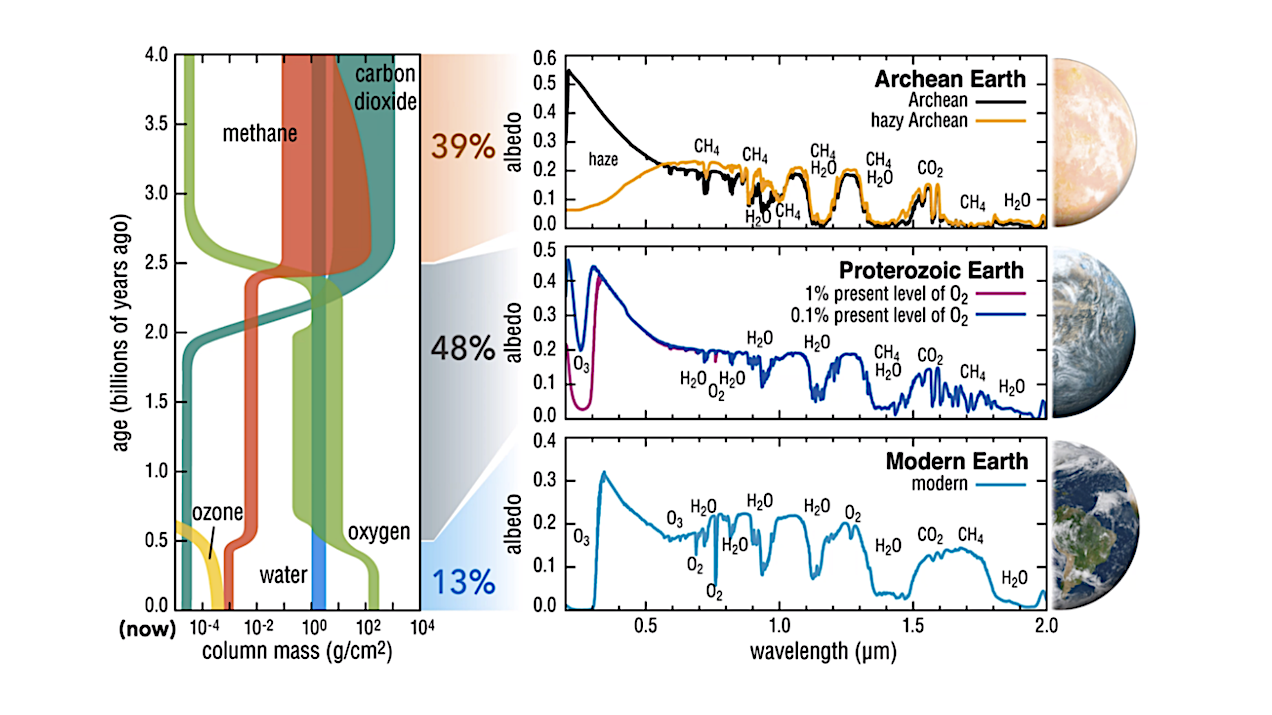

Earth’s planetary spectra through time as seen with the LUVOIR concept mission (LUVOIR
Team, 2019). Credit: G. Arney, S. Domagal-Goldman, T. B. Griswold (NASA GSFC) — astro-ph.EP
This article reviews the emerging field of exo-geoscience, focusing on the geological and geophysical processes thought to influence the evolution and (eu)habitability of rocky exoplanets.
We examine the possible roles of planetary interiors, tectonic regimes, continental coverage, volatile cycling, magnetic fields, and atmospheric composition and evolution in shaping long-term climate stability and biospheric potential. Comparisons with Earth and other planets in the Solar System highlight the diversity of planetary conditions and the rarity of conditions relevant to life.
We also discuss contingency and convergence in planetary and biological evolution as they relate to the spread of life in the universe. The observational limits of current and planned missions are assessed, emphasizing the need for models that connect internal dynamics to detectable atmospheric and surface signatures as well as the need for laboratory measurements of planetary properties under a wide range of conditions.
The large number of exoplanets promises opportunities for empirical and statistical studies of processes that may have occurred earlier in Earth’s history, as well as of the other pathways rocky planets and biospheres may take. Thus, exo-geoscience provides a framework for interpreting exoplanet diversity and refining strategies for detecting life beyond the Solar System.
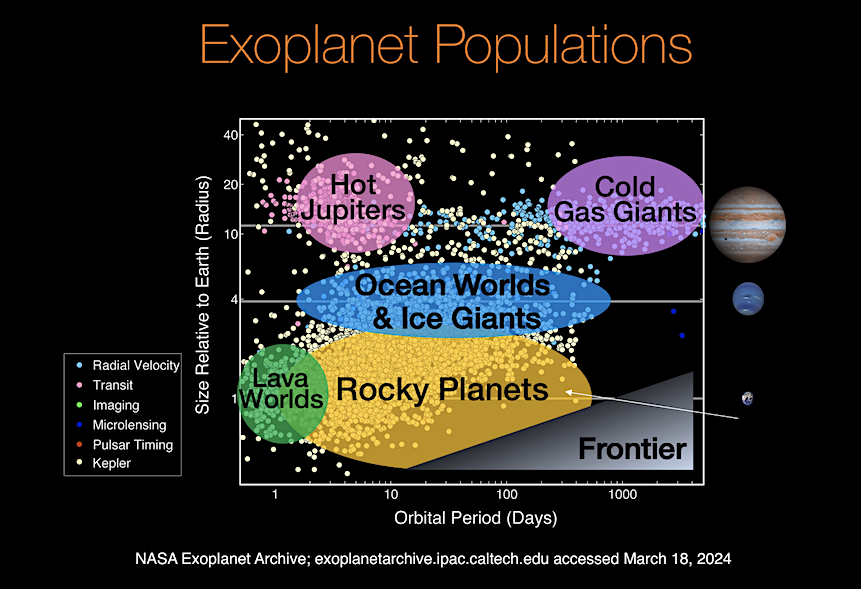
The NASA Exoplanet Archive compiled exoplanet populations. The legend at the left–hand side indicates the detection methods. To date, 6065 exoplanet detections have been confirmed, and 7687 candidates are awaiting confirmation. Of the confirmed planets, 1446 have radii of 2 Earth radii or less, masses between 0.5 and 10 Earth masses, and estimated densities between 3000 and 6000 kg/m3 . “Rocky planets”, the subject matter of this topical collection, include a wide variety of planets – from sub- to superterran sizes, with or without atmospheres, and with presumably a wide variety of surfaces and interior structures (https://exoplanetarchive.ipac.caltech.edu, retrieved Dec 17, 2025). — astro-ph.EP

Preliminary simulated HWO high-contrast spectrum of a modern Earth-twin orbiting a nearby Sun-like star. This spectrum is likely of sufficient quality to measure abundances of key indicators of habitability (H2O) and atmospheric biosignatures (O3, O2, and potentially CH4 for earlier phases of the inhabited Earth). The total time to acquire this spectrum, in multiple observations, varies dramatically depending on the distance of the system from the Sun. Credit: J. Lustig-Yeager (JHU-APL), T. Robinson (U of Arizona), & G. Arney (NASA GSFC) — astro-ph.EP
Tilman Spohn, Akli Roberge, M.J. Way, João C. Duarte, Francesca Miozzi, Philipp Baumeister, Paul Byrne, Charles Lineweaver
Comments: 57 pages, 10 Figures, to be published in Space Science Reviews as part of the Topical Collection “The Geoscience of Exoplanets: Going Beyond Habitability”
Subjects: Earth and Planetary Astrophysics (astro-ph.EP)
Cite as: arXiv:2601.01177 [astro-ph.EP] (or arXiv:2601.01177v1 [astro-ph.EP] for this version)
https://doi.org/10.48550/arXiv.2601.01177
Focus to learn more
Submission history
From: Tilman Spohn
[v1] Sat, 3 Jan 2026 12:51:48 UTC (12,449 KB)
https://arxiv.org/abs/2601.01177
Astrobiology,










Related Posts
Stay Informed With the Latest & Most Important News

Advertisement
-
 01Two Black Holes Observed Circling Each Other for the First Time
 -
 02From Polymerization-Enabled Folding and Assembly to Chemical Evolution: Key Processes for Emergence of Functional Polymers in the Origin of Life
 -
 03Astronomy 101: From the Sun and Moon to Wormholes and Warp Drive, Key Theories, Discoveries, and Facts about the Universe (The Adams 101 Series)
 -
 04True Anomaly hires former York Space executive as chief operating officer
 -
 05Φsat-2 begins science phase for AI Earth images
 -
 06Hurricane forecasters are losing 3 key satellites ahead of peak storm season − a meteorologist explains why it matters
 -
 07Binary star systems are complex astronomical objects − a new AI approach could pin down their properties quickly