
Now Reading: Exoplanet Atmospheres And Demographics In The 2040s
-
01
Exoplanet Atmospheres And Demographics In The 2040s


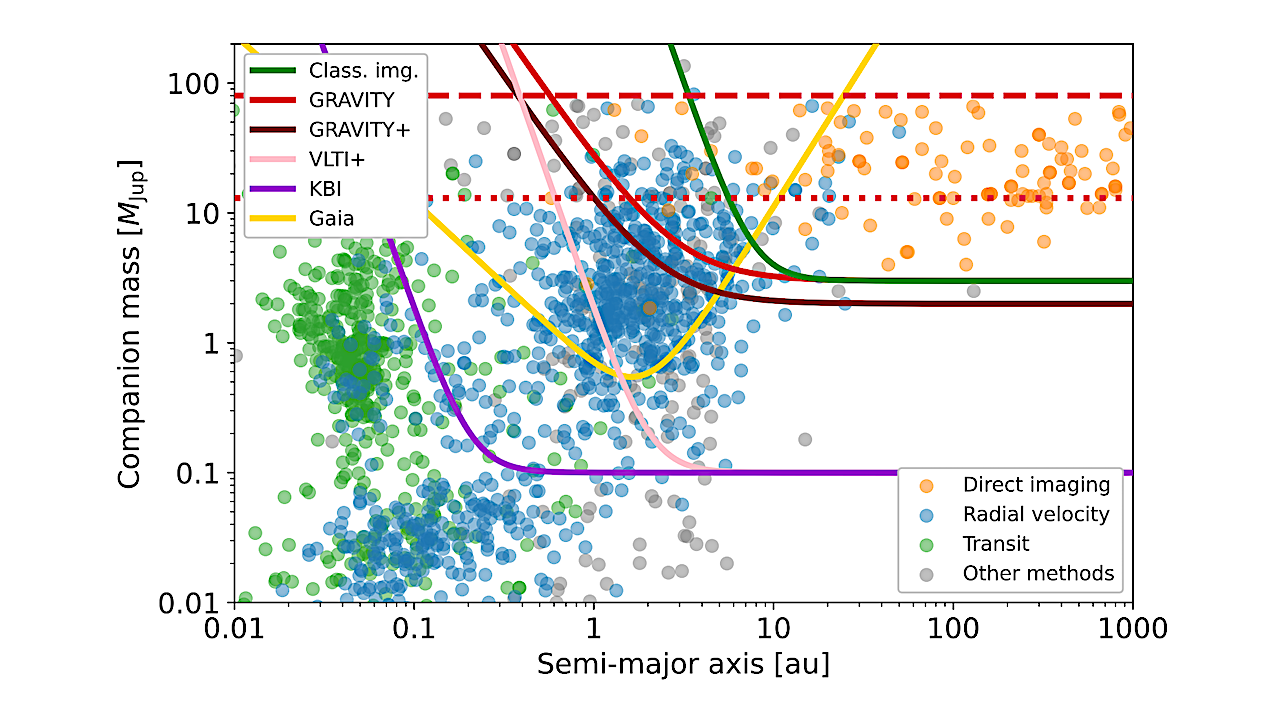

Currently known exoplanet population color-coded by detection technique in the companion mass vs. semi-major axis plane. The detection limits of various facilities are overlaid with solid lines. The boundary between giant planets and brown dwarfs is highlighted by a dotted red line and the boundary between brown dwarfs and stars is highlighted by a dashed red line. VLTI+ is an upgraded VLTI and KPI stands for Kilometric Baseline Interferometry. — astro-ph.IM
Direct observations of exoplanets probe the demographics and atmospheric composition of young self-luminous companions, yielding insight into their formation and early evolution history.
In the near future, Gaia will reveal hundreds of nearby young exoplanets amenable to direct follow-up observations. Long-baseline interferometry with current and future facilities is best capable of exploiting this unique synergy which is poised to deliver a statistical sample of benchmark planets with precise dynamical masses and in-depth atmospheric characterization.
This will enable tackling the longstanding question of how giant planets form from multiple angles simultaneously, shining light on the complex physical processes underlying planet formation.
Jens Kammerer, Sydney Vach, Sylvestre Lacour, Mathias Nowak, Thomas Winterhalder, Antoine Mérand, Akke Corporaal, Guillaume Bourdarot, Stefan Kraus, Sasha Hinkley
Comments: Submitted as science white paper to ESO Expanding Horizons call
Subjects: Instrumentation and Methods for Astrophysics (astro-ph.IM); Earth and Planetary Astrophysics (astro-ph.EP)
Cite as: arXiv:2601.11695 [astro-ph.IM] (or arXiv:2601.11695v1 [astro-ph.IM] for this version)
https://doi.org/10.48550/arXiv.2601.11695
Focus to learn more
Submission history
From: Jens Kammerer
[v1] Fri, 16 Jan 2026 17:49:11 UTC (475 KB)
https://arxiv.org/abs/2601.11695
Astrobiology, Astronomy, Exoplanet,











Related Posts
Stay Informed With the Latest & Most Important News
Previous Post
Next Post


Advertisement
-
 01Two Black Holes Observed Circling Each Other for the First Time
 -
 02From Polymerization-Enabled Folding and Assembly to Chemical Evolution: Key Processes for Emergence of Functional Polymers in the Origin of Life
 -
 03Astronomy 101: From the Sun and Moon to Wormholes and Warp Drive, Key Theories, Discoveries, and Facts about the Universe (The Adams 101 Series)
 -
 04True Anomaly hires former York Space executive as chief operating officer
 -
 05Φsat-2 begins science phase for AI Earth images
 -
 06Hurricane forecasters are losing 3 key satellites ahead of peak storm season − a meteorologist explains why it matters
 -
 07Binary star systems are complex astronomical objects − a new AI approach could pin down their properties quickly