
Now Reading: Exoplanet Orbital Distribution Around FGK Sun-like Host Stars I: Planet Occurrence Rate Derived From The Kepler Mission And Theoretical Interpretations From Planet Formation
-
01
Exoplanet Orbital Distribution Around FGK Sun-like Host Stars I: Planet Occurrence Rate Derived From The Kepler Mission And Theoretical Interpretations From Planet Formation

Exoplanet Orbital Distribution Around FGK Sun-like Host Stars I: Planet Occurrence Rate Derived From The Kepler Mission And Theoretical Interpretations From Planet Formation

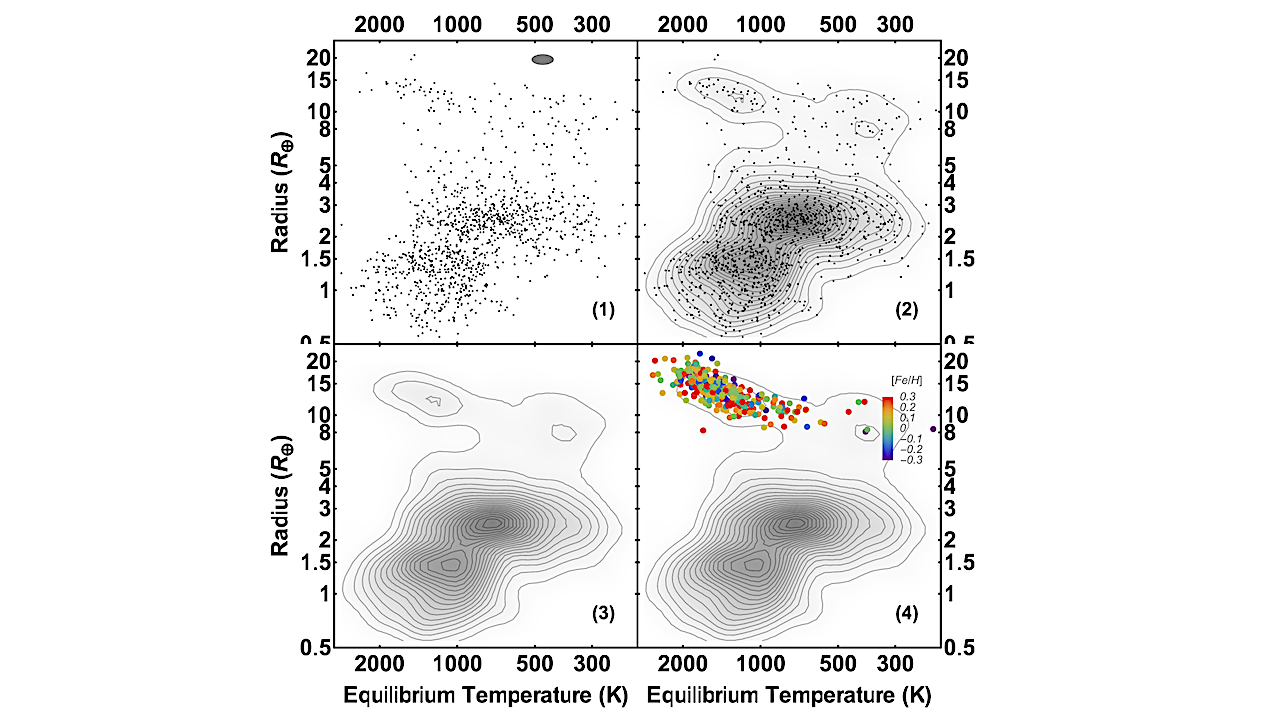
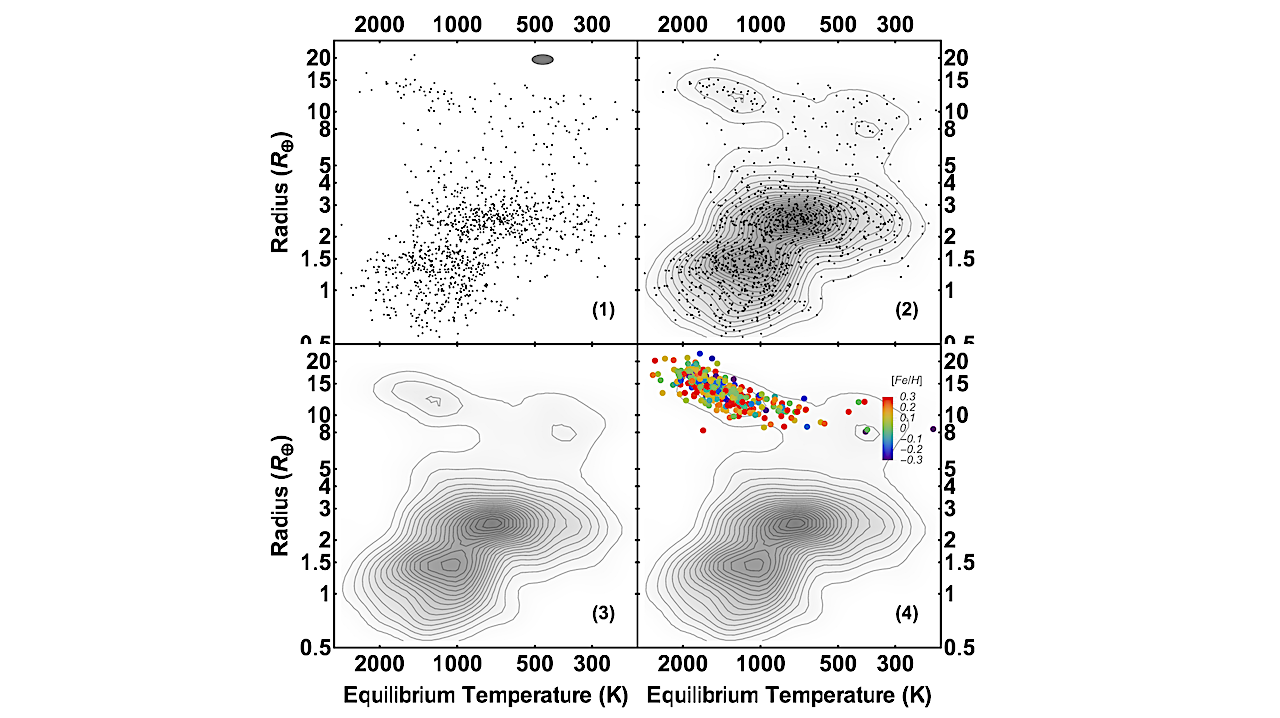
Plotted here are the Kepler confirmed planets/candidates with Gaia DR2 radius improvements. Selection criteria are main-sequence host-star with temperature 5000-6500 K and planet radius errors less than ±10%. Data source: exoplanet archive (Akeson et al. 2013) (Christiansen et al. 2025) (Thompson et al. 2017) and Gaia DR2 Berger et al. (2020, 2018); Brown et al. (2018); Lindegren et al. (2018). Sub-Panels: (1): 1100+ planets fulfilling the criteria, with gray ellipse showing the typical errors in planet radius and temperature. (2) and (3): Smooth Kernel fit to data. (4): All known transiting Hot Jupiters (Rp > 8 R⊕) which have masses measured from RV surveys (e.g. WASP, HAT, HAT-P, etc.), colored by metallicity ([Fe/H]). also c.f. (Castro-González et al. 2024). — astro-ph.EP
Recent astronomical observations, in particular from the Kepler and TESS missions and their related follow-ups, have revealed an abundance of exoplanets in the size range between Neptune (4 Earth radii) and Earth (1 Earth radii ), as well as a low occurrence rate of planets around twice the radius of Earth (2 Earth radii).
This paper uses statistical methods, in particular, the survival function analysis, to address the known exoplanet population observed mainly from the Kepler’s primary mission, in order to mathematically elucidate the orbital distributions (expressed in either the orbital period P or the orbital semi-major axis a), for each of the host stars, in both a collective way, and also separately for the planets grouped into various radius bins.
We uncover a log-uniform distribution for the majority of planets except the giants. Based on the results of the statistics, we then visit several possible formation scenarios and pathways for planets in different size ranges, in order to explain the results from a theoretical point-of-view.
Li Zeng, Stephanie C. Werner, Stein B. Jacobsen, Elena Mamonova, Reidar G. Trønnes, Ramon Brasser
Comments: submitted to MNRAS. comments welcome!:)
Subjects: Earth and Planetary Astrophysics (astro-ph.EP)
Cite as: arXiv:2604.08406 [astro-ph.EP] (or arXiv:2604.08406v1 [astro-ph.EP] for this version)
https://doi.org/10.48550/arXiv.2604.08406
Focus to learn more
Submission history
From: Li Zeng
[v1] Thu, 9 Apr 2026 16:03:40 UTC (2,235 KB)
https://arxiv.org/abs/2604.08406
Astrobiology, exoplanet,











Related Posts
Stay Informed With the Latest & Most Important News
Previous Post
Next Post



Advertisement
-
 01Two Black Holes Observed Circling Each Other for the First Time
 -
 02From Polymerization-Enabled Folding and Assembly to Chemical Evolution: Key Processes for Emergence of Functional Polymers in the Origin of Life
 -
 03Astronomy 101: From the Sun and Moon to Wormholes and Warp Drive, Key Theories, Discoveries, and Facts about the Universe (The Adams 101 Series)
 -
 04True Anomaly hires former York Space executive as chief operating officer
 -
 05Φsat-2 begins science phase for AI Earth images
 -
 06Hurricane forecasters are losing 3 key satellites ahead of peak storm season − a meteorologist explains why it matters
 -
 07Binary star systems are complex astronomical objects − a new AI approach could pin down their properties quickly