
Now Reading: Exoplanet Orbital Distribution Around FGK Sun-like Host Stars II: A Valley In The Orbital Semi-major Axis Distribution Of Sub-Neptunes
-
01
Exoplanet Orbital Distribution Around FGK Sun-like Host Stars II: A Valley In The Orbital Semi-major Axis Distribution Of Sub-Neptunes

Exoplanet Orbital Distribution Around FGK Sun-like Host Stars II: A Valley In The Orbital Semi-major Axis Distribution Of Sub-Neptunes

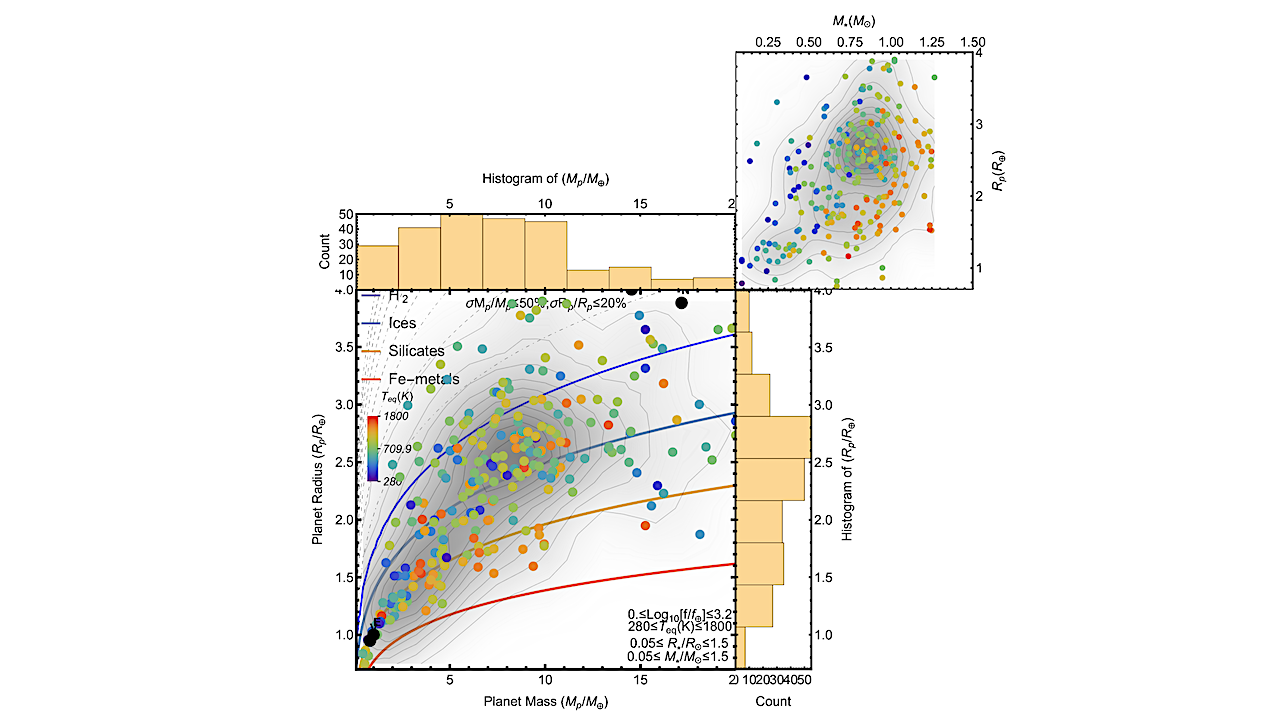
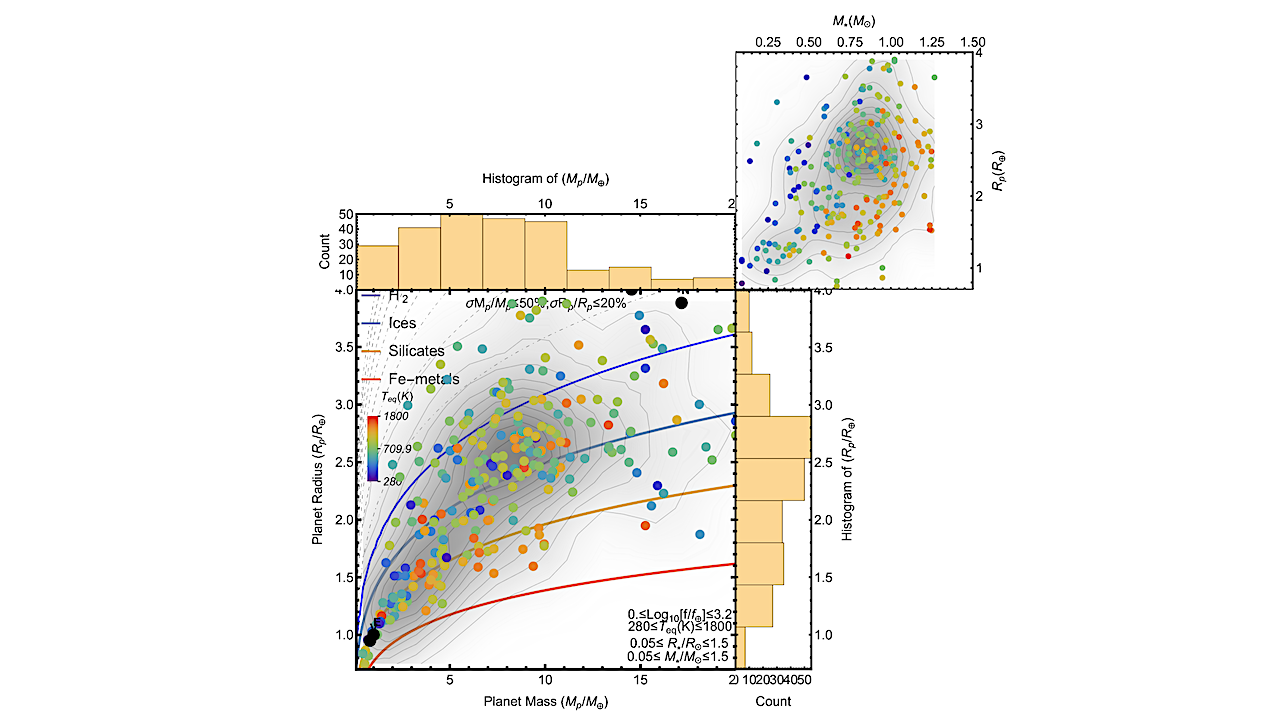
Main plot: mass-radius plot of well-studied exoplanets from TepCat in between 1-20 Earth masses and 1-4 Earth radii. Some theoretical mass-radius curves are shown for comparison. Although a subset of planets is below the silicate (i.e. pure rock) curve and can be identified as rocky planets, a larger proportion of the planets is above this curve. In particular, they exhibit a clustering in the range of 6-10 Earth masses as shown by the background with 2D probability density contours and shading. — astro-ph.EP
More than one hundred years ago, physics has been revolutionized when people realized that electronic orbitals, or electromagnetic interactions in general, are quantized. Now, in this study, we are presenting evidence of quantization of planet orbits around stars. Confining a wave in spatial dimensions “quantizes” its wave number.
Therefore, this study points to the evidence of the existence of long-range standing waves in the proto-planetary disks. Such waves, although being on a much larger scale of few tens of AU, have already been found by ALMA observation-so called ring-like structure.
Now we see that it may exist within 1 AU, and may exert its effect on the existence and distribution of planets within this distance range to the host star. Careful analysis has been carried out to compare the results of different surveys.
Li Zeng, Stephanie C. Werner, Stein B. Jacobsen, Elena Mamonova, Reidar G. Trønnes, Ramon Brasser
Comments: submitted to MNRAS. comments welcome! 🙂
Subjects: Earth and Planetary Astrophysics (astro-ph.EP)
Cite as: arXiv:2604.08428 [astro-ph.EP] (or arXiv:2604.08428v1 [astro-ph.EP] for this version)
https://doi.org/10.48550/arXiv.2604.08428
Focus to learn more
Submission history
From: Li Zeng
[v1] Thu, 9 Apr 2026 16:32:40 UTC (3,092 KB)
https://arxiv.org/abs/2604.08428
Astrobiology, Exoplanet, Stellar Cartography,











Related Posts
Stay Informed With the Latest & Most Important News
Previous Post
Next Post
Advertisement
-
 01Two Black Holes Observed Circling Each Other for the First Time
 -
 02From Polymerization-Enabled Folding and Assembly to Chemical Evolution: Key Processes for Emergence of Functional Polymers in the Origin of Life
 -
 03Astronomy 101: From the Sun and Moon to Wormholes and Warp Drive, Key Theories, Discoveries, and Facts about the Universe (The Adams 101 Series)
 -
 04True Anomaly hires former York Space executive as chief operating officer
 -
 05Φsat-2 begins science phase for AI Earth images
 -
 06Hurricane forecasters are losing 3 key satellites ahead of peak storm season − a meteorologist explains why it matters
 -
 07Binary star systems are complex astronomical objects − a new AI approach could pin down their properties quickly