
Now Reading: Exoplanet Transit Search At The Detection Limit: Detection And False Alarm Vetting Pipeline
-
01
Exoplanet Transit Search At The Detection Limit: Detection And False Alarm Vetting Pipeline

Exoplanet Transit Search At The Detection Limit: Detection And False Alarm Vetting Pipeline

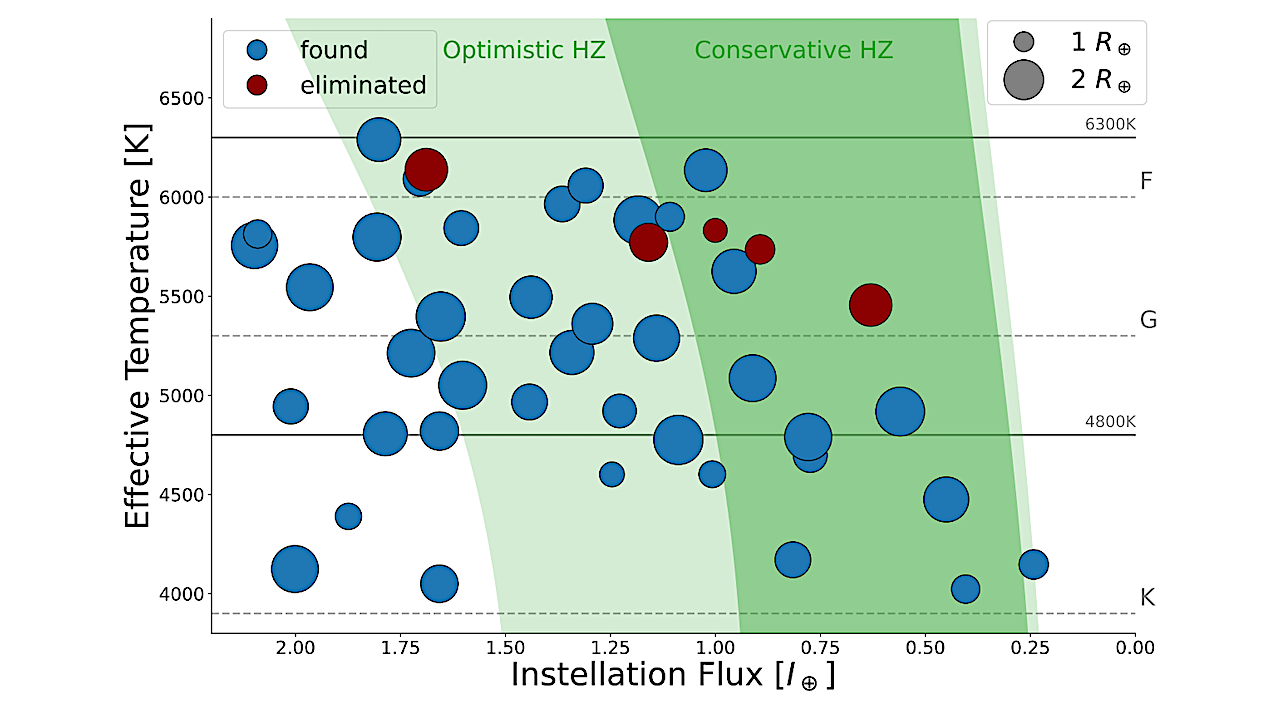
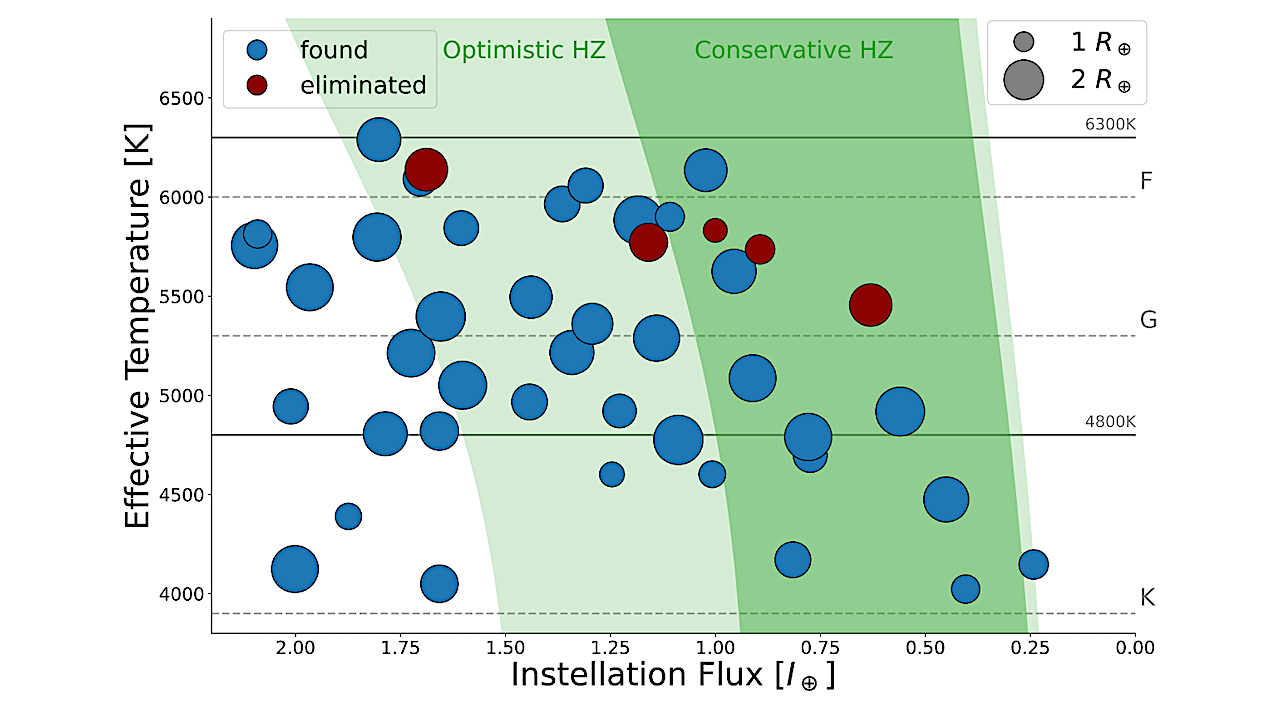
Earth-like and super-Earth candidates from Bryson et al. (2021) are displayed in the effective temperature–instellation flux plane, as in Bryson et al. (2021). The conservative and optimistic habitable zones defined by Bryson et al. (2021) are shown in green. Marker sizes are proportional to the planetary radius. The candidates that were independently identified by our pipeline are shown in blue, the other with red. Out of five eliminated candidates three are in the conservative HZ, one is on the edge between the optimistic and conservative HZ and one in the optimistic HZ. Due to the overall small number of candidates in the habitable zone with radius 1.8R⊕ this reduction could have a significant impact on η⊕ estimates. — astro-ph.EP
One of the primary mission goals of the Kepler space telescope was to detect Earth-like terrestrial planets in the habitable zone around Sun-like stars. These planets are at the detection limit, where the Kepler detection and vetting pipeline produced unreliable planet candidates.
We present a novel pipeline that improves the removal of localized defects prior to the planet search, improves vetting at the level of individual transits and introduces a Bayes factor test statistic and an algorithm for extracting multiple candidates from a single detection run.
We show with injections in the Kepler data that the introduced novelties improve pipeline’s completeness at a fixed false alarm rate. We apply the pipeline to the stars with previously identified planet candidates and show that our pipeline successfully recovers the previously confirmed candidates, but flags a considerable portion of unconfirmed candidates as likely false alarms, especially in the long period, low signal-to-noise ratio regime.
In particular, several known Earth-like candidates in the habitable zone, such as KOI 8063.01, 8107.01 and 8242.01, are identified as false alarms, which could have a significant impact on the estimates of η⊕, i.e., the occurrence of Earth-like planets in the habitable zone.
Jakob Robnik, Uroš Seljak, Jon M. Jenkins, Steve Bryson
Comments: 16 pages, 15 figures
Subjects: Earth and Planetary Astrophysics (astro-ph.EP)
Cite as: arXiv:2601.07465 [astro-ph.EP] (or arXiv:2601.07465v1 [astro-ph.EP] for this version)
https://doi.org/10.48550/arXiv.2601.07465
Focus to learn more
Submission history
From: Jakob Robnik
[v1] Mon, 12 Jan 2026 12:21:18 UTC (962 KB)
https://arxiv.org/abs/2601.07465
Astrobiology, Exoplanet,











Related Posts
Stay Informed With the Latest & Most Important News
Previous Post
Next Post


Advertisement
-
 01Two Black Holes Observed Circling Each Other for the First Time
 -
 02From Polymerization-Enabled Folding and Assembly to Chemical Evolution: Key Processes for Emergence of Functional Polymers in the Origin of Life
 -
 03Astronomy 101: From the Sun and Moon to Wormholes and Warp Drive, Key Theories, Discoveries, and Facts about the Universe (The Adams 101 Series)
 -
 04True Anomaly hires former York Space executive as chief operating officer
 -
 05Φsat-2 begins science phase for AI Earth images
 -
 06Hurricane forecasters are losing 3 key satellites ahead of peak storm season − a meteorologist explains why it matters
 -
 07Binary star systems are complex astronomical objects − a new AI approach could pin down their properties quickly